An integral part of the interpretation and preservation of the Waterford Historic District as an early American agricultural service village is the landscape around the village. In fact, the Waterford National Historic Landmark was one of the first nominations to the program to include the surrounding landscape as part of the significance. One of the most recognizable parts of the surrounding landscape is the Phillips Farm that runs behind Second and Main Streets of the Village extending on Old Wheatland Road. With April being Earth Month, it would surely be a remiss if this month’s Notes from the Preservation Desk didn’t dive into the Phillips Farm.
Brief History of the Phillips Farm:
The area we know as the Phillips Farm is a 144 acre portion of the culminated 220 acre parcel owned and collected by Thomas Phillips during the late 18th and early 19th centuries. Thomas Phillips was a Quaker and operated the Bond Street Tannery with fellow Quaker Asa Moore. After Moore passed away, Phillips acquired his business partner’s mill (on the same site as Waterford Mill) and associated acreage. Phillips would sell the mill in 1832, but kept the acreage for his farmland. After his death, Phillips’ descendants would continue to farm on the property for over a century. Products produced on the Phillips Farm include dairy and beef, pork, hay, corn, wheat, honey, and wool.
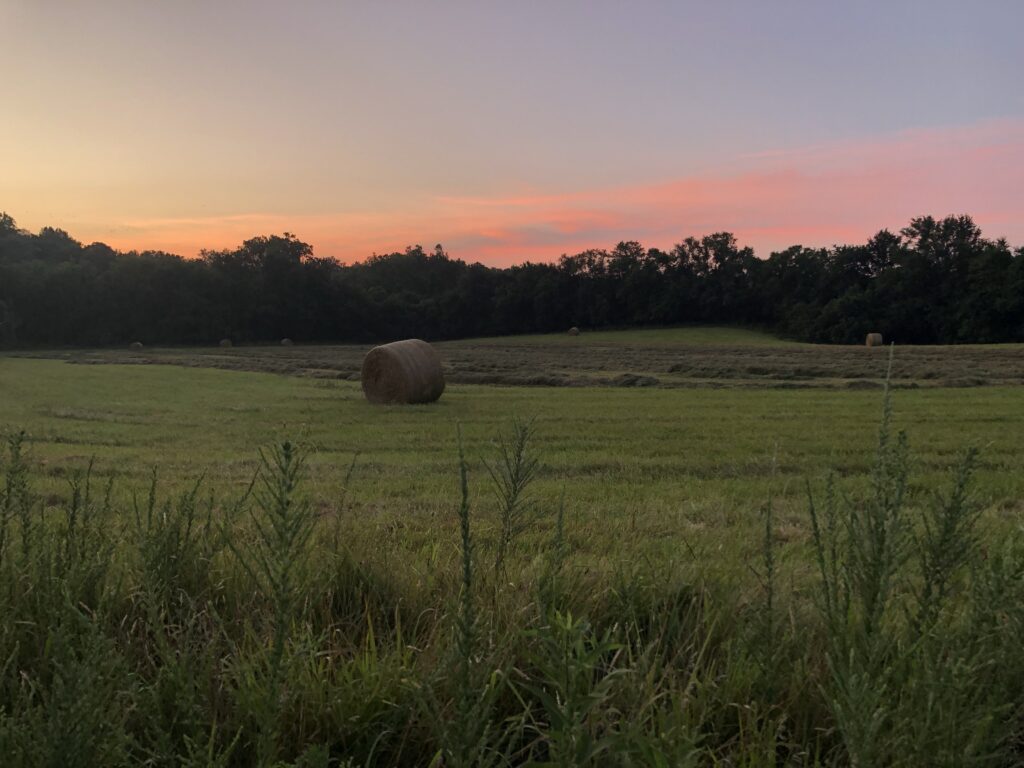
In 2003, the 144 acre parcel of land southwest of the village was slated to be subdivided into multiple lots. The Waterford Foundation and its many supporters locally and across the country secured nearly $4 million to purchase the Phillips Farm and conserve it as open space. Had that development occurred, destroying the pastoral viewshed beyond the South Fork of the Catoctin Creek, Waterford’s National Historic Landmark status would have been seriously jeopardized.
The Phillips Farm is now conserved open and agricultural space, under easement with the Virginia Outdoors Foundation. On the Phillips Farm, you can now find conserved meadow and streambank, an agricultural area that is tended to by a local farmer, hiking trails through the story of the Phillips Farm and the historic agricultural surrounds of the Village of Waterford.
Conservation Practices in Practice- Strategic Plan
In 2023, the Open Spaces Subcommittee reviewed and updated the Strategic Plan for the Management of the Phillips Farm (also known as the Phillips Farm Management Plan). A strategic plan is a living document that comprehensively looks at a project/area/organization’s long-term purpose and direction, goals, and what actions to take to meet those goals in a certain period of time.
For the case of the Phillips Farm, the strategic plan establishes the vision statement as: “The Waterford Foundation is committed to being an exemplary steward of the Phillips Farm by protecting it as an important contributing element of the Waterford National Historic Landmark and Loudoun County’s Waterford Historic & Cultural Conservation District. The Foundation will protect the agricultural, natural, historic, and cultural resources of the farm while providing opportunities for the public to engage with the farm through research, educational and passive recreation opportunities.”
The strategic plan lays out goals to best conserve the Phillips Farm and short and long-term actions to take to meet those in areas including but not limited to: natural resources (including stream health, forest, meadow, animal habitat areas, and agricultural areas), agriculture, historic resources, educational programming, and trails.
This plan has guided the work and project taken on by the Open Spaces Subcommittee, including some of the following that you might have seen:
- Invasive Management and Meadow Replanting: A large focus of the Open Spaces Subcommittee for the past couple of years has been in the invasive species of poison hemlock, mile-a-minute vine, and autumn olive. This is identified in the strategic plan as an initiative to take part in. Post-COVID, treatments focusing on the poison hemlock have taken place over the growing months of the plant. After the past two summers, no new growth of poison hemlock has been detected. In its place, mile-a-minute vine and autumn olive have taken its place. The Foundation in partnership with the Waterford Citizens Association and local Scout Groups have led periodic pulling days for these invasive species. This season, a large focus of the work will be on planning of what to plant after invasives are removed.
- Water Quality Monitoring of Ball’s Run and the South Fork of the Catoctin Creek: To best be able to understand the best practices for stream conservation, data needs to be collected to understand the current status. The Waterford Foundation, in partnership with the Loudoun Wildlife Conservancy, conducts twice yearly macroinvertebrate stream monitoring on each stream. This monitoring practice uses the macroinvertebrates living in the stream (that are caught and released back to the water for the monitoring) to help determine stream health. Along with that, the Foundation also conducts testing of the oxygen and e-coli counts of South Fork of the Catoctin Creek and Ball’s Run to also help get a better understanding of the streams and how they combine.
- Wildlife Monitoring: New this past year, the Open Spaces subcommittee implemented trail cams in different habitat areas- forest, streambank, meadow- around the Phillips Farm to better be able to observe animal habits on the property. These cameras are located off the beaten path of the trails to best observe wildlife on the Phillips Farm. Some of the animals seen have been deer, raccoons, foxes, coyotes, opposums, river otters, and blue heron. We can’t wait to see what gets spotted this next year!
Come Explore the Phillips Farm!
This Earth Month and beyond, we want to invite you to come and experience the Phillips Farm. There are two different trails that you can explore the Phillips Farm on: The Phillips Farm Interpretive Trail and the Western Trail. Find out more about these trails at this link!
For our younger explorers, check out the Phillips Farm Bingo and other bingo games including plants and animals to become a keen observer of the natural world. You can find Waterford Bingo cards at the link here!
Finally, check out some of our staff’s favorite spots and tips for the trail:
- The most mentioned place to see is the Dam that helped power the mills in Waterford, still standing at the end of an out and back trail off the interpretive trail. When back there, take a second and look across the stream because you might catch a glimpse of some deer and other wildlife running through! If you’re going to do this, make sure to wear shoes that can get wet
- On the Western Trail, make sure to go up to the overlook and look down. During the fall months, you might be able to see the Village through the trees but at this time of year, the greenery and surroundings can help you forget that you’re in a Village in the first place.
- This is a great trail to bring your furry friend on, with so much to see and explore! Just make sure to keep them on their leash, remove their waste, and be ready for some pets if you run into another hiker!
- The Phillips Farm provides some great context to the agricultural nature of the Village! If you plan on walking through and exploring the Village after your walk on the Phillips Farm, we recommend using this online version of our free walking tour booklet to help you learn more about the buildings you are passing by!
We hope to see you out on the trails this month and beyond!