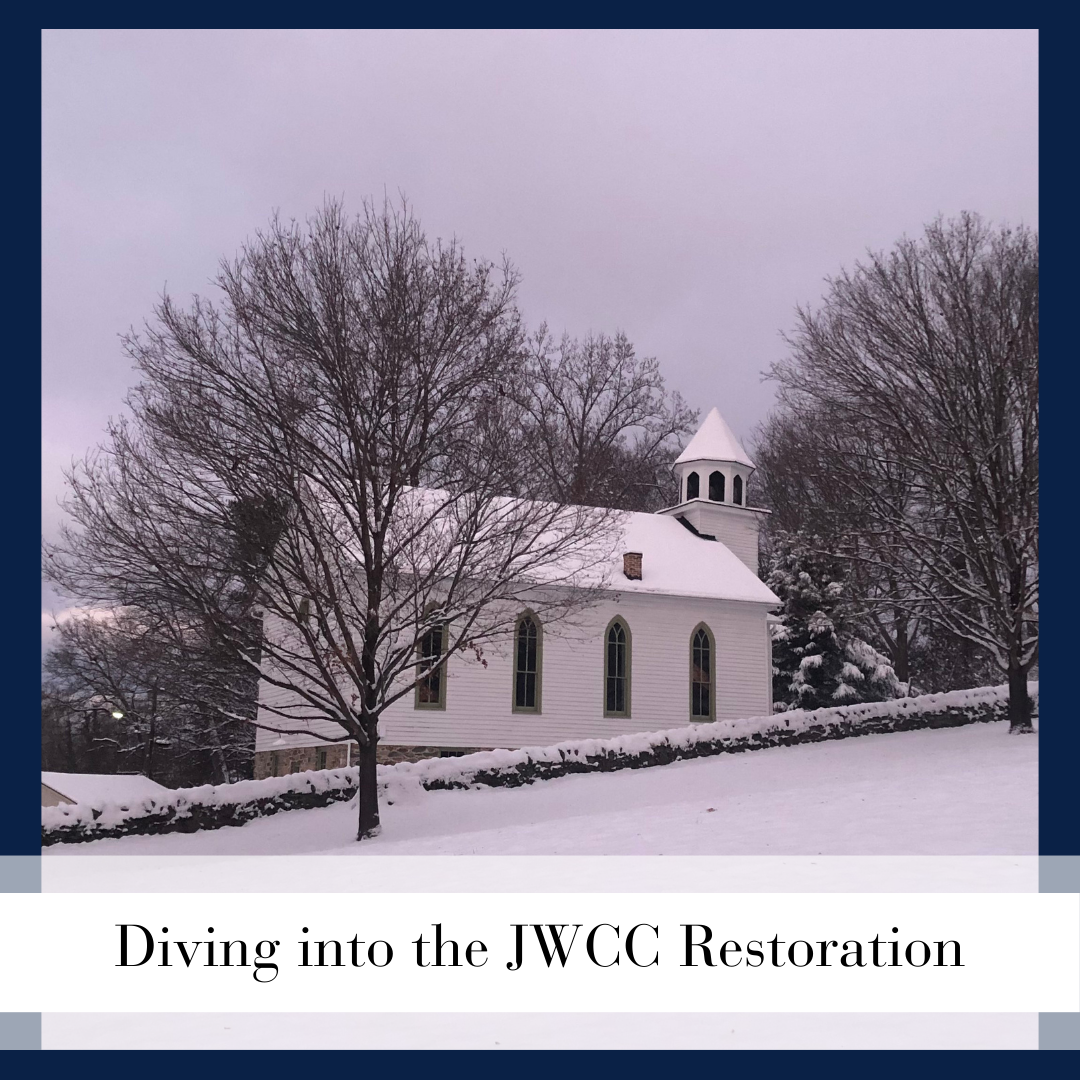
In 2002, a long term capital rehabilitation and restoration project began at the John Wesley Community Church. Boots are now ready to be back on the ground in the Church this February for the final stage of this long term project! The goals of this final stage is to finish returning the building to its period of significance and to finish making historically sensitive capital improvements to the building to improve accessibility and long-term stability. As well, the Foundation aims to implement interpretive materials in the space that shares the story of the African American community of Waterford, with the involvement and support of the descendant community. This would support the long-term preservation of this integral property to the Waterford National Historic Landmark and help in sharing the history of the church and its congregation to the public.
Whether the restoration and rehabilitation project is for a house, church, mill, or barn- there is a lot of planning work involved from the decision to move forward with a restoration project to boots on the ground construction works starts. Read on below to learn more about the planning work undertaken to get to the point we are at now in the John Wesley Community Church Restoration project.
Documentation: The Historic Structures Report
The first step in any project is to understand the full scope of it. When it comes to properties like the John Wesley Community Church, that means the production of a historic structures report (HSR). A historic structures report is a deep dive into the building to understand the totality of the property: compiling historic and archival research, documentation of the physical building from the roof to the foundation, expert evaluations of the current condition, and recommendations for work. These reports are pulled together by a team of experts from architectural historians, archaeologists, architects, and engineers.
In 2019, the HSR for the Church was created. This HSR is what was used to determine what restoration work remained at the John Wesley Community Church in this final stage. The entire report is 150 pages and documents the Church from the foundation to the steeple through the use of historic research, expert analysis, engineering assessments, and high tech imaging including laser scans and drone images. We pass along our gratitude for the entire team of specialists who created the HSR from SmithGroup, Robinson & Associates, and TYLIN (then Silman).
Creating Architecture and Engineering Plans
After the completion of the HSR, the next step is to determine the scope of work and create architectural and engineering plans for the project. For the John Wesley Community Church, the scope of work was determined to be restoring the exterior stone retaining wall, sanctuary balcony restabilization, creation of new entry paths at both the sanctuary and basement entrances, finish work in securing the exterior envelope, finish work in preserving the original wood elements (including pews, balustrade, floors, and altar) in the sanctuary, and a plaster restoration in the sanctuary as well. We can’t thank the team at SmithGroup- Susan Pommerer, Jim Shepherd, and Chris Wood- who has worked in creating and finalizing plans with us over the past year and a half pro-bono!
Funding Work: Grant Applications
The priorities and analysis of the John Wesley Community Church in the HSR, and further developed with architecture and engineering plans have also supported grant applications for funding for this project, including the $225,000 grant received from the Virginia Black, Indigenous, People of Color Fund managed by the Virginia Department of Historic Resources.
Engaging with Stakeholders and the Public
An important and integral stakeholder group of the John Wesley Community Church is the descendant community of the Church. We are so thankful for the support of the descendant community in this project: from sharing stories and images with us of the Church, writing letters of support in grant applications, providing comments and suggestions in plans, coming and sharing in design and approval meetings, assisting in plans to lead interpretation, and more! This vital restoration work would not be possible without your support!
The public were also invited to provide comments and ask questions about the project before finalizing the plans for the Church in 2025- at the John Wesley Community Church Restoration Open House and the Waterford Foundation Annual Meeting. Thank you to everyone who came to these events, asked questions, and provided feedback!
Easement Holder Review
For properties under easement like the John Wesley Community Church, all changes within the scope of the easement have to be approved by the easement holder. For the John Wesley Community Church, the easement holder is the Virginia Department of Historic Resources (VDHR). The easement stewardship team at VDHR were engaged throughout the design process, and approved of the finalized plans. Thank you to the easement stewardship team for your support!
Certificate of Appropriateness

The John Wesley Community Church is also within the County’s Waterford Historic and Cultural Conservation District, and therefore is subject to the guidelines of the Waterford Historic District. If a project is within the historic district boundaries and falls within the purview of the guidelines, a Certificate of Appropriateness is needed. A Certificate of Appropriateness is an official document authorizing exterior alterations (including restoration and rehabilitation work), new construction, or demolition subject to the historic district guidelines. In Loudoun County, the Historic District Review Committee issues Certificate of Appropriateness for the County’s historic districts (Aldie, Beaverdam Creek Historic Roads, Bluemont, Goose Creek, Oatlands, Taylorstown, and Waterford). A Certificate of Appropriateness was received for the Church project in January 2026. We appreciate the support of Loudoun County Planning and Zoning staff that supported us through the process of receiving a Certificate.
Choosing a Contractor
The final piece to the puzzle for a restoration project is choosing a contractor. For projects like this, a contractor specializing in historic restorations is required. After releasing a request for bid period this past summer, Carpenter Beach Construction was chosen as the contractor for the project. We look forward to working with them again!
What comes next? Construction work (depending on weather) is slated to begin in February 2026, and the timeline shows that work will be completed by the end of 2027. During this time, we will be working in collaboration with the descendant community of the Church to create a permanent exhibit about the African American community of Waterford and the history of the John Wesley Community Church to be displayed in the Church after the project is complete.
How to follow along: We look forward to updating you regularly about the project and sharing pictures of the project on social media and in the monthly Foundation newsletter.
Descendants of the John Wesley Community Church: sign up here to receive our descendants newsletter to get regular updates about the project and more!
How to support the project:
- Volunteer: we have an upcoming (February 2026) volunteer project to help prepare the Church for construction by moving, covering, and/or removing items from the Church to keep them protected during the project. If you’re available to help move furniture and other items out of the Church for safe storage, please let us know here.
- Donations: Donations to the Lantern Light Fund support the Foundation’s efforts to preserve and share Waterford’s African American heritage sites, stories, and artifacts. Lantern Light Funds go to support projects like the John Wesley Community Church Restoration as well as projects at the Second Street School, and educational programming such as field trips, lectures, exhibits, walking tours, and more. You can find out more about the Lantern Light Fund at this link.
We can’t wait to see what comes next for the Church!
Glossary of Terms:
- Capital Infrastructure: large-scale physical assets to a community such as buildings, roads, bridges, and utilities
- Conservation or Preservation Easement: a legal document between a property owner and an accepting and qualified organization or locality that aims to protect the historic, environmental, and/or cultural significance and heritage of the property.
- Historic District: a defined geographic area that is recognized for being historically and culturally significant to the region. Properties within this district can be (depending on locality and jurisdiction) subject to guidelines for preserving historic structures.
- Historic Structures Report (HSR): a comprehensive document prepared for a historic structure that documents the history, architecture, current conditions, and significance to support further preservation work on the property.
- Period of Significance: the recognized span of time where a property receives its’ historic significance
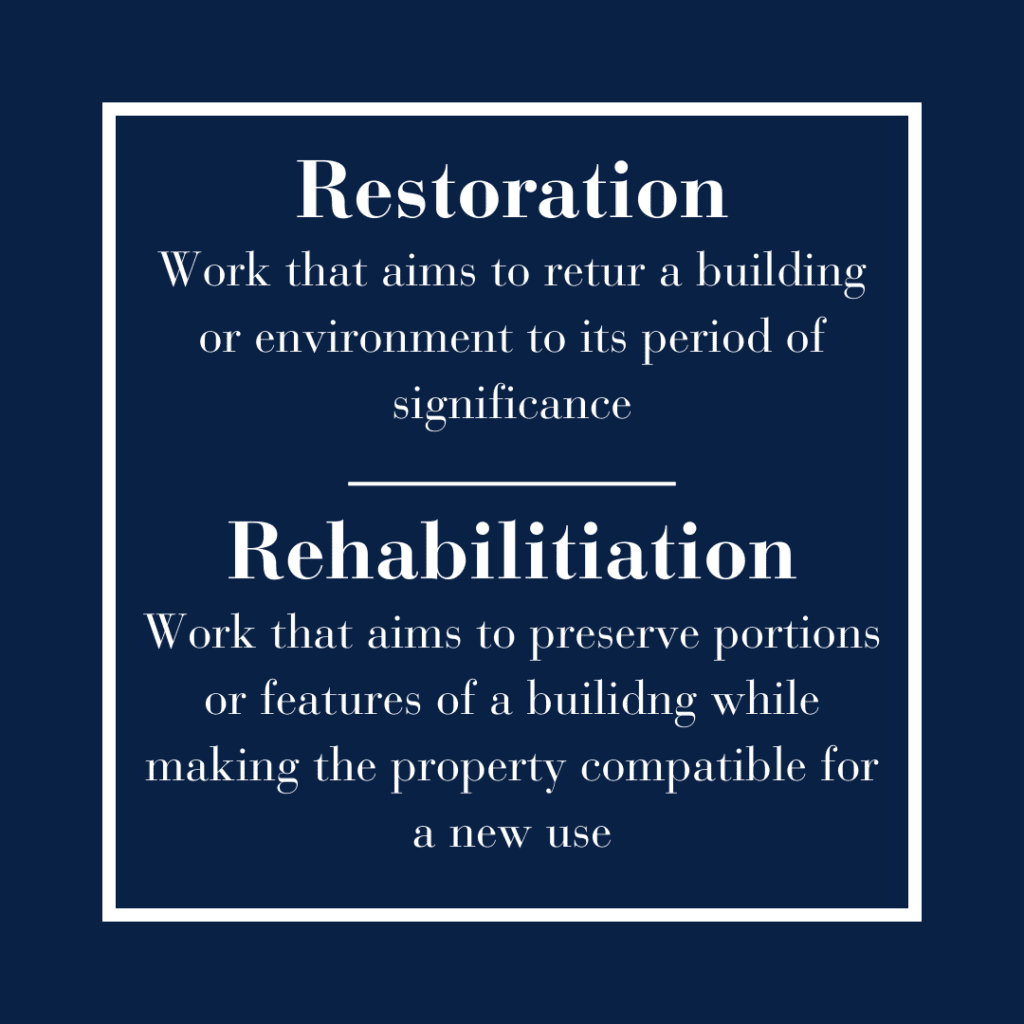
- Rehabilitation: work that aims to preserve portions or features of a project while making the property compatible for a new use
- Restoration: work that aims to return a building or environment to a certain period of time (period of significance)
- Secretary of Interior Standards for the Treatment of Historic Properties: often shortened to Secretary of Interior Standards, these are the nationally recognized guidelines for historic preservation projects to follow, sorted into four categories: preservation, rehabilitation, restoration, and reconstruction.
- Stakeholder: a person or group with documented interest in a subject