Blooming in the heat of the August sun is a brand new school year! Later this month, Loudoun County Public Schools will be back in session for another great school year, and all over the County kids, teachers, administrators, parents, and more are getting ready for the school year to start. This bubbling of excitement for learning is a great time to reflect on the interconnectedness of education and preservation. One cannot happen without the other: the past and history cannot be effectively shared without preservation, and you can’t effectively preserve historic resources without understanding and sharing the history and importance behind it.
The interconnectedness of historic preservation and education is reflected in the definition of historic preservation shared earlier in this series: the identification, interpretation, care of, and protection of historic artifacts and objects, sites, buildings and structures, landscapes, and districts. Many of the areas where preservationists specialize in can focus on the educational part of the definition, including museums, archives, interpretation, and public history. Whatever specialty a preservationist leans into, they are trained in the documentation, identification, and interpretation of historic resources- including preservationists here in Waterford. The Waterford Foundation mission statement itself perfectly captures the importance of education in historic preservation and environmental conservation: “To preserve the historic buildings and open spaces of the National Historic Landmark of Waterford, Virginia, and, through education, to increase the public’s knowledge of life and work in an early American rural community.”
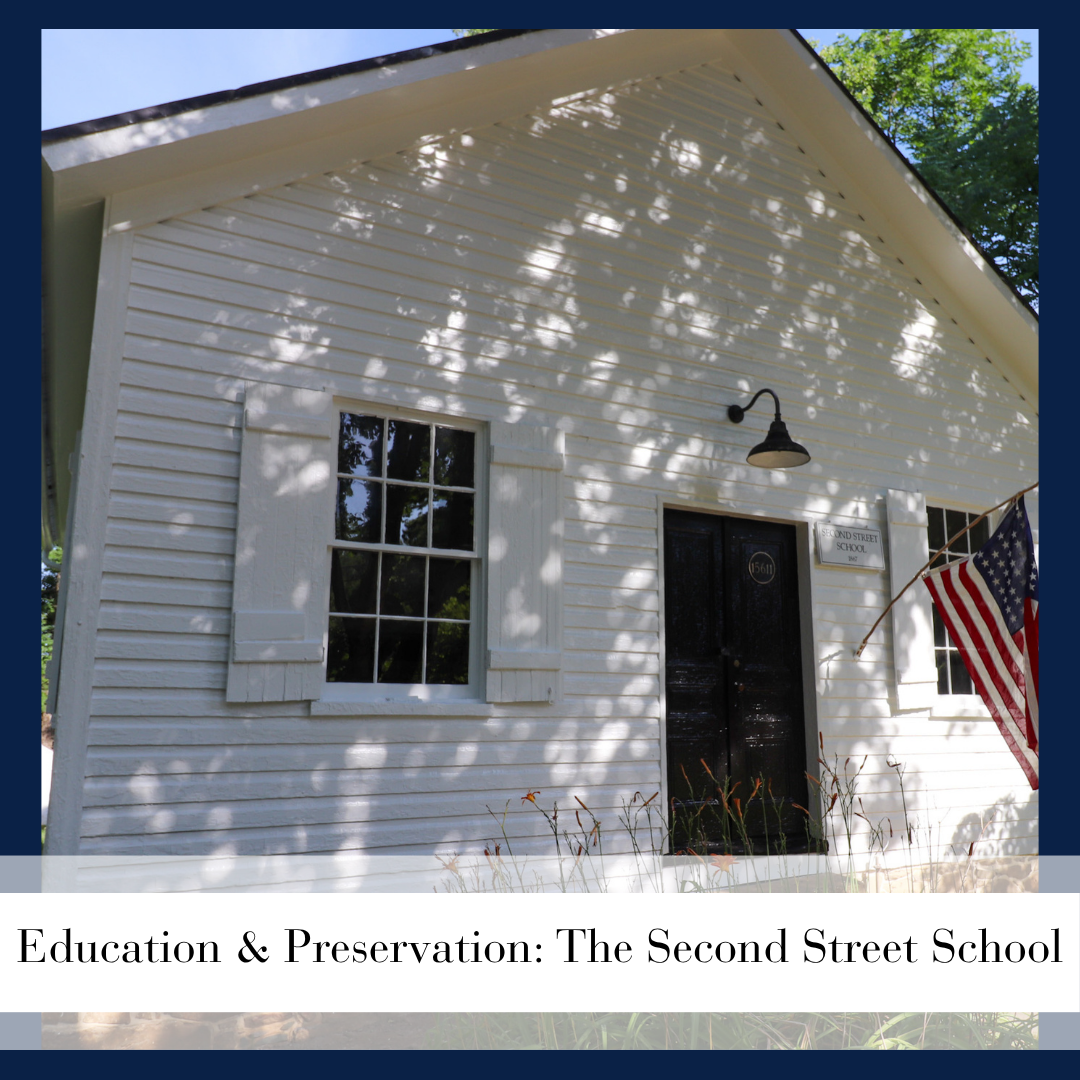
One of the best examples of the interlinking of preservation and education in practice in Waterford is the Second Street School Program. The Second Street School is the one room African American schoolhouse located on the corner of Second and Janney Streets. In 1866, Black school trustees purchased the property for school and church purposes. Using funds supplemented by the Freedmen’s Bureau and Philadelphia Quakers, the community promptly built a schoolhouse that also served as a place of worship that opened three years before the establishment of Loudoun County Public Schools. In 1870 when Loudoun County Public Schools was established, the school became Colored School A. Colored School A- always a one room schoolhouse- closed in 1957; students were then bused into Leesburg to the Douglas School.
Since 1984, the Second Street School program has invited elementary school students from all over Loudoun County and Northern Virginia to learn about what life would have been like for students attending the segregated school house in 1880, and largely of life during the Reconstruction Era. This is done through hands-on activities and lessons led by a docent at the Second Street School, which is interpreted to look as much like the 1880s as is known. Before coming to the school, teachers are provided with biographies of students who attended the School in 1880. Students are able to learn about these students, and how historians research people and places of the past.
How does the program work? Once registered, teachers will be provided with orientation materials, a pre-lesson about Waterford, and historic information about the Second Street School, including biographies about the students who attended in 1880. On the day of, students are welcomed to Waterford with a bus tour of the Village where houses of those who were studied and important places in Reconstruction Waterford are pointed out. When settled into the Second Street School, lessons like what would have been taught in the school in 1880 including reading, spelling, ciphering, math, and quill pen writing. Recess is held at the school with period toys, and the day is finished with questions and answers time where the students have the opportunity to ask the Waterford docent about life in Waterford and Colored School A, and the Reconstruction Era. The Second Street School program is held every spring, and booking opens in August for the following season. Educational offerings have expanded with options diving into the Reconstruction Era in Waterford and Loudoun County, and the African American history of Waterford with programs for middle and high school students.
One of the best parts of the year is when students come to explore Waterford, and the excitement it brings to everyone involved! Every year students always ask amazing questions that get us adults thinking about history in different ways, and it’s a thrill to watch students get excited about history and the world around them. As preparations are happening for another great year of school programs, everyone at the Foundation wishes everyone a great school year!