Written by Debbie Robison; Edited by Larisa Epatko
—
The Revolutionary War period was a time of immense pressure for the Northern Virginia area’s Quakers, who found their properties seized and their loyalties questioned by both their government and their church. It was only in the final year of the war, 1783, that Joseph Janney purchased the 12-acre parcel that would eventually serve as the site for the formal founding of the village of Waterford.
The agricultural shift and the slave economy
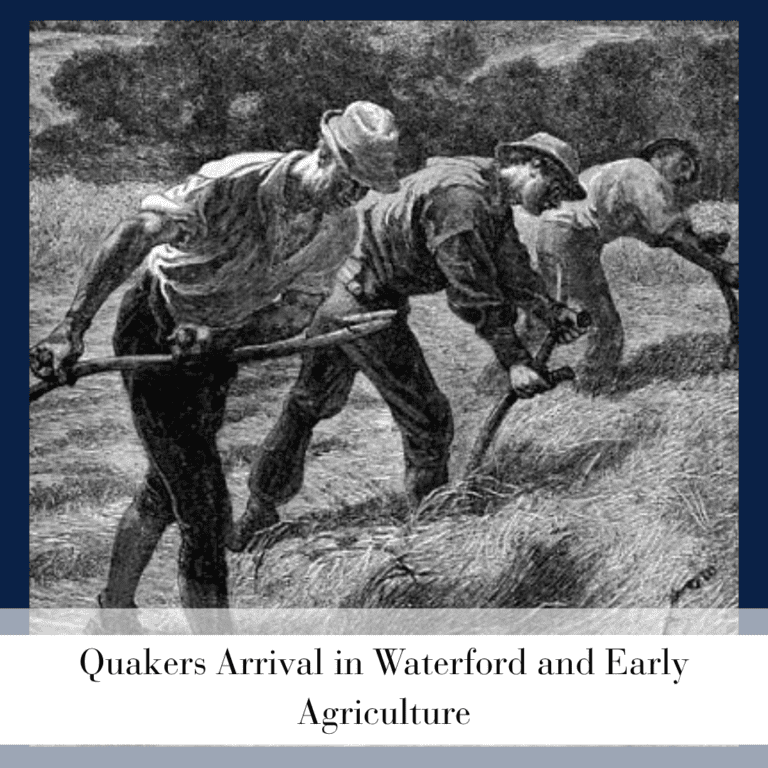
In the years leading up to the Revolutionary War, the region surrounding what would become Waterford underwent a major economic transformation. Farmers transitioned from tobacco to wheat cultivation, making the area a key supplier for the transatlantic flour trade.
Quakers played a significant role in this shift; for example, Mahlon Janney constructed a prominent stone and wood grist mill around 1762 as a commercial investment.
While Quakers typically did not own enslaved people, their involvement in the flour trade indirectly supported the institution of slavery. The flour produced in Loudoun County was frequently exported to the British West Indies to sustain the labor force on sugar plantations.
This economic connection caused a moral conflict within the Society of Friends, as leaders like John Woolman and John Wesley questioned the ethics of profiting from goods that supported the miseries of enslaved people.
Neutrality and the peace testimony
As tensions between the colonies and Great Britain escalated, the Quakers’ commitment to their “peace testimony” placed them in a precarious position. The newly formed Commonwealth of Virginia required male residents to affirm their allegiance and participate in the military.
Because Quakers refused to swear oaths or bear arms, they were often viewed with suspicion or labeled as “disaffected” by American leaders. General George Washington himself expressed frustration in his correspondence, noting that Quakers were doing everything in their power to counteract militia laws.
Military fines and property seizure
When voluntary enlistment proved insufficient, Virginia implemented a draft. Quakers who refused to serve or pay for a substitute faced heavy financial penalties. In April 1781, numerous Quakers, including Mahlon Janney, were fined 100 pounds each for failing to perform military service.
Because Quakers refused to pay these wartime taxes and fines voluntarily, the local sheriff was authorized to seize their property for sale. This process, known as “distraint,” resulted in the continuous loss of personal possessions.
Records from the Philadelphia Meeting of Suffering show that Loudoun Quakers had a wide range of goods confiscated, including cash, horses, cattle, clothing, household pewter, bedding and even a Bible.
Impressment of provisions
Loudoun County became a vital source of supplies for the Continental Army, particularly during the Yorktown campaign of 1781. Military officials “impressed” (forcibly requisitioned) resources from the local population.
While many items were taken, the most heavily impressed resource from Loudoun County was live beef. Local drovers would drive herds of cattle south for several days to reach military camps, such as the quartermaster’s camp at Fredericksburg.
Despite their pacifism, Quakers like Isaac Walker, Joseph Janney and Mahlon Janney saw their provisions seized to support the war effort.
Loyalty oaths and faith expulsion
The conflict also created internal religious crises. The Society of Friends strictly forbade any action that could be interpreted as support for the war, including the affirmation of allegiance required by Virginia law.
When individual Quakers chose to affirm their loyalty to the Commonwealth — placing patriotism over their faith’s principles — they were often admonished by their local Monthly Meetings. If they refused to renounce their affirmation, they faced expulsion from the Quaker community.
High-profile local figures, such as Israel Thompson and John Hough Jr., were among those who eventually wrote letters condemning their own affirmations of allegiance to maintain their standing within the Society.
Debbie Robison writes about Northern Virginia history. You can read more of her articles on her website.
Want to learn more about Waterford history? Check out some more articles below!