Written by Debbie Robison; Edited by Larisa Epatko
—
The region between the Catoctin and Blue Ridge Mountains began to see European American settlement during the Great Awakening, a series of religious revivals in the 1730s and 1740s. While land generally was granted to wealthy speculators, it also attracted members of the Society of Friends, or Quakers, who sought a community where they could worship freely. Although Indigenous people had already moved out of the immediate area by this time, settlers found traces of their presence, including burial mounds, forts and established trail blazes on trees that marked crossings of the Potomac River.
The role of John Mead and Amos Janney
The specific land where Waterford now sits was originally part of a 703-acre tract identified by Patrick Lynch as a desirable land holding. Lynch assigned the land to John Mead, a Quaker carpenter from Maryland, and his father-in-law, Richard Abrill. Although title fees briefly transferred the land to Catesby Cocke in 1731, Mead purchased it back in 1733. As a skilled carpenter, Mead used a variety of specialized tools to carve a homestead out of the wilderness, possibly on this tract, farming small plots of wheat, rye and barley.
In roughly 1733, Amos Janney, a Quaker from Pennsylvania, relocated to a 253-acre portion of Mead’s tract. Janney’s arrival is verified by Quaker Monthly Meeting records from 1733 and 1734. Janney became a pivotal figure in the region’s development, serving as a surveyor for Lord Fairfax’s land agent. This position allowed him to identify other vacant land, and he eventually acquired more than 5,000 acres, which he sold or leased to other Quaker families, effectively establishing a cohesive religious community.
Founding of the Quaker Society
Religion was a cornerstone of early settlement life. While the Anglican Church of England was the official state-supported church, the colonial government was largely tolerant of Quakers because they provided necessary labor and were a buffer to the frontier.
In 1744, local Quakers received permission to establish the Fairfax Preparatory Meeting. Before a formal meetinghouse was constructed, Amos Janney hosted these religious gatherings in his own home. By 1749, Quaker households accounted for approximately 11% of the taxable men in the local Cameron Parish.
Land division and village origins
John Mead continued to divide his original 703-acre grant. In 1742, he sold 147 acres to David Griffith, and in 1743, he sold the remaining 303 acres to Francis Hague. Hague and Amos Janney were brothers-in-law, having married sisters back in Pennsylvania. It was on this specific tract purchased by Francis Hague that the village of Waterford would eventually be founded.
Although the year 1733 is often cited in relation to Waterford, it marks the arrival of the first settlers in the immediate area rather than the founding of the town itself. The village of Waterford was not formally established until 1784, more than five decades after the initial Quaker arrival.
Colonial economy and agriculture
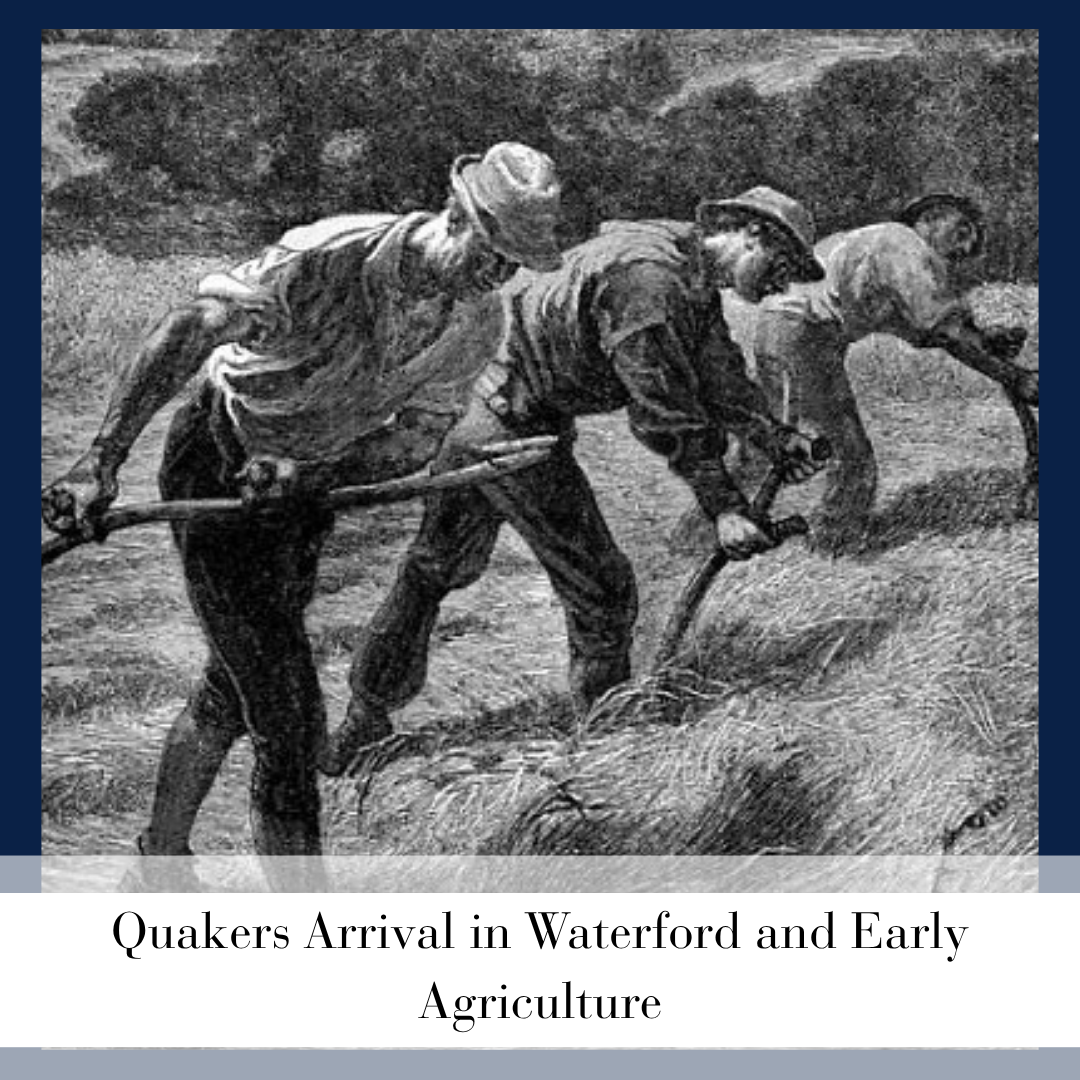
The early Quaker settlers were risk-takers who arrived with few possessions, often relying on wagons and small carts to transport their families and belongings from Pennsylvania. Early farming focused heavily on tobacco, which was a labor-intensive crop that required small, hand-worked fields. To manage this labor, some Quaker farmers utilized indentured servants.
Over time, the economy shifted due to British mercantilist policies and the demand for exports. By the 1750s, the focus began to move from tobacco to wheat cultivation. This transition led to the proliferation of grist mills in the area, marking a new economic era that would eventually support the growth of the post-Revolutionary War village.
Debbie Robison writes about Northern Virginia history. You can read more of her articles on her website.