• Skip to main content
  • Skip to footer
  • Donate
  • Become a Member
  • Volunteer With Us!
  • Cart

Waterford Foundation

  • Education
    • K-12 Education Programs
    • The Waterford Fair
    • Waterford Craft School
    • Waterford HIstory
    • Remote Learning
    • The Quakers
    • African Americans in Waterford
  • Preservation
    • Historic Buildings
    • Mill Stabilization Project (2009-2023)
    • John Wesley Community Church Restoration
    • Dashboard Map of Western Loudoun Development, 1950-2020
    • Phillips Farm
  • Shop
    • Books
    • Donate
    • Membership
    • Lantern Light Fund
  • Events
  • Weddings & Rentals
  • About
    • Contact Us
    • Meet the Staff
    • Meet the Board
    • Visit Waterford
    • Support
    • Join Us
  • News
  • Privacy Policy

News

The First Waterford Fair

September 2, 2021 by Waterford Foundation

The Waterford Fair has come a long way since the first exhibit held in 1944. Nevertheless, the exhibition of handmade crafts has always been a central and driving feature of the event. The first Fair was simply an exhibit of the products of local crafts persons. Those who entered items in the exhibit were encouraged but not required to attend the exhibit. There was no entrance fee the first year, and the proceeds from sales of exhibit items went back to the craftspeople. In addition to the crafts, a handout was created on the history of Waterford, to be distributed to all attendees. Read below to learn the story of the first Waterford Fair, in excerpts from the minutes of the Waterford Foundation, April through November, 1944.

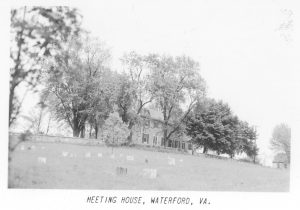
April 7, 1944, at the Meeting House, home of Mr. and Mrs. McDaniel:

“The promotion of crafts was then discussed and a motion made by Mrs. Stabler seconded by Mrs. Rogers that an exhibition of handicrafts be held to demonstrate the aim of the Foundation to foster and promote the practice and learning of these arts. The motion was passed. Mr. Stabler made a motion that [a] committee be appointed by the Chairman to examine the whole subject of local crafts, their learning and subsequent sale and to plan for the exhibit. The Chairman appointed Mrs. Stabler, Mrs. Rogers, Mrs. Myers and Mrs. McDaniel.”

May 12, 1944, at the home of Mr. and Mrs. Paul Rogers:

“The Committee appointed at the April Board Meeting to examine the subject of crafts, their promotion exhibit of sale, reported that they felt it possible to hold a display in the fall which would be of interest to the community. Some contacts had been made with the persons w[h]o do handwork and many others were to be interviewed. The committee subjected that the first anniversary of the founding of the corporation be selected for this project. The date of September 15th was approved by the Board. Mr. Chamberlain spoke of his feeling that it was important to assemble all the historical data concerning Waterford and interesting fold lore and anecdotes about the early days of the village and the people who used to live there. The Directors heartily approved this suggestion as being one of our basic responsibilities and requested Mr. Chamberlain to serve as chairman of that project and to secure what help he needed.”

August 11, 1944, at the home of Mr. and Mrs. Fred Stabler:

“A discussion of the Secretary’s seven-point recommendation pertinent to the holding of the Foundation’s proposed exhibit of handicraft resulted in the adoption of all seven items presented by her.

(The chairman of the committee of the Handicraft Exhibit submits the following suggestions,.)

  1. The exhibit is to be held from Friday through Monday on October 13, 14, and 15th.
  2. Announcement cards of the exhibit to be printed and mailed to a list of interested persons and a general invitation be printed in the county papers. Also a statement of the purpose of the Foundation.
  3. A printed or mineographed [sic] short history of Waterford, and its past industries should be prepared for those attending the craft exhibit to take with them when leaving.
  4. Insurance to be carried on the exhibits while in our custody.
  5. Members of the Foundation to alternate as recepturistics [and] as tea servers during the display making it a social occasion.
  6. All effort possible should be made to have those entering exhibits attend the display.
  7. All displays must be listed and (if desired) priced and a record of who are interested in certain work kept.
  8. Where is this to be held.

A motion to change the July meeting’s decision to hold the exhibit on September 15 was made and carried; the dates of October 13, 14, and 15 were definitely agreed upon as final dates.

Mr. and Mrs. A. B. McDaniel offered their home, The Meeting House, as a place for holding the exhibit. Their offer was gratefully accepted.”

September 16, 1944, at the home of Mrs. Ellen H. Fadeley and Mr. Fenton Fadeley:

‘Mrs. Stabler, chairman of the committee on exhibits reported that the committee had met twice and steps were being taken to maintain constant publicity in the county papers prior to the exhibit; that numerous cards had been sent to exhibitors; that Mrs. Myers was making noteworthy progress on the historical pamphlet[sic] and that further meetings of the committee are planned for the near future. After discussion of the frontispiece to be used on the pamphlet[sic] it was moved and seconded that all details of this matter be left to the committee. The motion carried.

Mr. Rogers moved that the treasurer be authorized to take out insurance with Mr. Armfield to cover the exhibits put in our charge, Mrs. Beans seconded the motion and the motion carried.

Mr. Fadeley made the motion that within two weeks after the exhibit a meeting of the directors of the foundation be called at which a comprehensive report of the attendance, interest, and all facts complied[sic] concerning the exhibit be reported. The motion was seconded and passed.”

November 4, 1944, at the home of Mr. and Mrs. Edward M. Chamberlin, Jr:

“Mr. McDaniel requested a report of the exhibit committee and after the report was made Mr. Rogers moved that said report be incorporated into the minutes. Mr. Chamberlin seconded the motion. The report in condensed form is as follows: Approximately 100 persons entered 300 exhibits of handwork. Great interest was shown by nearly 600 guests who attended and the fact that many returned again and again to further enjoy certain exhibits of particular interest to themselves.

All exhibits were listed by the committee and identifying tags were placed on the exhibits. All sales and orders were recorded and cash was received and turned over to the craftsmen in the amount of about $99.00 and orders for future delivery amounted to ___. The popular selling price range was from .75 to $15 and many more articles could have been sold on the spot if duplicates had been available. 

Two questions were repeatedly asked by both exhibitors and guests “Will this be held annually.” “What is the purpose of this exhibit.” The committee was impressed with the number of persons attending from out of the county and state. The total amount of expense for printing and advertising as shown by bills presented and paid was ___.

The committee also suggested that in the future some entrance fee or a percentage on sales could easily be charged which would defray any expenses entailed. Another suggestion by the committee was that those who have exhibited this year be written to and urged to continue the development of their line of work in order to have new and interesting entries for another year.”

The success of the first exhibit at promoting handmade crafts was soon apparent. The May 18 minutes of the following year noted the following:

“It was called to the attention of the group that an art class has been started by Mrs. Pickens which is a direct result of the inspiration of the Waterford Foundation’s exhibit of last fall. Mrs. Marshal also started work in weaving by hand”

And the rest, as they say, is history!


Filed Under: history, News

Lampshaders

August 12, 2021 by Waterford Foundation

Excerpt from 1951 Waterford Homes Tour and Crafts Exhibit (aka Waterford Fair) booklet, pages 16,17

historic image of ladies creating lampshades
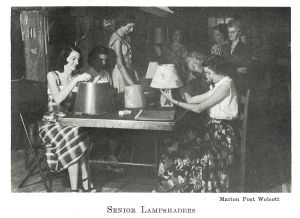
“Senior Lampshaders”, image by Marion Post Wolcott

In 1946 the Waterford Foundation launched an experimental class in lamp shade making, under the direction of Mrs. Paul V. Rogers. Membership in this class was open to anyone from Loudoun or adjacent counties who wished to join, and a small group of aspiring artists displayed and sold their lamp shades at the October Exhibit with great success.

Encouraged by the results of this first attempt, the class met once a week in work-rooms provided by the Mutual Fire Insurance Company until the building was sold in 1950. During these four years, the Lampshaders have grown from six to twenty-five members, varying in age from nine to sixty years. The 4-H Club last year took up the making of Lamp shades as one of their projects, and at the County-wide 4-H Fair their work won several ribbons. Janet Edwards won second prize in the senior state 4-H craft contest held in Blacksburg, Va. Stock and equipment has increased to such an extent that the group has outgrown its old shop, and the Foundation has recently reconditioned the second floor of the mill to accommodate this rapidly growing industry.

historic image of children building lampshades
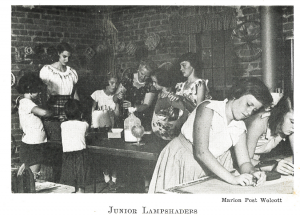
“Junior Lampshaders”, image by Marion Post Wolcott

At the classes, members receive instruction, materials and suggestions in planning and design, which they may profitably develop at home, a system particularly appealing to mothers of young children. Materials are furnished at wholesale prices.

In the last three years the group has collected lamp bases to combine with its shades. The artists specialize in making bases from antique glassware, bottles, oil lamps pitchers, tea pots, candle moulds, tea kettles, children’s toys, coffee grinders, old sad irons and even decoy ducks. The bases and shades they make for children’s rooms are original and designed to appeal to youngsters. Many customers bring their own treasures to be converted into lamps.

The Lampshaders are always on the lookout for unusual materials. Dyed feed sacks, spun rubber papers, spun glass and the popular new plastics have all been adapted to lamp shades with interesting results. Tinted or antiqued parchments, chintz and watercolors distinguish some, while others are appliqued with hunting scenes, birds or floral prints.

The Lamp Shade Shop is open every Thursday afternoon at the mill from one-thirty to four o’clock.


Filed Under: history, News

Waterford Dog Days Diversions

August 5, 2021 by Waterford Foundation

by John M. Souders, July 2021

As we swelter through another hot summer, it’s hard to believe that a century or so ago Waterford successfully marketed itself as an idyllic refuge from the simmering cities. In the latter third of the 1800s, after the railroad pushed west into the Loudoun Valley, farms and villages competed eagerly for cash-paying customers fleeing the urban heat.

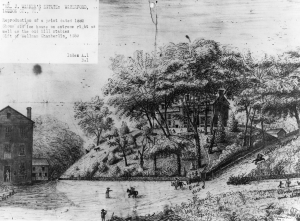
sketch of a house on a hill above the old Mill
Mill End, from 1882 sketch

Jake Walker, advertising his comfortable home [Mill End—40090 First Street] overlooking Waterford’s mill, promised guests in 1895 “an Ideal Summer Home—an abundance of fruit, flowers, ice and shade; high and dry; no mosquitoes; two hours’ ride from Washington.” The previous year he had attracted “quite a number of Baltimoreans” for the season.

In 1874, from the other end of town [Huntley Farm—15578 High Street], fellow Quaker Charles Hollingsworth touted a “high situation and view of the mountains fine.” In the wake of the Civil War, money remained scarce, even in productive Loudoun, and summer boarders could help keep homeowners solvent. Still there were sometimes limits to their hospitality. For the Hollingsworths, “only a few persons without children can be accommodated.” In their defense, Huntley in those days was much less spacious than it became after Robert Walker’s modifications in the 1890s. But maybe they just didn’t need the extra hassle. Sally Bond, widow of Waterford’s longtime tanner, was blunter in 1886: “Small children refused.” For the older set she offered “plenty of space, ice, fruit [and] good table” at her place on Bond Street [Janney-Phillips House—40132]. The last named inducement would have been especially important at a time when Waterford had about as many dining options as it does today.

At the northeast edge of town [Moxley Hall—40266 Water Street], Lewis Shuey, who had married Sally Bond’s niece, added a couple of extra attractions to the usual list: “shutters, mountain air [and] daily mail,” the indispensable equivalent of today’s wifi. In 1874 Sally’s sister-in-law Rachel (Mrs. Samuel) Means [40128 Bond Street] advertised her place’s convenient access to Washington: “two trains daily.” (A few years earlier, Albert Brown had inaugurated a stage line between Waterford and the train station at Clarke’s Gap. He promised to “meet the 11 o’clock A.M. train daily. Passengers conveyed comfortably and safely. Fare either way fifty cents.”) Rachel was in dire straits at the time. Husband Sam had formed and led the pro-Union Loudoun Rangers in the war, and his former rebel antagonists were intent on driving him to financial ruin. When they succeeded, the Meanses moved to Washington where Rachel ran a boardinghouse to support the family.

If fine food, “good water” and mountain air did not restore soul, as well as body, there were summer camp meetings. These could be major affairs. One of the first was held in August 1871, exactly 150 years ago.

The Waterford Methodist Episcopal Camp Meeting will commence on Thursday, the 10th instant. Conveyances will be running daily to and from the depot. The railroad will pass all persons coming and going from the meeting at half fare.—The grounds are well shaded, and very conveniently located. The best accommodations will be provided for all who may come. Boarding and lodging of the best kind will be furnished for the entire meeting for $7, and boarding, exclusive of lodging, for $5. We are expecting a real, old-fashioned Methodist Camp Meeting, and most cordially invite all well-disposed persons to come.

Charles King, Pastor, Waterford, Loudoun co.

Three years later, unfortunately, attendees included persons not so much “well-disposed” as well-inebriated. A “Mr. Tavenner attacked a reverend, and the services were interrupted by a man under the influence of alcohol. The drunken man was quieted by the ‘brawny arm of a big father’ and then ‘subjected to painful effects produced by phrenological examination of the head by a fence rail.’” Quite a vivid image! and “but for the early stopping of the affray there would have been such a fight, as that there would not have been enough men on the ground to stop.”

“Jim Crow” was also in attendance. “At this same meeting a group of African-American women attempted to take advantage of their promised civil rights by seating themselves amongst a group of white women, but they were quickly removed from the meeting by a local officer . . . otherwise it is to be understood that good order was observed throughout and the meeting attended with many gratifying results.”

Not everyone emerged gratified from such gatherings, or even unscathed. Waterford historian John Divine recalled that “someone stuck a knife into” his grandfather Joe Divine—a staunch Methodist—at a camp meeting, though the injury was not serious.

The Baptists appear to have had better luck with their meetings. At a gathering in August 1881 held in Charlie Hollingsworth’s woods, the press reported “an immense crowd” in attendance each day, with “great numbers of vehicles” passing through Hamilton en route to the meeting.

For those seeking a tamer diversion from the summer heat, there were traveling entertainments like the medicine show that in June 1903 set up a tent for two weeks on the “colored school house lot” [Second Street School—15611 Second Street]. The operators had a sure-fire tactic to separate attendees from their hard-earned cash. “They offered a gold watch to the lady who would receive the most votes as being the most popular lady in town. The number of votes being regulated by the amount of medicine, &c. purchased, and when the final count was made on Monday night it was found that Miss Louise Fling, the accomplished daughter of our miller, Mr. W.H. Fling, had received a total of over 87,000 votes, and she was accordingly awarded the watch for being the most popular young lady in town. We congratulate Miss Louise (she was going on 14 at the time), and think she well deserves the compliment.” Political correctness had not been invented yet.


Filed Under: history, News Tagged With: local history, summer, visit Waterford

July 2021 Newsletter

July 2, 2021 by Waterford Foundation

CLICK HERE to view our July 2021 Newsletter! 


Filed Under: News

2021 Waterford Fair

June 25, 2021 by Waterford Foundation

Save the date for the 2021 Waterford Fair. Learn more at waterfordfairva.org


Filed Under: Fair, News

June 2021 Newsletter

June 6, 2021 by Waterford Foundation

Click here to read the June 2021 newsletter!


Filed Under: News

May 2021 Newsletter

May 6, 2021 by Waterford Foundation

Click here to read the May 2021 newsletter!


Filed Under: News

April 2021 Newsletter

April 6, 2021 by Waterford Foundation

Click here to read the April 2021 newsletter!


Filed Under: News

  • « Go to Previous Page
  • Page 1
  • Interim pages omitted …
  • Page 5
  • Page 6
  • Page 7
  • Page 8
  • Go to Next Page »

Footer

Office Manager oldschool@waterfordfoundation.org
Phone: 540-882-3018 x 2

Privacy Policy


Join Us

Copyright © 2025 · Waterford Foundation · Log in