• Skip to main content
  • Skip to footer
  • Donate
  • Become a Member
  • Volunteer With Us!
  • Cart

Waterford Foundation

  • Education
    • K-12 Education Programs
    • The Waterford Fair
    • Waterford Craft School
    • Waterford HIstory
    • Remote Learning
    • The Quakers
    • African Americans in Waterford
  • Preservation
    • Historic Buildings
    • Mill Stabilization Project (2009-2023)
    • John Wesley Community Church Restoration
    • Dashboard Map of Western Loudoun Development, 1950-2020
    • Phillips Farm
    • Notes from the Preservation Desk
  • Shop
    • Books
    • Donate
    • Membership
    • Lantern Light Fund
  • Events
  • Weddings & Rentals
  • About
    • Contact Us
    • Meet the Staff
    • Meet the Board
    • Visit Waterford
    • Support
    • Join Us
  • News
  • Privacy Policy

News

Taverns in Waterford

August 4, 2022 by Waterford Foundation

by John Souders

Waterford’s history with alcohol is long, complicated and often dreadful. In 1888 a village correspondent commented, “I hear the charge that there is a good deal of drinking in Waterford and I am afraid the town is not in position to bring suit for slander on this score.”

By the mid-1830s, according to Martin’s Gazetteer of Virginia towns and villages, Waterford boasted four taverns, outnumbering churches and schools. The tavern with the longest run operated at 40170 Main Street. It was known variously as Talbott’s Tavern, after lapsed Quaker Joseph Talbott, who bought the property in 1810; Manning’s Tavern; Matthews’ Tavern; and for long stretches the Waterford Hotel. Waterford Quaker Mary Dutton Steer probably had this establishment in mind in the early 20th century when she added the following stanza to her poem “Old Memories”:

A tavern stood upon the street

That some did much deplore,

For many a noble-minded man Went down to rise no more.

An early competitor was Klein’s Tavern, which owner Lewis B. Klein opened in 1825 as a “house of entertainment.” Its run as a tavern was relatively brief. The building today is known as the Pink House (40174 Main Street).

Around the middle of the 19th century, Oscar Fitzallen Reed operated a tavern in the center of town.

Thirsty Waterfordians also bought brandy and whiskey at any of several stores in town. And there were numerous instances of villagers, both Black and White, selling liquor without a license (see below). The results of all the drinking were predictable; they pepper the historical record. The press account below, from December 1865, is a vivid example.

On Tuesday and Wednesday of last week the County Court of Loudoun, sitting as an examining Court, was engaged in the trial of William H. Hardy and Charles Curry, for an assault on John P. Gregg, and robbery committed by them of one Gold Watch valued at one hundred and seventy-five dollars, one Gold Chain valued at twenty dollars, and thirty-five dollars in currency (commonly called Greenbacks,) consisting of three ten dollar and one five dollar notes . . .

Lieut. W.F. Keys,[1]  late of the United States army, lives in Waterford, Loudoun county, was there on the night of the 8th of December, 1865, [where he] saw Curry and Hardy and Gregg, all warm friends of his, on that night. [Keys] was in his store when Hardy came in with Charles Virts and Gregg treated [them?] to cigars. Hardy was pretty drunk and commenced bragging about his shotgun, said it was the best gun in Waterford, in fact, the best gun in the County, and could out shoot any other gun. Gregg objected to the statement, and a bet was proposed. [Keys] Asked Hardy to drop it, as it was impossible for him to know whether this was the best gun in Loudoun, it was too broad an assertion. They asked him [Keys] to draw up a bond and he commenced to do so, and they urged him to do so; he consenting as he would do anything to get rid of them. Gregg immediately said he could get rid of him very soon if he did not want him. Hardy wanted Gregg to take back what he had said, but G. insisted that he had said nothing wrong.

Hardy wanted to fight badly, and took off his coat, and flung his arms about a good deal. Gregg also took off his coat, but after a good deal of wrangling, at Keys’ suggestion, put it on again. [Keys] tried to pacify them.

Gregg said he could whip the best man in Waterford, when Keys said hold on, you must not say so, when Gregg said he would take that back. Hardy continued quarreling and flinging his arms about, and Gregg, when he had his coat on his shoulder, said I can whip you with my coat on.

Hardy went out saying to Gregg, I can find someone who will dispose of you pretty soon. Shortly after he came back with Curry and [a] soldier of the United States army. Was about 12 o’clock that the whole row took place. Door [to Keys’s store] was open, Gregg staid there. Hardy came up to the door; Curry came in near the side of Gregg. Hardy said, “now John Gregg you damned rebel son of a bitch, I will settle your hash for you.”  Gregg struck him and knocked him out of the door. Curry seized Gregg and they went down together. When I got out, Hardy was a little distance down the hill, with a stone in his hand, Gregg was on top of Curry, and the soldier on top of Gregg and struck at him twice. [Keys] Jerked the soldier violently off of Gregg, and then Gregg off of Curry. Young Howard Hardy came up and Wm. Hardy who had sidled round threw his stone, [supposedly] at Gregg, and it struck Howard, who threw his and struck William. This was done at his [Keys’s] door; he pushed Gregg in and locked the door. Hardy and Curry wanted [the] soldier to break the door, and [the] soldier wanted them to do it. [They] Called Gregg a damned rebel son of a bitch, and said he Keys, was harboring him. Looked into the store, saw back window open and concluded Gregg had gone, and let them into the store; they all searched for Gregg, but not finding him, commenced abusing Keys, and wanted to whip him. This witness [Keys] used a great deal of profane language and was ordered by the Court to cease using it.

W.T. McNully[1] testified that hearing a noise near Keys store, went up and found Hardy with a stone in his hand, in his shirt sleeves; soon after [he, McNulty] returned to Mr. Graham’s bar-room; which he keeps. Some fifteen minutes afterwards, Curry came with a soldier to borrow a pistol, which he refused to lend him; [he, Curry] was in the bar-room several times during the evening, and was pretty well intoxicated. This was about twelve o’clock at night.

John P. Gregg [was] examined [and] gave substantially the same statement that Keys did until he got outside of the door after knocking Hardy down, was in close contest with Curry and the soldier, one of them laid his hand on the hook of his watch chain, and he [Gregg] said that’s what you’re at is it? and knocked Curry down [and] from that time [he] became so excited, that he remembers nothing until he was again in the store, the door locked and violent attempts made to force it open. He escaped by the back door and retreated to the house of ——- two hundred yards distant; some time after returned to Dr. Fox’s office to have his wound dressed, and while there Curry and soldier came in threatening violently, demanding a [fight]. He being in fear of bodily harm and acting in defense of his life, knocked Curry down with a chair and thinks he bounded over him, and got out of Waterford; as he went out someone called halt, halt, several times, but he did not halt. Lost his watch, chain and money; watch and chain [were] recovered from the hands of a negro named Robinson by warrant from a Justice.

For [the] defense Henry Virts and Henry Hough testified that Hardy was pretty drunk, and Curry very effectually whipped. Submitted without argument. Both prisoners sent on to Circuit Court. Hardy bailed in $500, H.[enry] M. Hardy his father, [acted as] security. Bail was refused to Curry.

Whiskey seems to have been a very potent agent in producing this scene, as it is in almost all others.


[1] Pvt. [not Lieut.] William “S.” Keyes of the Loudoun Rangers lived after the war with wife Virginia at what became known as the Collins Cottage (no longer standing). William applied for a county liquor license in 1866, but in 1869 was fined a stiff $50 for selling without a license.

[2] William T. McNulty was about 17 at the time. He was living with his widowed mother at 40145 Main Street (Camelot School).


Loudoun County Liquor & Ordinary Licenses (Waterford)

Ordinary License 1852 Anderson, James S
Liquor License 1868 Berry, Newton
Liquor License 1847 Conrad, David
Liquor License 1867,1868 Hain[e]s, Joel
Liquor License 1866 Keys, William S.
Ordinary License 1824, 1827, 1828, 1831-1836 Klein, Lewis
Ordinary License 1837, 1838, 1851 Lee, Dodridge
Ordinary License 1848, 1849, 1854 Mathews, John
Liquor License 1852 Matthews, John
Liquor License 1901 Patton, M.H.
Ordinary License 1829-1833, 1835 Paxson, John
Liquor License 1849, 1850, 1854 Reed, Oscar F.
Ordinary License 1843-1849 Reed, Oscar
Liquor License 1867 Russell, James
Ordinary License 1840 Smith, George
Ordinary License 1856, 1858, 1859, 1860 Williams, Robert W.
Ordinary License 1851 Williams, J
Ordinary License 1861 Wine, George H.

Loudoun County Restaurant and Hotel Licenses 1856-1876 (Waterford)

Berry, Newton 1867 Taxed to Keep an Eating House
Haines, Joel 1867, 1868 To Keep an Eating House
Hough, Henry C. 1868 Eating House
Russell, James W. 1856 to keep an eating house
Russell, James W. 1866 to keep a hotel

Loudoun County Criminal Papers 1800-1899 (Waterford)

1790  McGavack, Patrick Selling liquor without a license. 2 counts
1800  Lacey, David Selling liquor without a license
1809  Patterson, Flemon Selling liquor without a license
1812  Lacey, David Selling liquor without a license Inn Keeper
1812  Sappington, John Keeping a Disorderly House Nov-1812 Listed as Inn Keeper
1815  Patterson, Fleming Selling liquor without a license

  • Conrad, David Selling liquor without a license
  • Bogges[s], Peter (Free Black) Selling liquor without a license
  • Talbot[t], Joseph Selling liquor without a license Guilty

1828  Lacey, Sarah White Female Selling liquor without a license
1828  Minor, Nathan (Free Black) Selling liquor without a license Guilty
1832  Hough, Joseph Selling liquor without a license
1859  Densmore, William Selling liquor without a license
1859  Roberts, Lorenzo D. Selling liquor without a license
1869  Keys, William, Selling Liquor without a license Guilty $50.00 Fine


Filed Under: Fair, From the Local History Collection, News, Waterford History

Stories from the Attic: A. W. Phillips Meadow pastel, Interview Bronwen Souders

August 3, 2022 by Waterford Foundation

“Stories in the Attic” is a series compiled and edited by Edith Crockett, Waterford Foundation Archives & Local History Collections Subcommittee. Individual stories are written by different authors.  This month’s “story” is the result of a collaboration between Bronwen C. Souders and Jane Williams.


Bronwen C. Souders grew up in the American West and in a recent interview said her younger self found history “boring”.  The past 50 years living near Waterford have changed her perspective. Now, as she used to say of her friend and mentor, historian John Divine, she is more familiar with the village of the 1820s than of the 2020s.  This month’s interview with Bronwen focuses on the A.W. Phillips Meadow pastel, created by
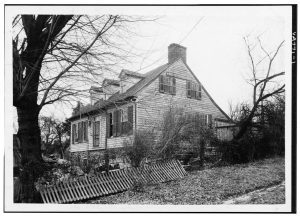
Mary “Molly” Dutton Steer, a Quaker, in 1900.  Think you have never seen this artwork? Think again.  It graces Waterford’s new signs on the entrances to our village.   Nearly lost to history, the pastel has recently been reframed for preservation by the Archives & Local History Collections Subcommittee.

Jane:  Bronwen, how did the Dutton Steer pastel come to the Waterford Historical Collections?

Bronwen:  More than 20 years ago, I was visiting with John Middleton (1925-2021) to discuss his early memories of Waterford.  John grew up in the village and was a member of the African American Collins family, long-time residents of the Waterford area.  He told me he had an old picture of Waterford that I might be interested in.  (His daughter only wanted the frame.) It was a charming view of the Phillips Farm from Second Street.

Jane:  Who was Molly Dutton Steer?

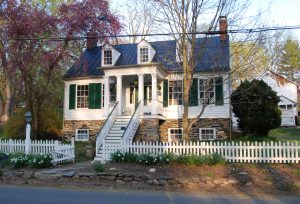
Sunnyside, circa 2007
Sunnyside, circa 1930

Molly Steer grew up at Sunnyside, a house that still stands on Second Street.  She was the artist of the four Dutton sisters.  Sisters Lida and Lizzie, along with Sarah Steer, created the Waterford News.  This pro-Union newspaper was one of the few women-run newspapers in the country during the Civil War.  Their father, John B. Dutton, was a strong Unionist who, with Sarah’s father Samuel Steer, sat out the war at Point of Rocks, Maryland, sneaking home periodically to see their families.

In the early 2000s, the owner of the Phillips Farm died, and 144 acres of the farm came on the market. The Waterford Foundation raised $2M to purchase the property, but a developer won the sales contract and announced plans to develop the property as a residential subdivision. The Foundation worked with the community, the Trust for Public Land, and other public and private supporters to buy the farm from the developer for just under $3.9M. Read more about this effort from the Washington Post. The Waterford Foundation embarked on an all-out fund-raising effort. To help raise money, the Foundation created T-shirts featuring the historic pastel.

Mary Frances “Molly” Dutton Steer with husband Frank Steer
Martha Parmes, pictured on Janney Street

During the war Molly married Franklin M. Steer, son of Second Street neighbor James M. Steer, a blacksmith. She lived into her 90s and eventually moved to a Quaker home in Baltimore, returning to Waterford for summertime visits.  During one such visit she gave the pastel to her friend Martha Parmes, a highly respected and much beloved member of the African American community.  Miss Parmes most likely passed it along to John Middleton.

Jane: Molly’s friendship with Martha Parmes suggests that the white community and the African American community were intertwined?

Bronwen: Waterford had always been integrated–even house-by-house.  There were enslaved African Americans living in White-owned homes, of course, but there were free African Americans who owned homes in Waterford alongside Whites well before the Civil War.  The African American community oversaw the Second Street School and built the John Wesley Church in the village.  Black and White children played together but never attended the same schools.  Black and White women would sometimes share a cup of tea, particularly in Quaker homes.

Jane:  Bronwen, thank you so much for your time and invaluable knowledge of Waterford!  This lovely pastel gives us an important portrait of how rural Waterford looked in the past.  And, as an artifact, provides insight into the close relationships among individuals despite racial segregation.  Thank you!


Filed Under: From the Local History Collection, history, News, Waterford History

Samuel Gover’s Desk

July 14, 2022 by Waterford Foundation

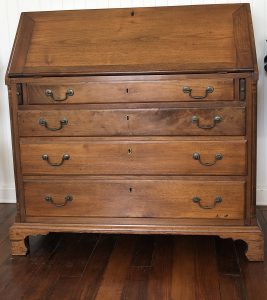
C. 1812 desk donated to the Waterford Foundation

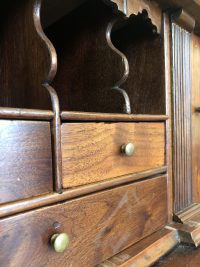
c1812 Slant-top Desk made for Samuel Gover

The Waterford Foundation recently became the proud exhibitors of an American walnut slant-top desk, believed to have been made in Leesburg, Virginia, about 1812, for Samuel Gover (born before 1765 in Maryland, died between 1822-26 in Waterford). The donation was made by Gover descendant and Highland, Maryland residents Margaret Rose and her husband Gerald on October 21, 2016 at the Waterford Corner Store. Co-archivists Bronwen Souders and Edith Crockett accepted it on behalf of the Foundation.

A member of Fairfax Monthly Meeting of the Society of Friends (Quakers), Gover headed a household of seven individuals in 1810 in the village (although 14 children in all had been born to hi and his second wife Sarah Harris Janney between 1

785 and 1806). Their home, now called the Griffith-Gover House, is at 40139 Main Street. The desk was handed down through the family to Samuel’s great grandson Henry Taylor Gover (1875-1969), and through Henry’s niece Mary Armstrong Pierdon to her daughter Margaret Rose.

An appraisal report for the piece gives the following details:

The classic form, with few embellishments and no veneers, is in keeping with Quaker tastes, comprising a set of four graduated drawers with toe-molded overlapping edges; the shallowest drawer is on top, flanked by sliding supports for the writing surface; the desk compartment is symmetrically arranged around a central cabinet with crotch-grained prospect door, with a fluted-front document box to either side, then three small drawers show beneath valanced pigeon holes; decorative flued quarter columns are on the front corners. It is supported on bracket feet; overall measurements are 41 inches high; 41 3/4 inches wide, and 21 inches in depth.

The primary wood appears to be walnut; drawers and hidden surfaces in the case constructed of poplar; drawer guides are yellow pine or hemlock; drawers and hidden surfaces in the desk compartment, white pine. Escutcheons and locks appear to be original. Bale pulls are of the period but do not appear to be original with the desk.

Wear, cracks and repairs are consistent with age and use, most notably along the top edge of two drawers and the front left foot. Some pigeonhole valances are detached, but retained. The wood surface has been polished and refinished during years of domestic use.

Interior drawer and pigeonhole detail
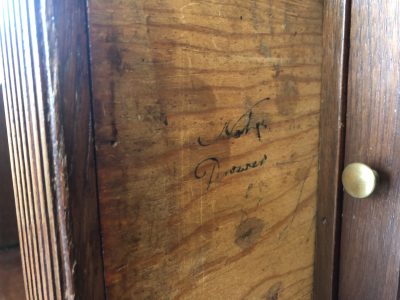
“Notes Drawer”


If you have artifacts from Waterford’s history that you would like to share, please contact our office at oldschool@waterfordfoundation.org.


Filed Under: From the Local History Collection, News, Waterford History

Zoning Ordinance Rewrite White Paper

July 8, 2022 by Waterford Foundation

Dear Waterford Friends and Supporters,

As you may be aware, the County is in the process of revising the zoning ordinance to reflect the new 2019 Comprehensive Plan.    Loudoun’s zoning ordinances have not been updated for 20 years and a re-write is certainly due to reflect current needs and citizen vision as outlined in the new Comprehensive Plan.

We are now in the ‘Public Input’ phase, a three-month period continuing through July 18th, where comments from Loudoun citizens are welcome and encouraged.    It’s important that the Loudoun County Zoning Staff hear from all Waterford’s citizens as the zoning code is what governs land use policy   Staff will send their recommendation to the Planning commission, then forward to the Board of Supervisors for final approval

The Waterford Foundation has read the zoning code, with a focus on Adaptive Reuse (Chapter 5.10), which is important to the viability of our historic structures in the village.   The Waterford Foundation has prepared a summary sheet to shorten your workload, attached below.   We encourage citizens to make their voices heard before the July 18th deadline by following these steps for communicating with Zoning Staff.

If you have questions, feel free to call Jane Covington at 434-960-4678 or jane@janecovington.com

Thank you for your help!

Stephanie C. Thompson, Executive Director


Directions for submitting your comments on Adaptive Reuse to Loudoun’s Zoning Staff

Email your comments to Loudoun’s zoning staff at this address:   ZOrewrite@loudoun.gov     The Waterford Foundation has summarized our recommendations below in blue italics, but it’s best to communicate recommendation in your own words. While writing your comments, please feel free to reference the County’s zoning code on Adaptive Reuse, which can be found here: https://online.encodeplus.com/regs/loudouncounty-va-crosswalk/doc-viewer.aspx?secid=966 – secid-966. You may also wish to include with your email message a photo of your favorite historic Waterford building that you think is appropriate for adaptive reuse.

Chapter 5.10  Adaptive Reuse

Purpose

Discussion The new zoning code encourages adaptive reuse of historic structures but omits including standards of rehabilitation.   We recommend referencing recognized standards to encourage retention of character defining features of historic properties or consulting with the local HDRC.  We also see a natural overlap between adaptive reuse and the Sustainability movement.

Recommendation  Please ask zoning staff to include the following:

“Encourage preservation of historic structures through appropriate renovation,such as the Secretary of Interior Standards and/or ruling by HDRC”

“Encourage sustainability by allowing more older buildings qualify under the Adaptive Reuse zoning regulations.”

Eligibility  / Section B

Discussion  We recommend broadening the scope of eligibility with the intention of allowing more older buildings to qualify under the Adaptive Reuse zoning regulations.  We recommend streamlining the rezoning process to make the process more user-friendly and financially affordable by removing requirements such as market analysis, structural engineers, and verification of obsolescence. Adaptive reuse should not be expensive and burdensome

Recommendation: Please ask zoning staff to include the following:

“All properties over 50 years old should be eligible for adaptive reuse under the new zoning code or as designated locally historic’ by the Heritage Commission.”

“Please remove all the Zoning Administrator’s considerations of obsolescence of an old building, including past and current vacancy rate, existing and previous uses, structural condition, and real estate market information.”

Standards and Requirements / Section C   

Discussion  We recommend allowing more options when making changes as many historic buildings and sites don’t lend themselves to traditional zoning set-backs or rear, off-street parking spaces.   When there are questions, we recommend the Zoning Administrator consult with the HDRC. It is agreed that the setting of an historic property warrants protection, but there needs to be flexibility to accommodate small or non-conforming sites.    We also want to encourage agricultural buildings, such as old barns or mills, to have future uses.

Recommendation: Please ask zoning staff to include the following:

“Allow more exceptions for non-conforming sites for setbacks, on-site parking, and additions to the front of the structure.  Where there are questions, the Zoning Administrator should consult with the HDRC.”

“Please allow industrial /craft uses such as woodworking, metal working and stonework”


Extra Credit:

  • If you have the time and energy to submit detailed comments through the online public comment system, see the detailed instructions for posting comments in this pdf: ZOR Public Comment Instructions
  • To learn more about recommendations from the Loudoun Historic Village Alliance, see this document: LHVA Recommendations


Filed Under: News, Preservation

Stories from the Attic: Just Like Home c1862

June 23, 2022 by Waterford Foundation

The following letter is in the Local History Collection of the Waterford Foundation. It was written by James Dickinson, a Union soldier of the 9th Division, bivouacked in Waterford, one of thousands of Yankee troops on their way south. James Dickinson’s home state was Michigan. His unit had only recently been mustered. For the most part, the original spelling and grammar of the letter have not been changed. Our thanks to John Souders for providing the history of the letter writer and identifying him..

Waterford Ver Mar the 1 1862

Dear Aunt,

I have a fine chance know[sic] to write you a few lines to let you know how we get along   We are all well know[sic] and in good spirits we are four miles in advance of our forces on picket Guard.   It is a splendid country and we have first rate times. The weather is very pleasant and warm. We are in a beautiful little grove where the walnuts are in abundance, aunt, perhaps that you would like it. Now what we had for Breakfast that perhaps that you know that while we are in the Enemys country that what we can get comes without money or without price. This morning there were twenty-eight very nice chickens came into our camp and only 20 of us to eat them so we fared first rate. We had chickens, pork, peas, sauce and coffee [illegible] hard bread for our breakfast and it relished first rate to [illegible] it is not very often that we are favored with such blessings as these here. We can crack nuts and apples, pears and chickens and thore [there] is a very nice spring of water not but a few feet from our tents. Aunt, this seems most like home of anything that I have had since we left home. You see we are left as a reserve so that if the rest of the pickets are driven(?) in we are to support them, so that we do not have to have but one man out of twenty to stand guard. Well Aunt you may think it strange that I do not write oftener but we are bothered most to. death to get postage stamps here and we have to divide them amongst our friends as equal as we can. Well, Aunt, I don’t know as I can think of anything more to write. At present I have just written home but have not received any letter from there in a long time. I must close. Give my love to all inquiring friends and don’t forget to accept a share for yourself. Good Buy [sic].

From  J D Dickinson

Image of unknown Union soldier courtesy of the Library of Congress.


Filed Under: From the Local History Collection, history, News, Waterford History

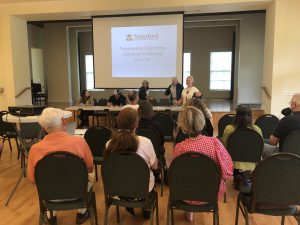
Preservation Committee Community Meeting Held June 22, 2022

June 23, 2022 by Waterford Foundation

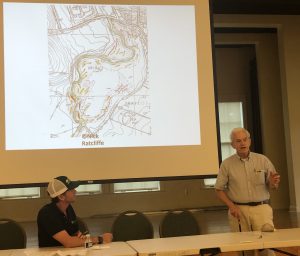
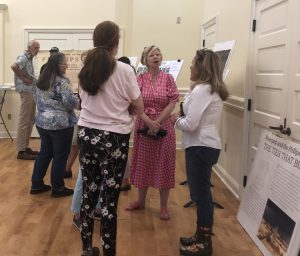
On Wednesday, June 22, 2022, the Waterford Foundation Preservation Committee welcomed the community for an informational meeting about the Phillips Farm and other ongoing preservation work on Foundation properties. Attendees gathered at 5:30 pm for a reception and opportunity to view exhibits, maps, and images of the Phillips Farm and properties under easement within the Waterford National Historic Landmark. At 6pm, WF President Susan Manch welcomed those assembled for a information packed presentation by a panel of speakers, including:
  • Erika Richardson from the Virginia Outdoors Foundation, who spoke about VOF’s work throughout the Commonwealth and detailed the particular protections of the easement they hold on the Phillips Farm,
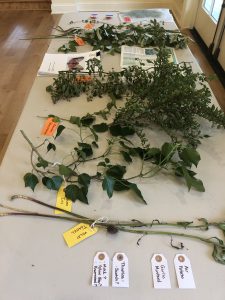
  • James Remuzzi of Sustainable Solutions, LLC, who gave a report of herbicide treatments applied to date to manage the invasive poison hemlock that presents a threat to Phillips Farm visitors,
  • Susan Honig-Rogers of the Phillips Farm Subcommittee, who spoke about the subcommittees current and future efforts to document and manage other invasive plants present on the Phillips Farm,
  • Nick Ratcliffe, who educated the audience on the geology and hydrology of the Phillips Farm and explained the present conditions of the South Fork Catoctin Creek as a result of damming the creek to generate power for Waterford’s mills,
  • Carl Sheider, who introduced the Phillips Farm Western Trail Pilot Project recently approved by the WF Board of Directors to establish a new walking trail on the western side of Catoctin Creek beginning summer 2022, and
  • Stephanie Thompson, Waterford Foundation Executive Director, who provided updates on the status of other preservation work this year including the Mill Stabilization Project, the Bond Street Tanyard easement project, and repair and restoration work throughout WF properties.
    Nick Ratcliffe speaks about the geology and hydrology of the Phillips Farm.
    Samples of invasive plants found on the Phillips Farm.
    Attendees in discussion during the opening reception.


We look forward to holding more such community meetings in the future, to keep our neighbors, members, and community members informed of our work. See the presentation slides from the evening for more information on the easement overview, poison hemlock treatment, pilot trail project, and preservation updates. Slides are available online here: Preservation Community Meeting Presentation Slides.


Filed Under: Committees, News, Preservation

Stories from the Attic: The Moore Family’s Influence on the Growth of Waterford

June 2, 2022 by Waterford Foundation

By Debbie Robison, May 27, 2022

When the village of Waterford was founded at the close of the American Revolutionary War, a mercantile store and a number of manufacturing ventures were established that had a significant impact on the success of the village. Almost immediately, a remarkable variety of goods began to be manufactured, including tanned leather, saddles, and cabinets.  Credit for developing these key businesses goes to one industrious Quaker family. Thomas Moore and his three adult sons, James Moore, Thomas Moore Jr, and Asa Moore, began several businesses on lots they bought and leased near Mahlon Janney’s mill. They likely named this new village after their homeland where the elder Thomas Moore was born.[1]

Receipt for payment of a five pound seven shilling four pence debt in wheat

Thomas Moore Jr. opened a store, operated as Thomas Moore & Co, with financial assistance from Alexandria merchant John Sutton.[2] The success of the business was hindered by a post-war depression that began the year the store opened. While it was typical at that time to sell merchandise on credit, the store had to discontinue the practice during the depression and limit providing credit to the purchase of small trifles. During this time, when a new nation was being formed, the United States did not yet have a federal banking system. Virginia had its own currency, a holdover from the colonial period, in denominations of pound, shilling, and pence. On at least one occasion, the company accepted wheat, the predominant cash crop of the time, to pay down debts owed to the store.[3] The store closed about 1790 when Thomas Moore Jr. moved to Maryland.

The tannery, where animal hides were tanned to make them pliable, was established ca. 1785 on a small branch that became known as Tan Yard Run. James Moore leased the 3/4-acre lot from Joseph Janney, who developed the village.[4] Pits were dug in the ground for soaking the animal hides; first to remove the hair and fat from the hide, then to soften the hide into leather. Tanners often sold the hair that was removed from the hides to a local plasterer. Original lime plaster walls in the village may contain animal hair from the tannery. Asa Moore and his son-in-law, Thomas Phillips, took over the business from James Moore. In 1832, following Asa Moore’s death, the tannery had 40 to 50 in-ground vats, a large bark house (to store bark used to tan hides), a currying house (where leather was treated), and a handling house.[5] The Waterford Foundation owns this historic tannery site.

This open space bordered by Main, Liggett, and Bond streets was the site of the Moore family tanning operation from c1785 to 1832.

Asa Moore operated the saddlery where saddles were manufactured using tanned leather.[6] Saddle making required skilled craftsmanship to assemble saddles using glues while stitching together the various components.

Thomas Moore (Sr. or Jr.) was involved in a woodworking trade. It is unknown what type of products were made, though the skills of cabinet makers and joiners were used.[7] They could have been making furniture or had a role in building houses. A cabinet maker constructed furniture, such as cupboards, drawers, doors, and coffins. Joints, such as dovetail joints, were constructed by joiners to connect pieces of wood together.

The significance of the Moore family businesses is due, in part, to the many apprentices who were taught skills as boys while working for the Moores. At least 21 boys were apprenticed to the Moore family to work in these trades. Upon completing their apprenticeships, a number of these young men, along with other men who worked for the Moore family, established businesses in Waterford. For example, Henry Burkett, who lived with Thomas Moore, Jr. from 1789 through 1791, leased two lots on the south side of Main Street in 1792.[8] Evidently, Burkett knew the cabinet making/joiner trade because in 1793 Daniel Lovett (previously apprenticed to Thomas Moore) was bound to him to learn the trade of joiner.[9] In 1794, Jesse James (previously apprenticed to Thomas Moore, Jr to learn the trade of cabinet maker) was living with Burkett in the village.[10] Apparently they were operating a cabinet making shop. Another example is Joseph Talbott who, before becoming a tavern keeper, operated a saddle making business on Main Street.[11] He had previously lived with Asa Moore, who ran the Moore’s saddlery business, from 1792-1795.[12]

So not only was the Moore family vitally important at the formation of the village of Waterford, but they were also influential in its expansion and growth.


References

[1] Souders, Bronwyn C., Waterford, Virginia: Named for Waterford, Ireland, or not? (A Moore family history) [manuscript].

[2] Trust agreement between Thomas Moore Jr. and John Sutton, Loudoun County Deed Book O:423, 17 Jun 1785.

[3] George Emery etc. v. John Sutton, etc., Loudoun County Chancery Case 1791_009, pp. 12 and 15, as viewed at https://www.lva.virginia.gov/chancery/.

[4] Joseph Janney’s Will, Loudoun County Will Book D:341, probated October 11, 1793; Loudoun County Land Tax Ledgers: Alterations 1786, 1787-1799.

[5] “Public Sale,” Genius of Liberty, March 3, 1832, as viewed at www.geneologybank.com. Ad describes the tannery business of Moore & Phillips that was for sale.

[6] Loudoun County Order Book I:87, September 12, 1785.

[7] Loudoun County Order Book I:336

[8] Lease from Joseph Janney to Henry Burkett, Lots 7 and 8, Loudoun County Deed Book U:266, June 1, 1792.

[9] Loudoun County Order Book P:321.

[10] Loudoun County Personal Property Tax Ledgers, 1794-1796.

[11] Talbott, Joseph, Alexandria Daily Gazette, 11 Nov 1808.

[12] Loudoun County Personal Property Tax Ledgers, 1792-1795.


Filed Under: history, News, Waterford History

New Waterford Foundation Directors and Officers – 2022

May 6, 2022 by Waterford Foundation

We were pleased to welcome so many members and guests to our 2022 Annual Meeting on April 19, 2022. The evening included a presentation by Kathryn Smith of the National Park Service about the study to update Waterford’s National Historic Landmark designation. Find more information about the update and links to the documents on our website. President Chris Gleckner, Executive Director Stephanie Thompson, and Treasurer Dave Hunt provided reports on the state of the organization. Much of this information can be found in our Annual Report, available in pdf form here, or hardcopy at our offices in the Old School. Please see the letters below from our Executive Director Stephanie Thompson and new President of the Board, Susan Manch.

Valued Foundation Members,

Thanks to those of you able to attend our annual meeting on April 19.  We were especially pleased to honor our Scout volunteers Niko Kesari, John Case Hall, Evan Smith, Arabella Horton, and Emma Dolega-Jasinski, 2021 Community Partner Hunt Country Sotheby’s International Realty, and 2021 Volunteer of the Year, Liz Hohm.  We also presented the Lifetime Achievement Award to Margaret Good for her many years of service to the Foundation. It is because of dedicated community members such as these that the Foundation continues to be able to do its important work.

The Foundation Board added new members Jane Covington, Chris Doxey, and Susan Manch and elected new officers.  The Officers are as follows:

President – Susan Manch            Vice President – Annie Goode

Treasurer – Dave Hunt                 Secretary – Jane Covington

We are committed to continuing to fulfill our mission of preservation and education.

Best regards,

Stephanie Thompson

Executive Director, Waterford Foundation


A Personal Note From the Incoming Foundation Board President:

I want to thank Christine Gleckner, outgoing President, for her many years of service and for her continuing support of the Board and Foundation.  I am honored to be entrusted with this role.  While I am a more recent resident of Waterford, I have been a long-time Waterford Fair attendee and fan of this National Historic Landmark.  As the Foundation nears its eightieth year in 2023, I look forward to working with the Board to set ambitious goals for furthering our primary mission and preparing for our 300th anniversary in 2033.

As is true with all non-profits, the pandemic created hardships that we will have to work hard to overcome.  The return of the in-person Fair this year was a welcome return to normalcy and our Leaders and Committees will work collaboratively to chart a course that ensures that the Foundation and the National Historic Landmark are on solid footing for many years to come.

My goal is to be available to hear members’ priorities, ideas, and concerns.  To that end, I intend to hold office hours in the Old School every Thursday from 1:00 to 2:00 pm, beginning May 5.

I hope you will visit me there and actively partner with the Board and the Foundation as we embark on the next phase of the Waterford journey.

With gratitude,

Susan Manch

President, Waterford Foundation Board of Directors


Filed Under: News

  • « Go to Previous Page
  • Page 1
  • Interim pages omitted …
  • Page 3
  • Page 4
  • Page 5
  • Page 6
  • Page 7
  • Interim pages omitted …
  • Page 9
  • Go to Next Page »

Footer

Email: oldschool@waterfordfoundation.org
Phone: 540-882-3018

Privacy Policy

Join Our Email List and Stay Connected!

Copyright © 2026 · Waterford Foundation · Log in