• Skip to main content
  • Skip to footer
  • Donate
  • Become a Member
  • Volunteer With Us!
  • Cart

Waterford Foundation

  • Education
    • K-12 Education Programs
    • The Waterford Fair
    • Waterford Craft School
    • Waterford HIstory
    • Remote Learning
    • The Quakers
    • African Americans in Waterford
  • Preservation
    • Historic Buildings
    • Mill Stabilization Project (2009-2023)
    • John Wesley Community Church Restoration
    • Dashboard Map of Western Loudoun Development, 1950-2020
    • Phillips Farm
  • Shop
    • Books
    • Donate
    • Membership
    • Lantern Light Fund
  • Events
  • Weddings & Rentals
  • About
    • Contact Us
    • Meet the Staff
    • Meet the Board
    • Visit Waterford
    • Support
    • Join Us
  • News
  • Privacy Policy

Uncategorized

2023 Annual Awardees

May 2, 2024 by Elizabeth McFadden

Eagle Scout Recognition

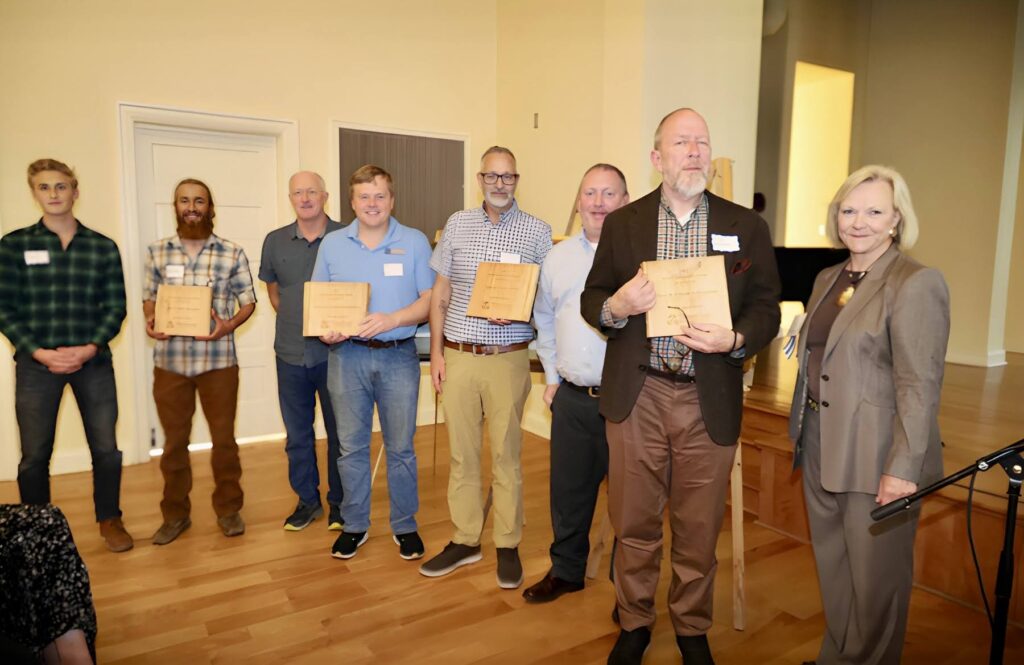
The awards portion of the evening kicked off with our Eagle Scout Recognition of Jonathan Jovene for his Second Street School fence work.  Jonathan cleared the brush and re-installed fence posts in the schoolyard and make the fence sound again! Thank you, Jonathan! 

Strategic Partners

We were so pleased to see the Mill re-stabilization project come to a successful and on-time completion at the end of July last year. The Mill has never looked better, and we are looking forward to expanded use of the building in the days to come. The construction phase of this project was the culmination of over 10 years of work to secure funding, to study the building and produce a historic structure report, and to plan and execute a restoration project that would stabilize the building for the future. Our 2023 special recognition award(s) recognizes the members of the team who worked to make this treasured building safe for many years to come.  Loudoun County Department of Transportation and Capital Infrastructure has managed the project from the beginning and through the design and construction phases. Glave and Holmes Architects served as project architects through the design and construction phases. As contractor, Carpenter Beach Construction managed the carpenters, masons, and other tradespeople who worked to stabilize and rehabilitate the historic structure. Finally, Arbor Ridge Builders reproduced the massive timber-framed Hurst frame, the most significant structural artifact of the circa 1818 mill. Thank you to everyone involved in this huge and important project! 

Community Partners

We would not be the great organization we are today without some great community partners.  An important part of preserving the Landmark is conserving the bountiful open spaces that help tell Waterford’s agricultural and industrial story. The connection between the historic and natural fabrics of Waterford can easily be seen out on the Schooley Mill Meadow.

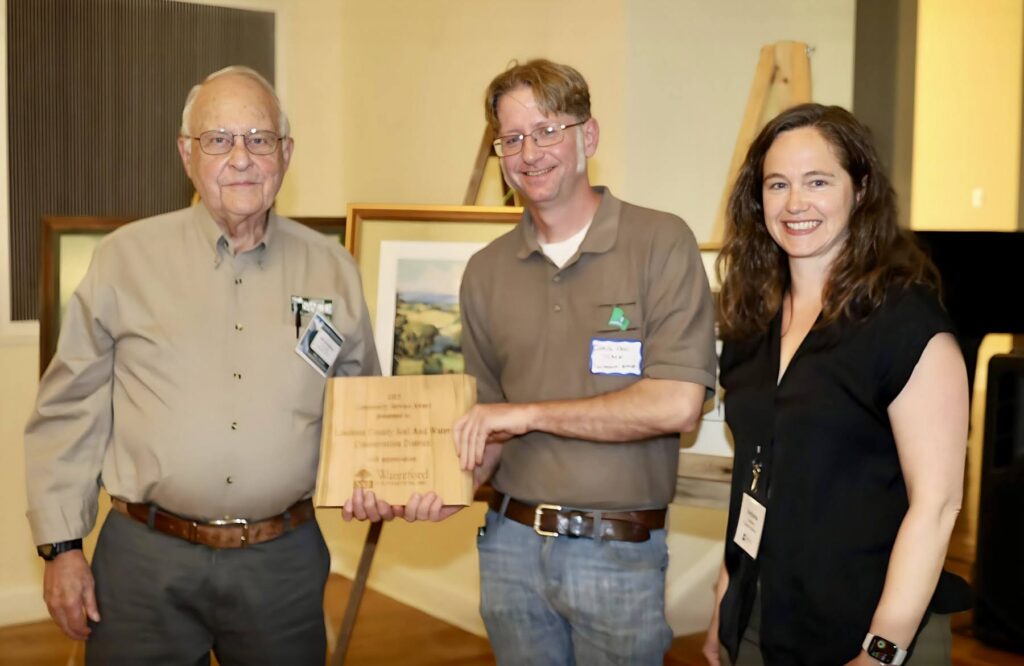
Balls Run, a tributary of Catoctin Creek runs through the property. As erosion has happened naturally along the bank, the need for a riparian buffer was made clear. Thanks to our Community Partners of 2023 – the Loudoun County Soil and Water Conservation District and the Piedmont Environmental Council – 600 trees were planted on both sides of the Catoctin to make up the new riparian buffer at no cost. Now the creek bank will be protected for many years to come. We thank you for your important contribution to our preservation and conservation mission, and look forward to seeing your important work continue in Loudoun County.

Volunteer of the Year

Everyone should have someone to call when you’re in a pinch right before a big event. Say, for example, that you are days away from your biggest educational outreach event and fundraiser, and you find out that the only toilet in a critical building is out of order. Or that the pilot program of your brand new field trip is two days away in November and the heat goes out in a critical building. Who would you call? We’re so grateful that we have Jeff Bean’s number, who has helped us solve so many problems in the past year and beyond. When we discovered that the Mill toilet was not working properly within a few days of the start of the Fair, he understood the urgency of the issue and pulled out all the stops to make sure the toilet was fixed in time for the event. And then just a month later, the heaters at the Second Street School continued to cause problems days before the first group of the Reconstruction program came out. Jeff once again pulled out all the stops, staying until the early hours in the morning to make sure that the seventh graders coming had a comfortable environment to learn in. We can’t thank you enough for all that you have done to keep the Foundation running smoothly Jeff. 

Lifetime Achievement

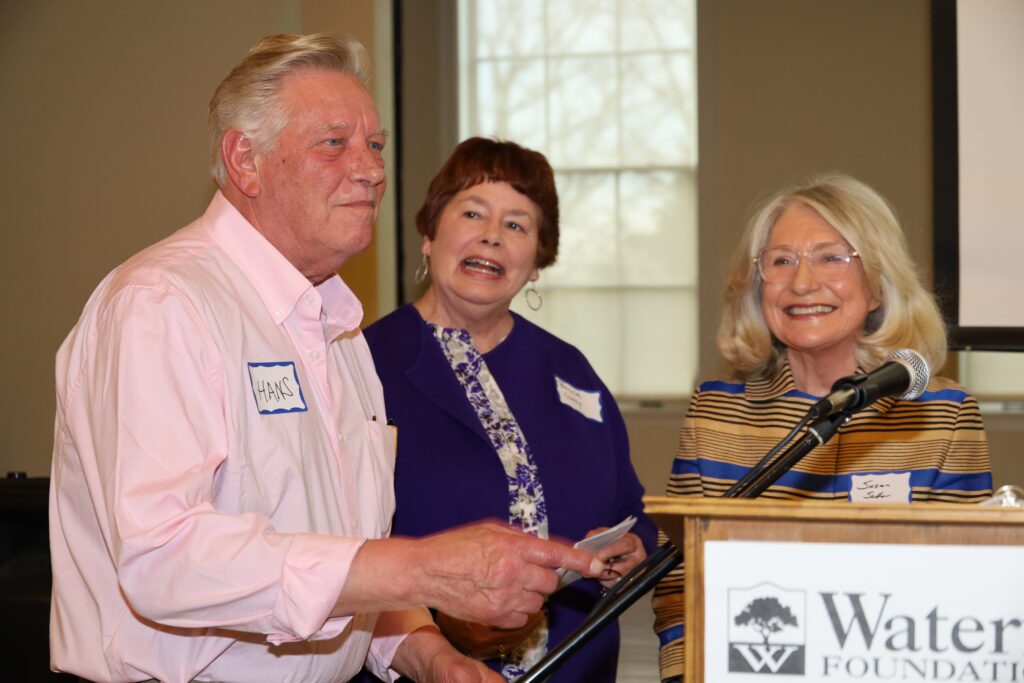
The Lifetime Achievement Award was established to recognize outstanding contributions to the work of the Waterford Foundation.  This year, we are honoring a man whose dedication and hard work have been the backbone of our Fair’s ticket booth operations for over two decades and who was a major contributor to the Old School restoration project. Hans Hommels, has been the invisible hand ensuring thousands of fairgoers are greeted with a smile, despite the challenges that arise before they even step foot into Waterford. For 25 years, Hans has orchestrated the complex ballet of ticket booth operations, a task that might seem straightforward to the uninitiated but is, in reality, is a huge undertaking. Managing up to four booths, coordinating shifts that stretch from the early morning till the close of day, and training dozens of volunteers each year, Hans has created the first impression of the Fair for countless attendees. After co-chairing with John DeCourcy from 1997 to 2014, Hans took over as chair for 7 more years, demonstrating an unwavering commitment to the Fair and to Waterford. This incredible tenure of service, came to a close in 2022, marking the end of an era. But that’s not all…

In 2007 the Foundation recruited Hans for a job that no one else could have done. Many of us remember watching the fire that destroyed our auditorium and damaged the Old School on that dreadful day in January 2007. The fire was a devastating blow to the Foundation and to the community.  However, from the beginning the determination to restore the classroom building and rebuild the auditorium was strong. Hans agreed to lead the rebuilding effort by chairing the Old School Steering Committee, a group that included Susan Sutter, Walter Music, and Kathleen Hughes. With Hans’s commitment to the village and his years of experience in construction management, he was the ideal candidate for the job. Hans thrives on challenges, and there were many challenges during the five years of the reconstruction project. The committee involved the community in the process. Hans visited village residents to ask for their views and participated in a series of public meetings.  Then Hans and his team interviewed 12 architectural firms. That search led to the hiring of Quinn Evans, a firm with vast experience with historic buildings, as the project architects for both the classroom building and the auditorium. After Loudoun County approvals had been secured, reconstruction of the classroom building began with Corbett Construction in March of 2008. Hans was a constant presence on the site, working with the builder, checking progress daily, and solving problems as they arose, while always insisting on high quality work. Meanwhile Hans and his team members worked with Quinn Evans to create a design for the auditorium that would complement the historic architecture. The design was finalized after more input from the community and approvals from both the Historic District Review Committee and the Virginia Department of Historic Resources, which holds an easement on the building.  During this time Hans and his team sent out Requests for Proposals to ten construction firms.  After meeting with the firms that submitted the top five bids, the team recommended Scott Long. Construction began on the auditorium in the summer of 2011.  Again, Hans was on site at the auditorium almost every day, with pages of plans under his arm, checking work as it was installed—carpentry, plumbing, electrical, HVAC. Amazingly, the project came in under budget, a rare achievement. None of this would have happened without the hundreds of hours of pro bono work Hans donated to the Foundation as our in-house Project Manager.  Without his dedication, the Foundation would not have a beautifully restored Old School and a spectacular new auditorium. Please look around you to see his contribution. 

Hans, your legacy is not just in the smooth operation of ticket sales or the countless hours you’ve dedicated to the Old School. It’s in the community you’ve helped build, the volunteers you’ve inspired, and the countless fairgoers and Old School event attendees whose experiences you’ve enhanced. On behalf of everyone here, and all those who have had the privilege of working with you or being welcomed by you, we say thank you. 

Thank you to Susan Sutter & Bonnie Getty for these kind words.

Thank you to everyone who joined us for such a great evening. We are looking forward to seeing you at all of the fun events coming up in 2024! 

Filed Under: News, Uncategorized, Volunteer Tagged With: 2024, meeting, news

2024 Waterford Foundation Board Updates

May 2, 2024 by Elizabeth McFadden

Our Board is made up of some extraordinary people.  Unfortunately, we only get our members for a short time before they must rotate off for a while.  Ann Goode returned to the Waterford Foundation Board in 2018, bringing her wealth of experience and expertise in planning and land use issues. Having previously served on the Board as well as a member of the Waterford Foundation staff, her deep institutional knowledge has been an asset to the Foundation for the past six years. Ann has been a strong supporter of the formation and subsequent reorganization of the Preservation Committee, serving as chair of the Committee as well as its Open Lands Subcommittee while also serving as Vice President of the Board. Ann’s expertise and steadfast leadership has enabled the Foundation to make great strides in advancing its preservation mission. We will miss her voice on the Board, but we look forward to her continued active involvement on the Preservation Committee. Thank you, Annie!

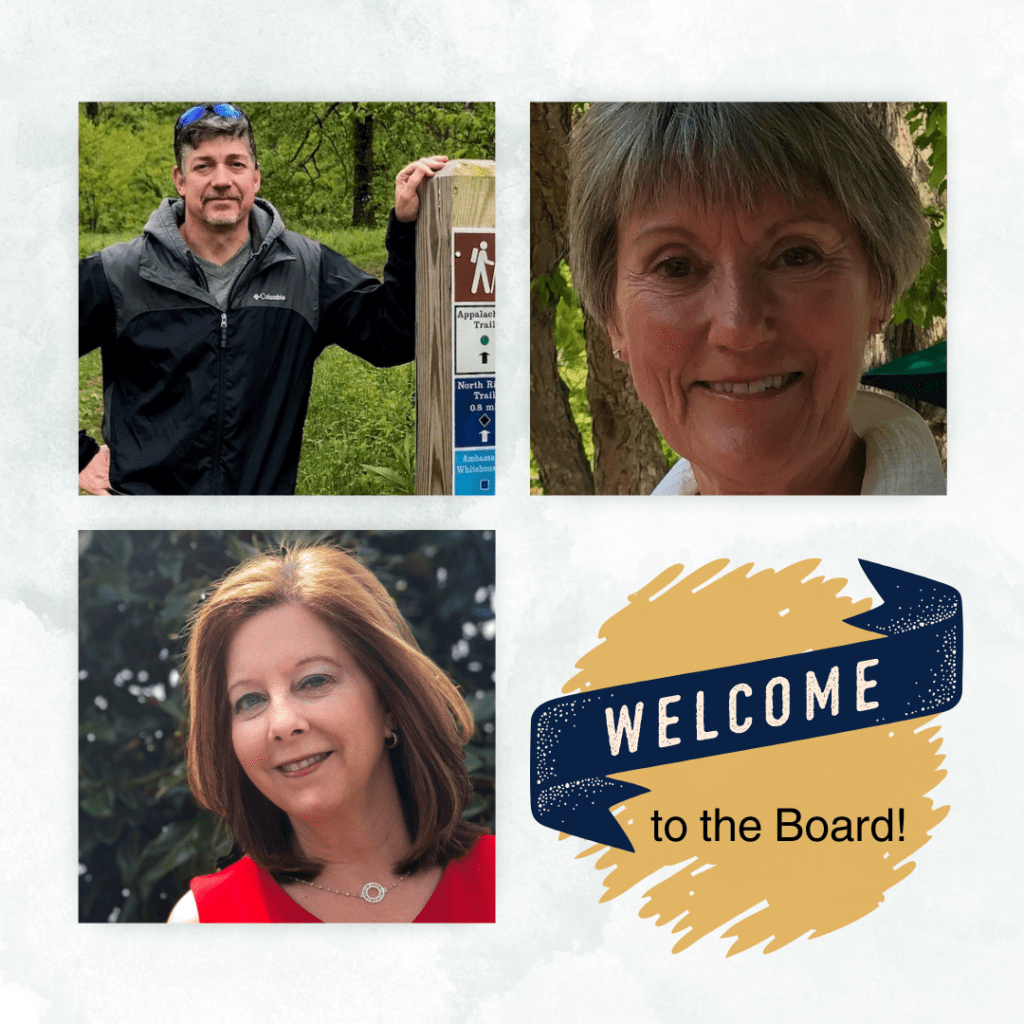
We are excited to welcome 3 new Board members this year.  Nancy Iarossi, Susan Hill & Carl Scheider were voted onto the Board at the annual meeting.  Each of them brings important experience in various fields that will greatly contribute to our Board and mission. 

Finally, the Board appointed the Executive committee to serve this year! Susan Manch will continue as President, Chris Wood has taken over as Vice President, Chris Doxey has taken over as Treasurer and Sharyn Franck is serving as our Secretary! 

Learn more about all of our great Board members here: https://www.waterfordfoundation.org/meet-the-board/

Filed Under: News, Uncategorized Tagged With: 2024, news

2024 Annual Meeting Recap (FY2023)

May 1, 2024 by Elizabeth McFadden

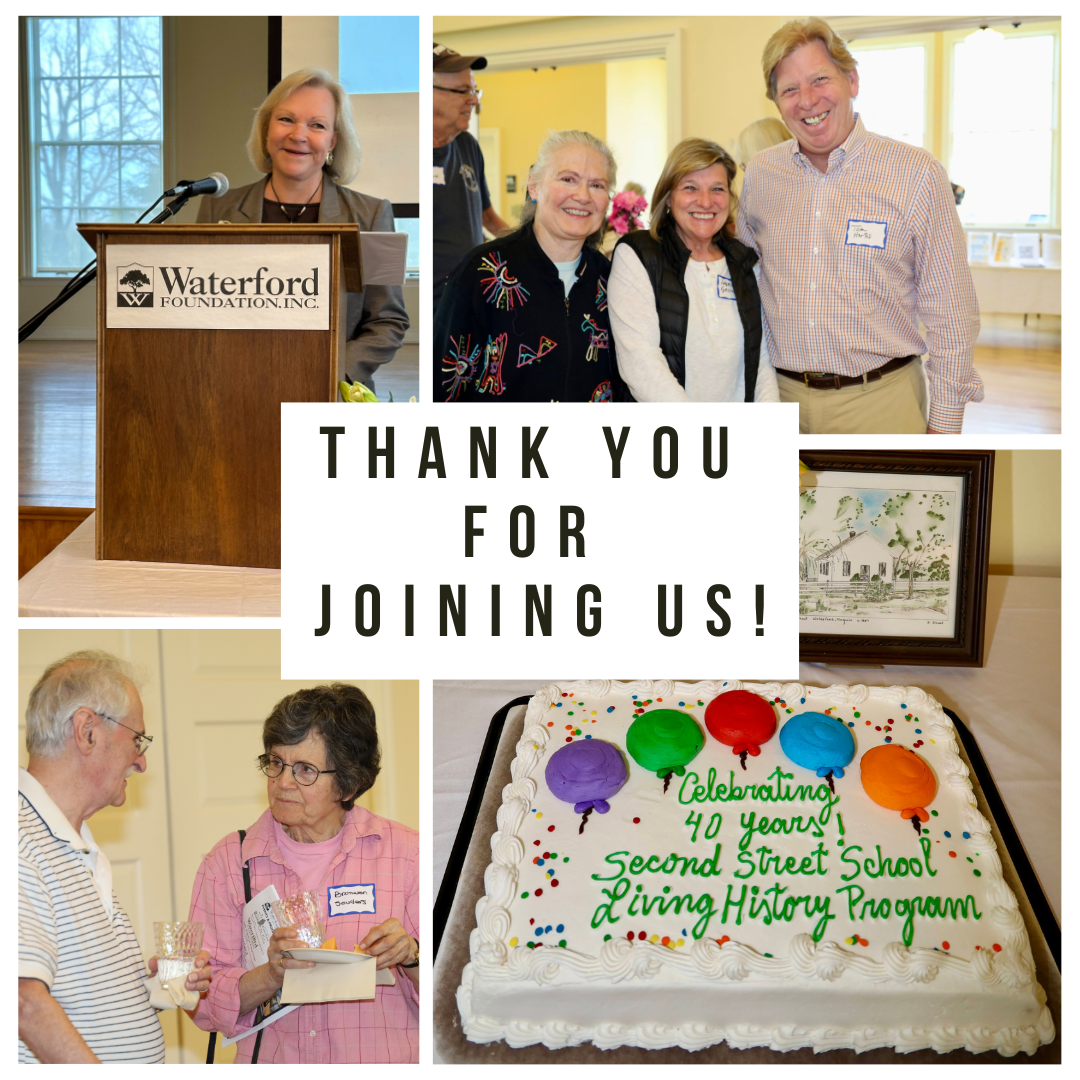
We gathered at the Waterford Old School on Tuesday, April 16th for our Annual meeting. It was a wonderful celebration of 2023’s successes, the 40th anniversary of the Second Street School Living History Program, and our esteemed awardees. We shared an interesting presentation on easements and the meeting was finished with new board member voting and executive committee appointments.  

2023 Annual Awardees:

Eagle Scout Recognition

The awards portion of the evening kicked off with our Eagle Scout Recognition of Jonathan Jovene for his Second Street School fence work.  Jonathan cleared the brush and re-installed fence posts in the schoolyard and make the fence sound again! Thank you, Jonathan! 

Strategic Partners

We were so pleased to see the Mill re-stabilization project come to a successful and on-time completion at the end of July last year. The Mill has never looked better, and we are looking forward to expanded use of the building in the days to come. The construction phase of this project was the culmination of over 10 years of work to secure funding, to study the building and produce a historic structure report, and to plan and execute a restoration project that would stabilize the building for the future. Our 2023 special recognition award(s) recognizes the members of the team who worked to make this treasured building safe for many years to come.  Loudoun County Department of Transportation and Capital Infrastructure has managed the project from the beginning and through the design and construction phases. Glave and Holmes Architects served as project architects through the design and construction phases. As contractor, Carpenter Beach Construction managed the carpenters, masons, and other tradespeople who worked to stabilize and rehabilitate the historic structure. Finally, Arbor Ridge Builders reproduced the massive timber-framed Hurst frame, the most significant structural artifact of the circa 1818 mill. Thank you to everyone involved in this huge and important project! 

Community Partners

We would not be the great organization we are today without some great community partners.  An important part of preserving the Landmark is conserving the bountiful open spaces that help tell Waterford’s agricultural and industrial story. The connection between the historic and natural fabrics of Waterford can easily be seen out on the Schooley Mill Meadow.

Balls Run, a tributary of Catoctin Creek runs through the property. As erosion has happened naturally along the bank, the need for a riparian buffer was made clear. Thanks to our Community Partners of 2023 – the Loudoun County Soil and Water Conservation District and the Piedmont Environmental Council – 600 trees were planted on both sides of the Catoctin to make up the new riparian buffer at no cost. Now the creek bank will be protected for many years to come. We thank you for your important contribution to our preservation and conservation mission, and look forward to seeing your important work continue in Loudoun County.

Volunteer of the Year

Everyone should have someone to call when you’re in a pinch right before a big event. Say, for example, that you are days away from your biggest educational outreach event and fundraiser, and you find out that the only toilet in a critical building is out of order. Or that the pilot program of your brand new field trip is two days away in November and the heat goes out in a critical building. Who would you call? We’re so grateful that we have Jeff Bean’s number, who has helped us solve so many problems in the past year and beyond. When we discovered that the Mill toilet was not working properly within a few days of the start of the Fair, he understood the urgency of the issue and pulled out all the stops to make sure the toilet was fixed in time for the event. And then just a month later, the heaters at the Second Street School continued to cause problems days before the first group of the Reconstruction program came out. Jeff once again pulled out all the stops, staying until the early hours in the morning to make sure that the seventh graders coming had a comfortable environment to learn in. We can’t thank you enough for all that you have done to keep the Foundation running smoothly Jeff. 

Lifetime Achievement

The Lifetime Achievement Award was established to recognize outstanding contributions to the work of the Waterford Foundation.  This year, we are honoring a man whose dedication and hard work have been the backbone of our Fair’s ticket booth operations for over two decades and who was a major contributor to the Old School restoration project. Hans Hommels, has been the invisible hand ensuring thousands of fairgoers are greeted with a smile, despite the challenges that arise before they even step foot into Waterford. For 25 years, Hans has orchestrated the complex ballet of ticket booth operations, a task that might seem straightforward to the uninitiated but is, in reality, is a huge undertaking. Managing up to four booths, coordinating shifts that stretch from the early morning till the close of day, and training dozens of volunteers each year, Hans has created the first impression of the Fair for countless attendees. After co-chairing with John DeCourcy from 1997 to 2014, Hans took over as chair for 7 more years, demonstrating an unwavering commitment to the Fair and to Waterford. This incredible tenure of service, came to a close in 2022, marking the end of an era. But that’s not all…

In 2007 the Foundation recruited Hans for a job that no one else could have done. Many of us remember watching the fire that destroyed our auditorium and damaged the Old School on that dreadful day in January 2007. The fire was a devastating blow to the Foundation and to the community.  However, from the beginning the determination to restore the classroom building and rebuild the auditorium was strong. Hans agreed to lead the rebuilding effort by chairing the Old School Steering Committee, a group that included Susan Sutter, Walter Music, and Kathleen Hughes. With Hans’s commitment to the village and his years of experience in construction management, he was the ideal candidate for the job. Hans thrives on challenges, and there were many challenges during the five years of the reconstruction project. The committee involved the community in the process. Hans visited village residents to ask for their views and participated in a series of public meetings.  Then Hans and his team interviewed 12 architectural firms. That search led to the hiring of Quinn Evans, a firm with vast experience with historic buildings, as the project architects for both the classroom building and the auditorium. After Loudoun County approvals had been secured, reconstruction of the classroom building began with Corbett Construction in March of 2008. Hans was a constant presence on the site, working with the builder, checking progress daily, and solving problems as they arose, while always insisting on high quality work. Meanwhile Hans and his team members worked with Quinn Evans to create a design for the auditorium that would complement the historic architecture. The design was finalized after more input from the community and approvals from both the Historic District Review Committee and the Virginia Department of Historic Resources, which holds an easement on the building.  During this time Hans and his team sent out Requests for Proposals to ten construction firms.  After meeting with the firms that submitted the top five bids, the team recommended Scott Long. Construction began on the auditorium in the summer of 2011.  Again, Hans was on site at the auditorium almost every day, with pages of plans under his arm, checking work as it was installed—carpentry, plumbing, electrical, HVAC. Amazingly, the project came in under budget, a rare achievement. None of this would have happened without the hundreds of hours of pro bono work Hans donated to the Foundation as our in-house Project Manager.  Without his dedication, the Foundation would not have a beautifully restored Old School and a spectacular new auditorium. Please look around you to see his contribution. 

Hans, your legacy is not just in the smooth operation of ticket sales or the countless hours you’ve dedicated to the Old School. It’s in the community you’ve helped build, the volunteers you’ve inspired, and the countless fairgoers and Old School event attendees whose experiences you’ve enhanced. On behalf of everyone here, and all those who have had the privilege of working with you or being welcomed by you, we say thank you. 

Thank you to Susan Sutter & Bonnie Getty for these kind words.

Board Member Vote / Executive Committee Appointment 

Our Board is made up of some extraordinary people.  Unfortunately, we only get our members for a short time before they must rotate off for a while.  Ann Goode returned to the Waterford Foundation Board in 2018, bringing her wealth of experience and expertise in planning and land use issues. Having previously served on the Board as well as a member of the Waterford Foundation staff, her deep institutional knowledge has been an asset to the Foundation for the past six years. Ann has been a strong supporter of the formation and subsequent reorganization of the Preservation Committee, serving as chair of the Committee as well as its Open Lands Subcommittee while also serving as Vice President of the Board. Ann’s expertise and steadfast leadership has enabled the Foundation to make great strides in advancing its preservation mission. We will miss her voice on the Board, but we look forward to her continued active involvement on the Preservation Committee. Thank you, Annie!

We are excited to welcome 3 new Board members this year.  Nancy Iarossi, Susan Hill & Carl Scheider were voted onto the Board at the annual meeting.  Each of them brings important experience in various fields that will greatly contribute to our Board and mission.  Learn more about them and all of our great Board members here https://www.waterfordfoundation.org/meet-the-board/

Finally, the Board appointed the Executive committee to serve this year! Susan Manch will continue as President, Chris Wood has taken over as Vice President, Chris Doxey has taken over as Treasurer and Sharyn Franck is serving as our Secretary! 

Thank you to everyone who joined us for such a great evening. We are looking forward to seeing you at all of the fun events coming up in 2024! 

Please find the 2023 Annual Report here: https://www.waterfordfoundation.org/wp-content/uploads/2024/04/2024-Annual-Report-web.pdf

Filed Under: Uncategorized Tagged With: 2024, meeting, news

About the Alliance

February 29, 2024 by Stephanie Thompson

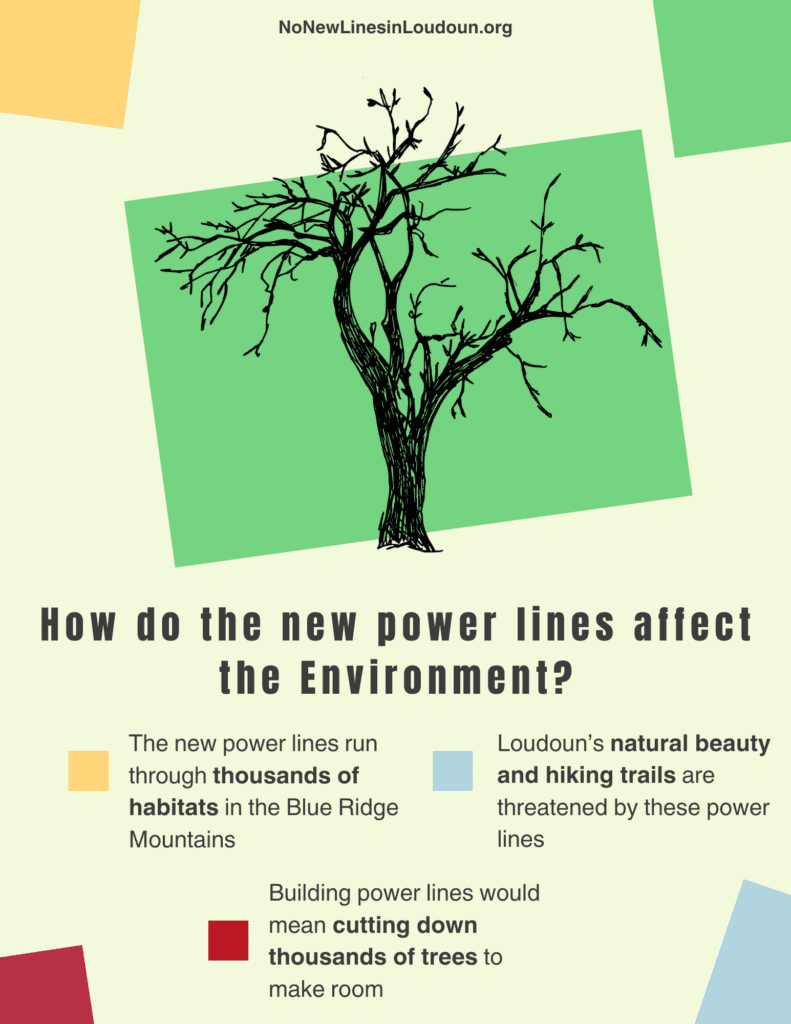
In January 2024, representatives from Loudoun nonprofit organizations, community and neighborhood associations, business organizations and other interested parties gathered at the Old School in Waterford, Virginia to coordinate efforts to oppose the proposed greenfield transmission lines of the Mid-Atlantic Resiliency Link contract awarded to NextEra Energy by PJM Interconnection. Instead, the Alliance believes that all transmission lines should be built in existing power corridors The members of the alliance developed and agreed to the following Declaration to clarify their common purpose (link to PDF Version)–

Sign the Declaration by the Loudoun Transmission Line Alliance on the NextEra MARL Proposal using this link!
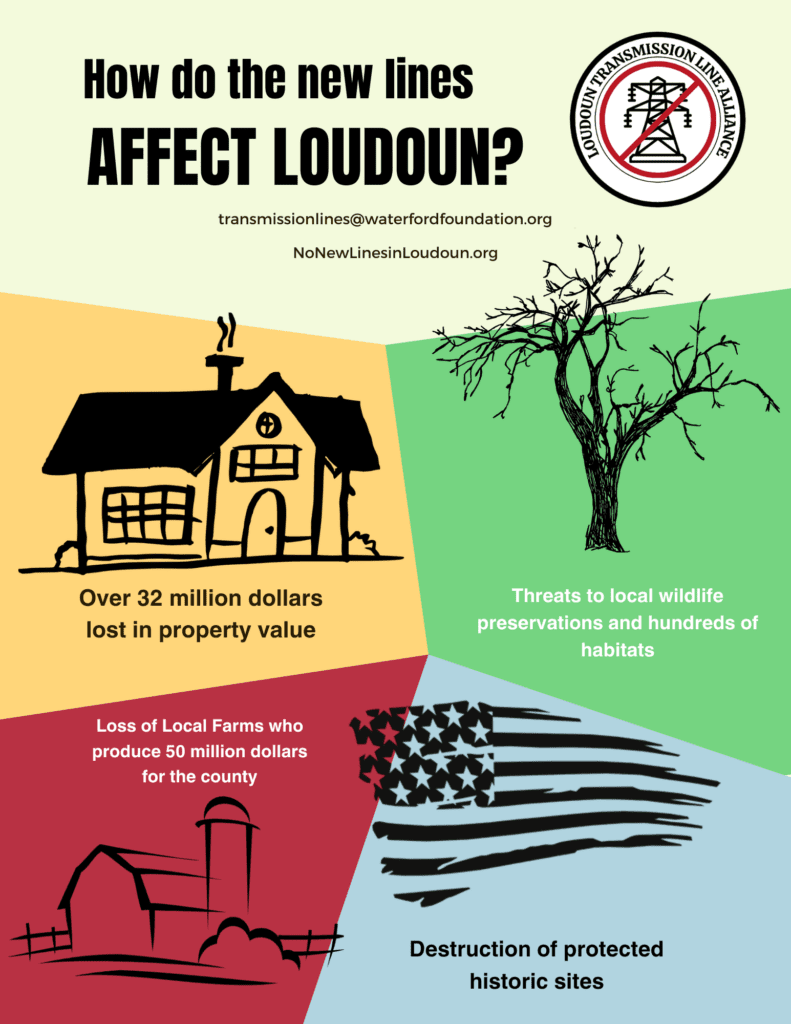
Declaration by the Loudoun Transmission Line Alliance on the NextEra MARL Proposal:

We, the undersigned stakeholders, representing business, preservation, agricultural, environmental, and community organizations in Loudoun County, Virginia, call upon NextEra Energy to avoid building a new power corridor through rural Loudoun County, in view of the negative impact of such construction on the agricultural community, local economy, heritage and natural resources, and residents of the region. 

We strenuously oppose construction of new “greenfield” lines in rural areas of the County.  All new transmission lines should be located within existing power corridors – which we understand would be acceptable to PJM.

  • We also request that NextEra utilize existing rights of way and alternative methods, such as advanced conductors and the use of underground lines in highly populated areas, in order to meet the power needs of Loudoun’s data center industry.

As currently configured, the proposed route will cause major collateral damage to existing local businesses, notably in the agricultural and tourism sectors, as well as to residential valuations.  Power corridors must be sited to minimize the impact on existing businesses, including those dependent on intact open landscapes.

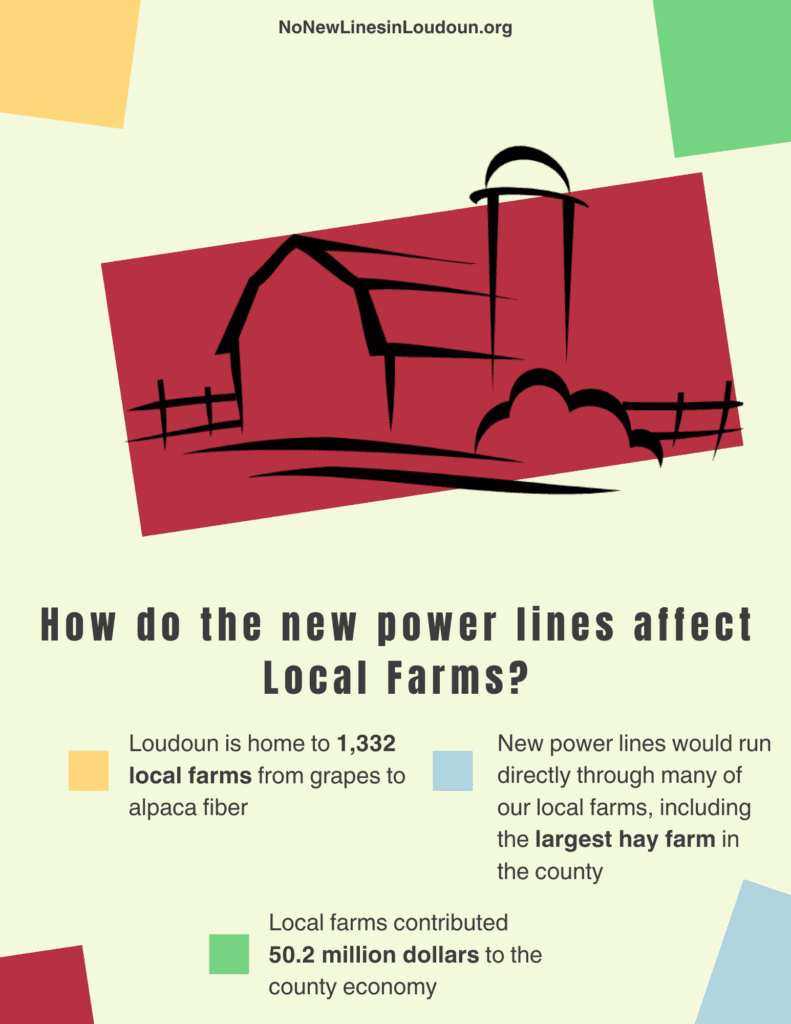
  • Loudoun County remains a thriving agricultural region, with 1,332 farms accounting for $50 million in sales in 2022 alone. Moreover, Loudoun’s thriving equine industry has an annual economic impact of $180 million.
  • The proposed lines also threaten Loudoun’s $4 billion tourism industry, including $400+ million in agritourism alone.  Surveys show that the County’s landscapes, farms, wineries, breweries, and historic sites are a major draw for visitors.
  • NextEra must account for its damage to these vital sectors of the economy. 

Historic and environmental sites, including landscapes, define the distinctive heritage of Loudoun County.  In no instance should power corridors transit through or near National Historic Landmarks, historic districts, and other properties under conservation or preservation easements.

  • Loudoun boasts six National Historic Landmarks, seven county historic districts, and 4,426 easements that safeguard important environmental and historic sites.
  • Conservation and historic preservation easements are legal deed restrictions that in Loudoun, are very site-specific and hence cannot be exchanged for uneased property.  Easement holders will vigorously defend these protections as any plan ignoring these protections will undermine the sanctity of easements state-wide.
  • A noteworthy example of local, state, and federal historic and environmental protections at risk is the Waterford National Historic Landmark.  Waterford’s 1,420 acres are a rare instance of a fully intact 19th century community with scores of protected historic properties, agricultural land, natural habitats, and open spaces.
  • New transmission corridors in rural Loudoun would directly threaten a number of eased sites, as well as prime farmland, waterways, habitats, open spaces, and historic properties.

For NextEra, this is a commercial decision, but for Loudoun it’s existential.  We call for no new power corridors in rural Loudoun!

See who all have signed the Declaration here! This Declaration is a living document, and signers are consistently updated. Please consider signing on to support our stance!


Who do I contact in the Loudoun Transmission Line Alliance?

Our communications and outreach team can be reached out transmissionlines@waterfordfoundation.org. You can also find them during Foundation office hours from 10am-2pm Tuesday-Friday at 40222 Fairfax Street, Waterford VA 20197, around the county during travelling office hours, or available for appointments.

Abigail Zurfluh- Communications Chair

Abigail is also the Historic Preservation Director for the Waterford Foundation. She has been involved with the Alliance since the beginning meetings at the Waterford Old School. She has a degree in historic preservation and geography from the University of Mary Washington. In her free time, she loves to explore all of what Loudoun County has to offer, playing games (especially board games, card games, or trivia) with friends and family, and line dancing. Her favorite part about Rural Loudoun is the balance of the built and natural environments achieved through historic preservation and environmental conservation.

Alexander Newton- Field Operations Director

Alex joined the communication and outreach team as the Field Operations Director in June 2024. After graduating with a Master’s Degree in History Education from Virginia Tech, he moved back to Loudoun and started teaching at John Champe High School. In his free time, Alex enjoys visiting local businesses, painting miniatures, reading historical nonfiction, and wildlife photography. His favorite part of Rural Loudoun is the local community he is a part of. He loves participating in local events like Oktoberfest in Lovettsville and the Waterford Fair.

Filed Under: Uncategorized

Poison Hemlock Treatments

January 2, 2024 by Abigail Zurfluh

Project Completion Date: Ongoing

The presence of poison hemlock has been confirmed on approximately 11-acres of the Phillips Farm. This invasive plant is quite toxic, and while it has been present in the US since the 1800s, distribution of the plant has increased significantly in the past decade. Learn more about poison hemlock on the fact sheet at the bottom of this article.

The Phillips Farm Subcommittee (now Open Spaces Subcommittee) mapped the presence of plants that were visible in spring 2022 and locations confirmed by the Loudoun County Extension Service. These are the same locations for treatment in 2023 and 2024.

To manage this difficult invasive plant, the Waterford Foundation has retained NatureWorks (previously Sustainable Solutions) to initiate applications of an herbicide, approved by EPA for application in and around aquatic environments to the affected areas. Treatments in 2022 and 2023 made a significant impact in the distribution of the hemlock on the Farm; however, further treatment will be needed for the next several years to fully control the invasive poison hemlock.

While the Foundation has rarely used herbicides on the Farm, the approved management plan for the Phillips Farm permits the use of herbicides when absolutely necessary. Out of concern for public health and for the potential for poison hemlock to continue to spread, the Foundation elected to utilize herbicide as part of an integrated approach to invasives management that will also include mowing and cutting of flower heads before they seed and promoting the establishment of native plant species.

Filed Under: Uncategorized

Call to Action: Oppose Transmission Lines Through the Waterford National Historic Landmark

December 1, 2023 by Stephanie Thompson

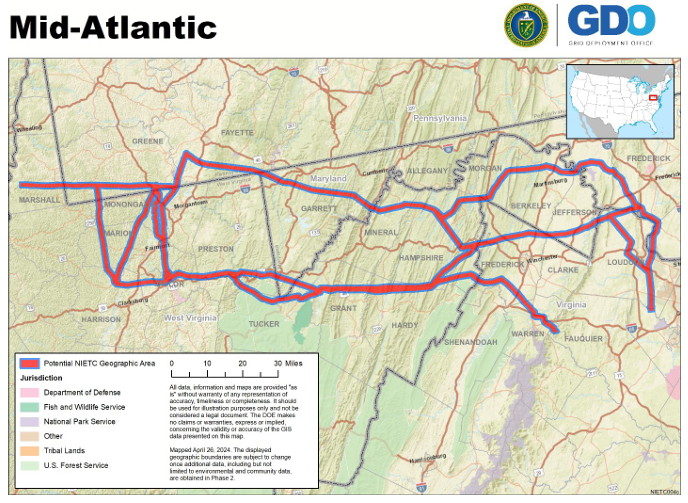
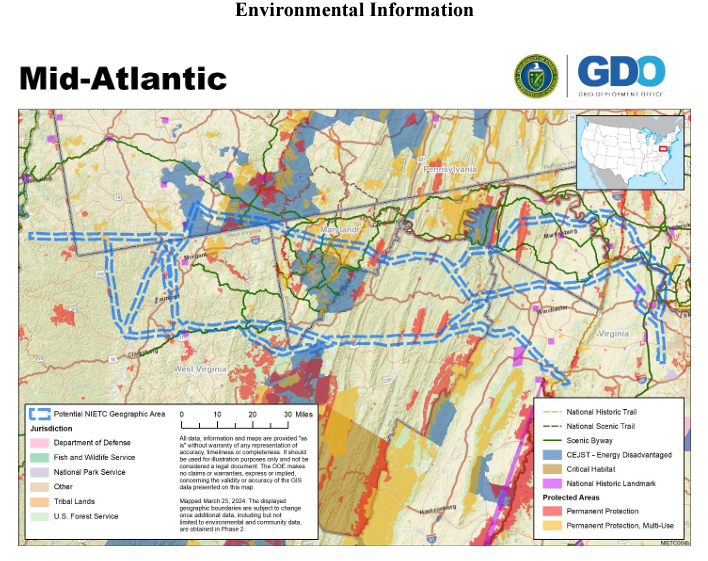
PJM, a regional transmission organization, has accepted a proposal for new power transmission lines that would go through Western Loudoun and directly through the Waterford National Historic Landmark to support the needs of the data center industry. The proposed 500KV lines go directly through conserved land and land under easement with the Virginia Outdoors Foundation.  These transmission lines pose a major threat to the integrity of the Landmark and the region we sit in. Our Landmark status is intrinsically linked with the unspoiled viewshed surrounding our historic village. Not only that, but every resident and business who calls Waterford home would be impacted by the construction of these power transmission lines. The Waterford Foundation stands opposed to such violation of our conservation values, and will work to oppose any impact to the integrity of Waterford’s Landmark status. 

Why is this important? Western Loudoun has remained relatively untouched by the massive growth of the data center industry in the past years. Instead, it remains a haven for farmland, open spaces, conservation, and preservation. Amongst the picturesque hills sit wonderful and profitable businesses and organizations that rely on the surrounding. It is also an area where history and past of Loudoun County can be found woven into the hustle and bustle of 21st century life. The best example of this can be found in the National Historic Landmark of Waterford. Building transmission lines through this region would impact the daily lives of residents in an unprecedented manner; damage the livelihoods of farms, businesses, and organizations that are in its path; and damage the integrity of the Waterford National Historic Landmark. This is similar to a proposal to put transmission lines through Gettysburg National Battlefield or Mount Vernon. 

We need your support to fight this threat. One thing that the Foundation has learned is the power of the Loudoun County community banding together for a common cause. Please see below for ways you can help us oppose this threat.

Stay in touch:

The Waterford Foundation is maintaining an email list for those who would like to stay informed about this issue. If you would like to be included, please email Historic Preservation Director Abigail Zurfluh here, or fill out the form at the bottom of this page.

How you can help: 

Share your concerns with decision makers:

National Interest Electric Transmission Corridor (NIETC):

  • Changes in the designation of the National Interest Electric Transmission Corridor could pose a challenge for opposing proposed transmission lines. If it is determined by the Department of Energy that Loudoun County is a NIETC, the Federal Energy Regulatory Commission could issue permits for transmission line construction even if state authorities deny applications.
  • The Department of Energy is currently accepting public input regarding NIETC designations for Phase One. In Phase Two, a preliminary list of areas being considered will be released and public comments on that list will open. In Phase Three, the DOE will develop geographic boundaries, more public comments, and go over Needs Study. Finally, in Phase Four, the DOE will release any necessary environmental documentations before final NIETC designations.
  • The Department of Energy is currently accepting public comments for phase one until February 2nd. Public comments can be emailed to NIETC@hq.doe.gov

Virginia State Corporation Commission:

  • In Virginia, the State Corporation Commission will be making the decision on the actual chosen route when application is submitted by NextEra. Watch this space for instructions on how to voice your opposition to this project to the Virginia State Corporation Commission.

Elected Officials:

  • Watch this space for ways to share information with elected representatives about transmission lines.
  • For more information about bills in the General Assembly in 2024 surrounding this issue, check out this flyer made by our collogues at the Piedmont Environmental Council

Spread the word about this issue:

  • Share social media posts from the Waterford Foundation, Piedmont Environmental County, Loudoun Wildlife Conservancy and other organizations to strengthen local opposition.
  • Tell friends, family and neighbors about this issue to broaden our base of support

Show your support by signing our online petition:

  • Sign this online petition to show your opposition to the proposed transmission lines.
  • Share the petition so that we are able to show large opposition in this region!

Donate to support the Waterford Foundation’s work to preserve the Waterford National Historic Landmark and oppose threats like this.

Donate Now!

Important Upcoming Dates and Timelines: 

February 2nd- Due Date to Submit Public Comments on Stage One of National Interest Electric Transmission Corridor to the DOE. Public comments can be submitted via email to NIETC@hq.doe.gov

February 7th at 6:30pm- Loudoun Nonprofit Leadership Summit is taking place at the Old School in Waterford. If you are a leader/staff member of a preservation, conservation, or other related organization/stakeholder in this issue, please RSVP using this link.

May/June: Possible completion of NextEra routing study

Summer 2024: Be on the look out for community open houses hosted by NextEra about the routes.

Late 2024: Possible aim for a proposal to SCC

Resources to Learn More:

Background Information: Our colleagues at Piedmont Environmental Council have been monitoring PJM’s transmission line proposals for some time. Visit their page to view a map of the proposed path and learn more about the issue. Linked here is a video made by our collogues at the Piedmont Environmental Council providing important background to this issue. Running time is roughly eight minutes.

NextEra Information: Read more about the Mid-Atlantic Resiliency link from NextEra at their website here. Specific questions, comments, or concerns can be sent to the NextEra team using the email box on the webpage. Currently, NextEra is working on the routing study through a third party.

Loudoun County Government Role: Read more about the role of the Loudoun County government in this civic alert.

National Interest Electric Transmission Corridor: Read more about the designation process here.

In the News:

  • Western Loudoun farmers say proposed power lines could put them out of business, Loudoun Times Mirror, 1/31/2024
  • Newly appointed SCC judge will recuse herself from western Loudoun transmission line case, Loudoun Times Mirror, 1/24/2024
  • General Assembly Appoints NextEra Attorney to SCC Seat, Loudoun Now, 1/24/2024
  • Concern Grows Over Data Centers, Power Lines in Loudoun, Loudoun Now, 1/23/2024
  • Department of Energy Changes Could Pose More Challenges for Power Line Opposition, Loudoun Now, 1/16/2024
  • Data Center Campus Plan Hit with Community Power Concerns, Loudoun Now, 1/11/2024
  • FERC Commissioner urges reform of federal transmission planning and financial incentives, Blue Ridge Leader and Loudoun Today, 1/3/2024
  • Company to build transmission lines in Loudoun has history of legal problems, Blue Ridge Leader and Loudoun Today, 1/3/2024
  • SCC Poised to Make Decisions on Greenway Tolls, Western Loudoun Power Lines in 2024, Loudoun Now, 1/2/2024

Opposition Letters:

  • See Waterford Foundation President Susan Manch’s letter to PJM here.
  • Waterford Citizens’ Association letter citing alternative routes.
  • Read the opposition letter from the National Park Service here.
  • Opposition Letter from the Maryland Office of People’s Counsel.
  • Opposition Letter from the Virginia Outdoors Foundation.
  • Opposition Letter from the Loudoun HRDC

Other letters:

  • November 28, 2023 letter from the Organization of PJM States (OPSI) to the PJM Board.
  • December 8, 2023 letter from NextEra Energy to PJM regarding PJM staff recommendation of the acceptance of NextEra’s MidAtlantic Resiliency Link (MARL) project and citing plans to engage with local stakeholders beginning in January 2024.
  • December 18, 2023 response letter from PJM about the proposed transmission lines to interested stakeholders.

Other Resources:

  • Executive Summary of Key Points on the NextEra Transmission Line
  • Presentation slides from the 12/7/23 Waterford Citizens’ Association meeting.
  • Meeting summary from Hamilton and Waterford Meeting provided by Board President Susan Manch.
  • Comments provided by Tom Donahue for the Federal-State Task Force on Electrical Transmission.
  • Fact Sheet provided by Tom Donahue about the NextEra Power Line
  • Tips in Writing Letters Sheet linked here

Past Milestones

December 5th, 2023: PJM Transmission Expansion Advisory Committee (TEAC) meets to review proposals for the Regional Transmission Expansion Plan (RTEP). See public comments associated with this meeting here. Thank you to those who sent letters of opposition!

December 11th, 2023: PJM Board approves the slate of proposed projects, including the proposal from NextEra to construct a new greenfield transmission line through the Waterford National Landmark. See details in the PJM whitepaper, here.

December 13th, 2023: Loudoun County Board of Supervisors met to adopt a new zoning ordinance in Loudoun County that includes new approval processes for data centers in Loudoun County.

December 17th, 2023: People gathered together in the Old School to celebrate the 20th Anniversary of Conservation on Phillips Farm. It was a fun evening full of celebration and reminiscing. Thank you to everyone who was able to attend!

Past News Articles:

  • ‘To preserve the view, you have to own it’: Waterford Foundation Marks 20 Years Since Phillips Farm Purchase, Loudoun Times Mirror, 12/27/2023
  • After Zoning Ordinance Adoption the Work Continues, Loudoun Now, 12/21/2023
  • Waterford Commemorates 20 Years of Phillips Farm Conservation, Loudoun Now, 12/18/23
  • PJM advances proposal for transmission line in Western Loudoun, Loudoun Times Mirror, 12/13/23
  • PJM Ignores Stakeholders and Approves Transmission Lines to be Built, Blue Ridge Leader and Loudoun Today, 12/12/23
  • PJM Approves Proposal for 500 kV Power Lines Across Western Loudoun, Loudoun Now, 12/12/23
  • PJM Board of Managers Approves Critical Grid Upgrades, PJM Inside Lines, 12/11/2023
  • PJM recommends transmission line be built despite overwhelming public concern, Blue Ridge Leader and Loudoun Today, 12/7/2023
  • Power Line Objections Move to PJM, Loudoun Now, 12/5/2023

Filed Under: News, Preservation, Uncategorized

Holiday Recollections in Early 20th Century Waterford

December 1, 2023 by Stephanie Thompson

In the early 1900s, Christmas was an occasion when Waterford residents of different congregations came together to celebrate. According to recollections by late Waterford resident John Divine (1911-1996) in When Waterford and I Were Young:

“All three churches [The Presbyterian, Methodist, and Baptist, still standing on High Street in Waterford] shared in a Wednesday evening prayer meeting and all three had Sunday School picnics. The reward for going to Sunday School was two-fold: the picnic, when ice cream flowed abundantly, and the Christmas program, when we got an orange and a small box of chocolate drops.

The Christmas program also gave all of us amateur actors a chance to perform. Any similarity between our Three Wise Men and the real Magi was purely coincidental. Only the parents enjoyed that group of squirmy little boys singing Away In A Manger off key.” 

Many holiday recollections center around special foods and feasts among family and friends. Divine remembers the special foods that came to Waterford during the holidays in the early 1900s, sold out of the meat shop operated by E. L. James and later his son Minor out of the Old Insurance office on Second Street:

“At Thanksgiving and Christmas, the meat shop handled oysters. The only time I ever ate oysters was at those two dates: at $6.00 per gallon, they were a real delicacy. Orders were placed about ten days in advance and they were received a day or two before the holiday. The gallon cans, packed in ice, were shipped up on the railroad to Paeonian Springs. Later, when Minor James got a Model T truck, he would drive to the wharf in Washington, D.C. to get them.”


When Waterford and I Were Young is available for purchase online or in person at our offices in the Old School.

Filed Under: history, News, Uncategorized, Waterford History

Phillips Farm Online Guide

June 26, 2023 by Julie Goforth

  • CATOCTIN_CREEK
    1. South Fork of Catoctin Creek

    The power potential of the South Fork of Catoctin Creek helped draw skilled Pennsylvania Quakers in the mid 1700s to settle what is now Waterford. For 200 years the stream powered grain, saw and woolen mills, including the three story brick mill still standing. But the creek was also an obstacle to transportation and dangerous to ford during high water. The current bridge is just the latest of many. A covered wooden bridge spanned the creek from the 1830s until it was swept away in the 1889 storm that caused the Johnstown Flood disaster in Pennsylvania.

  • 2. Tannery Branch

    As you look upstream, Tannery Branch flows from springs a few hundred yards to the left, beyond Bond Street. From the late 18th to late 19th centuries it supplied water to a tannery at Main and Liggett Streets that processed hides into leather for cobblers, saddlers, and harness makers. Visible in the eroded banks here are gray seams of clay. Such deposits were dug, shaped and baked into the bricks that built much of Waterford. In the mid 20th century, clay drain pipe was installed under much of the nearby floodplain to make it suitable for farming. Water still pours from pipes visible along the eroded creek bank. The modern plastic pipe you see drains water from cellars along lower Main Street.

  • 3. Monarch Butterfly

    In the summer, common milkweed is in bloom here. Female monarch butterflies will lay their eggs only on milkweed, the sole host plant for monarch caterpillars. In the fall, the adult monarchs migrate 1,900 miles from here to central Mexico, a feat of stamina and navigation unmatched in the insect world. The plentiful milkweed on the Phillips Farm has earned it formal recognition as a “Monarch Way Station” by the Monarch Watch Organization.

  • 4. Various Habitats

    Phillips Farm offers a wide variety of habitats for wildlife — floodplain, stream, riparian buffer, deciduous woodland, hedgerows, and meadows. Here on the floodplain, you find such water-loving plant species as the graceful river birches, willows, and the majestic sycamores. You can find over 30 species of birds, including belted kingfishers, red-winged blackbirds and great blue herons.

  • 5. Riparian Buffers

    Riparian buffers are vegetated areas along waterways that help protect the water from pollution, stabilize stream banks, and provide streamside habitat for wildlife. Water loving shrubs (such as gray and silky dogwood, buttonbush and elderberry) have recently been planted here by the Loudoun Wildlife Conservancy to restore the riparian buffer.

  • 6. The Civil War

    During the Civil War, Phillips Farm suffered. Quaker Thomas Phillips was a pacifist, but troops from both sides helped themselves to his horses and crops. A sister lamented, “. . . it is really too bad for him to be treated so.” In October 1862, after the Battle of Antietam, a Federal infantry division paused at Waterford for several days on its way south. Soldiers camped here and on nearby farms. In July 1863, after Gettysburg, thousands of Union troops poured into Waterford; many set up camps along Catoctin Creek. Quakers offered “grass for thy horses, a fine spring for thy men and beasts, and ricks of cordwood for thy cooking.” But the following year Federal troops burned the Phillips barn.

  • 7. Eroding Stream Banks

    The eroding stream banks here offer nesting habitat for northern rough-winged swallows. Please be aware that the banks are very unstable. This accelerated erosion, as well as area land use practices, impact the quality of Catoctin Creek. Volunteers assess the quality of the creek and the surrounding environment three times a year and provide the data to appropriate state agencies. Bottom-dwelling aquatic insects such as mayfly, caddisfly and stonefly larvae are biological indicators of good water quality.

  • 8. Bluebird Trail

    Eastern bluebirds dwell on the Phillips Farm year round. Their numbers have declined nationwide due to habitat loss and competition from invasive bird species. If you follow the tree line along the millrace, from the mill to this point, you can see a “bluebird trail” of seven nesting boxes. The stovepipe below each box blocks climbing predators. Volunteers monitor the boxes from March through August. Ten baby bluebirds fledged from these boxes in 2008, the trail’s first year. With the help of man-made trails such as these, bluebird populations are recovering.

  • 9. Ball’s Run

    Ball’s Run, which here joins Catoctin Creek, once powered two Waterford mills a few hundred yards up-stream. But it presented a problem for owners of the mill at the foot of Main Street, who had dug a channel or millrace to carry water from a dam farther upstream on Catoctin Creek and needed to get that water past the Run, which flowed at a lower level. In the early years they probably built a wooden trough or aqueduct to carry the water over Ball’s Run. By the early 1900s, though, they had dammed the Run to bring it up to the level of the millrace. Then, by way of sluice gates, they could divert its water into the race to augment the flow to the mill in dry seasons. The over-flow was known as “The Chute,” and below the dam was a favorite swimming hole until time and repeated floods took their toll. Today only a stone buttress or two and scattered chunks of concrete mark the site of the dam. A short path to the left takes you to the spot.

  • 10. Family Farm

    For 150 years this property flourished as a diversified family farm. In 1850 it produced wheat, corn, oats, beef, milk, butter, wool, hay, horses, pork, poultry, eggs, fruit and honey, as well as potatoes and other garden crops. The small white barn you see on the hillside shelters the machinery used today for haying the surrounding fields.

  • 11. Invasive Plants

    Invasive plants such as multiflora rose, tree of heaven, autumn olive, Japanese barberry, and Canada thistle have been encroaching into the Phillips Farm environment for some time and are overtaking habitat of native flora. The tallest tree in front of you is a tree of heaven. The Management Plan for the Phillips Farm includes efforts to control the growth of invasive species, particularly in this area.

  • 12. Millrace

    Here a small wet weather stream intersects the old hand-dug millrace, visible from the path at the left. Hikers can follow the dry bed of the race back to Ball’s Run at the site of “The Chute.” This channel, some two-thirds of a mile long, in all, was dug by hand, probably around 1760. Etched in the cement cap of the low stone containment wall here, is the date October 28, 1928, the initials of the last miller, William S. Smoot, and those of his 17-year-old helper, John E. Divine, who later helped preserve much of Waterford’s history.

  • 13. Green Ash

    The large tree here is a green ash, an aging survivor of the 19th century. It and other ashes on the farm face an uncertain future with the recent arrival in the Washington area of the emerald ash borer, a destructive beetle native to Asia.

  • 14. White Oak

    Its long, low branches indicate that it did not grow in a forest. Local villagers have nicknamed it “Old John” in memory of John Hough (1720-1797), a Waterford Quaker who owned thousands of acres and a number of mills in Loudoun. White oaks were favored by early settlers for building, baskets, barrels, flooring, furni-ture, and many other uses. Native Americans made flour from the acorns.

  • 15. The Mill Dam

    Consider how laborers managed to collect, move, and place such large boulders with no more than human and animal muscle. The dam once stood a few feet higher—enough to raise the level of the impoundment more than 12 feet above the outflow from the wheel at the mill. In 1908 at the near end of the dam, miller William M. Fling signed his name in wet concrete he used to cap and reinforce the dam.A bit beyond the dam, in 1814, African American Benjamin Kins and wife Letitia bought two acres spanning the creek and built a house. They were among the first black families in the area to own their own land. Benjamin had been born a slave in Calvert County, Maryland, about 1770, but owner John Talbott freed him when the Quakers abol-ished the use of slaves in 1776. Talbott Farm remains today just southeast of the village.

Filed Under: Uncategorized

  • « Go to Previous Page
  • Page 1
  • Page 2
  • Page 3
  • Go to Next Page »

Footer

Office Manager oldschool@waterfordfoundation.org
Phone: 540-882-3018 x 2

Privacy Policy


Join Us

Copyright © 2025 · Waterford Foundation · Log in