• Skip to main content
  • Skip to footer
  • Donate
  • Become a Member
  • Volunteer With Us!
  • Cart

Waterford Foundation

  • Education
    • K-12 Education Programs
    • The Waterford Fair
    • Waterford Craft School
    • Waterford HIstory
    • Remote Learning
    • The Quakers
    • African Americans in Waterford
  • Preservation
    • Historic Buildings
    • Mill Stabilization Project (2009-2023)
    • John Wesley Community Church Restoration
    • Dashboard Map of Western Loudoun Development, 1950-2020
    • Phillips Farm
  • Shop
    • Books
    • Donate
    • Membership
    • Lantern Light Fund
  • Events
  • Weddings & Rentals
  • About
    • Contact Us
    • Meet the Staff
    • Meet the Board
    • Visit Waterford
    • Support
    • Join Us
  • News
  • Privacy Policy

history

Waterford Dog Days Diversions

August 5, 2021 by Waterford Foundation

by John M. Souders, July 2021

As we swelter through another hot summer, it’s hard to believe that a century or so ago Waterford successfully marketed itself as an idyllic refuge from the simmering cities. In the latter third of the 1800s, after the railroad pushed west into the Loudoun Valley, farms and villages competed eagerly for cash-paying customers fleeing the urban heat.
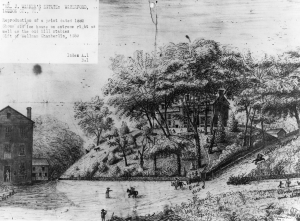
sketch of a house on a hill above the old Mill
Mill End, from 1882 sketch

Jake Walker, advertising his comfortable home [Mill End—40090 First Street] overlooking Waterford’s mill, promised guests in 1895 “an Ideal Summer Home—an abundance of fruit, flowers, ice and shade; high and dry; no mosquitoes; two hours’ ride from Washington.” The previous year he had attracted “quite a number of Baltimoreans” for the season.

In 1874, from the other end of town [Huntley Farm—15578 High Street], fellow Quaker Charles Hollingsworth touted a “high situation and view of the mountains fine.” In the wake of the Civil War, money remained scarce, even in productive Loudoun, and summer boarders could help keep homeowners solvent. Still there were sometimes limits to their hospitality. For the Hollingsworths, “only a few persons without children can be accommodated.” In their defense, Huntley in those days was much less spacious than it became after Robert Walker’s modifications in the 1890s. But maybe they just didn’t need the extra hassle. Sally Bond, widow of Waterford’s longtime tanner, was blunter in 1886: “Small children refused.” For the older set she offered “plenty of space, ice, fruit [and] good table” at her place on Bond Street [Janney-Phillips House—40132]. The last named inducement would have been especially important at a time when Waterford had about as many dining options as it does today.

At the northeast edge of town [Moxley Hall—40266 Water Street], Lewis Shuey, who had married Sally Bond’s niece, added a couple of extra attractions to the usual list: “shutters, mountain air [and] daily mail,” the indispensable equivalent of today’s wifi. In 1874 Sally’s sister-in-law Rachel (Mrs. Samuel) Means [40128 Bond Street] advertised her place’s convenient access to Washington: “two trains daily.” (A few years earlier, Albert Brown had inaugurated a stage line between Waterford and the train station at Clarke’s Gap. He promised to “meet the 11 o’clock A.M. train daily. Passengers conveyed comfortably and safely. Fare either way fifty cents.”) Rachel was in dire straits at the time. Husband Sam had formed and led the pro-Union Loudoun Rangers in the war, and his former rebel antagonists were intent on driving him to financial ruin. When they succeeded, the Meanses moved to Washington where Rachel ran a boardinghouse to support the family.

If fine food, “good water” and mountain air did not restore soul, as well as body, there were summer camp meetings. These could be major affairs. One of the first was held in August 1871, exactly 150 years ago.

The Waterford Methodist Episcopal Camp Meeting will commence on Thursday, the 10th instant. Conveyances will be running daily to and from the depot. The railroad will pass all persons coming and going from the meeting at half fare.—The grounds are well shaded, and very conveniently located. The best accommodations will be provided for all who may come. Boarding and lodging of the best kind will be furnished for the entire meeting for $7, and boarding, exclusive of lodging, for $5. We are expecting a real, old-fashioned Methodist Camp Meeting, and most cordially invite all well-disposed persons to come.

Charles King, Pastor, Waterford, Loudoun co.

Three years later, unfortunately, attendees included persons not so much “well-disposed” as well-inebriated. A “Mr. Tavenner attacked a reverend, and the services were interrupted by a man under the influence of alcohol. The drunken man was quieted by the ‘brawny arm of a big father’ and then ‘subjected to painful effects produced by phrenological examination of the head by a fence rail.’” Quite a vivid image! and “but for the early stopping of the affray there would have been such a fight, as that there would not have been enough men on the ground to stop.”

“Jim Crow” was also in attendance. “At this same meeting a group of African-American women attempted to take advantage of their promised civil rights by seating themselves amongst a group of white women, but they were quickly removed from the meeting by a local officer . . . otherwise it is to be understood that good order was observed throughout and the meeting attended with many gratifying results.”

Not everyone emerged gratified from such gatherings, or even unscathed. Waterford historian John Divine recalled that “someone stuck a knife into” his grandfather Joe Divine—a staunch Methodist—at a camp meeting, though the injury was not serious.

The Baptists appear to have had better luck with their meetings. At a gathering in August 1881 held in Charlie Hollingsworth’s woods, the press reported “an immense crowd” in attendance each day, with “great numbers of vehicles” passing through Hamilton en route to the meeting.

For those seeking a tamer diversion from the summer heat, there were traveling entertainments like the medicine show that in June 1903 set up a tent for two weeks on the “colored school house lot” [Second Street School—15611 Second Street]. The operators had a sure-fire tactic to separate attendees from their hard-earned cash. “They offered a gold watch to the lady who would receive the most votes as being the most popular lady in town. The number of votes being regulated by the amount of medicine, &c. purchased, and when the final count was made on Monday night it was found that Miss Louise Fling, the accomplished daughter of our miller, Mr. W.H. Fling, had received a total of over 87,000 votes, and she was accordingly awarded the watch for being the most popular young lady in town. We congratulate Miss Louise (she was going on 14 at the time), and think she well deserves the compliment.” Political correctness had not been invented yet.


Filed Under: history, News Tagged With: local history, summer, visit Waterford

The Sins of Christopher Fiddes

January 30, 2018 by Waterford Foundation

Sometimes a query from a Waterford descendant will, as below, reopen a neglected chapter of the village’s rich history…

Of the hundreds of thousands who emigrated to North America from the British Isles before 1800, the great majority were not free. Most had bound themselves to a number of years’ servitude in exchange for their trans-Atlantic passage or had entered into contracts as apprentices, hoping to learn a trade. Many of the remainder were felons who accepted a period of bondage in the New World rather than face notoriously harsh punishment in the United Kingdom, even for minor transgressions. One of the latter unfortunates summed up
his plight:

Forc’d from your country for to go
Among the negroes to work at the hoe,
In different countries void of relief
Sold for a slave because you prov’d a thief . . .

Waterford’s settlers drew from such indentured arrivals to supplement their own labor. And not infrequently, problems arose. At some point in the 1760s, Quaker Francis Hague, brother-in-law of the town’s founder, Amos Janney, took on an Irish offender, Christopher Fiddes, probably “to work at the hoe” on his farm at the north edge of the village. Unfortunately for Hague, Mr. Fiddes’s contrarian inclinations had accompanied him to Virginia. In August 1769 the new hand was “detected” gambling in a local tavern. At the time he was described as a “servant” of Mahlon Janney, Amos’s son and Hague’s nephew. Perhaps Francis, who was nearing 70, thought that the younger Mahlon might better be able to deal with the refractory Irishman. After all Mahlon had hauled into court that same year would-be runaway Duncan McDonald, and had additional time added to his term of service. But Christopher proved a hard case. Within weeks Francis was obliged to post a notice in the Virginia Gazette:

Run away from the subscriber, living in Loudoun County, near the Quaker meeting house, about 12 miles below the Blue Ridge, an Irish convict servant man named Christopher Fiddes, about 5 feet 9 or 10 inches high, and pretty well set. He had on when he went away a light coloured linsey jacket, a cotton ditto, a felt hat, two homespun shirts patched on the back with new linen, two pair of trowsers home made, a good pair of strong shoes, and a large flag handkerchief. He is very talkative, and of a very proud bold behavior, very near sighted, is a lover of strong drink, and very subject to take too much when opportunity offers, and is then very ill behaved; he walks briskly but heavy, taking long steps with a proud air, and is very subject to set his hands on his sides when speaking to any person; has a down look, and is marked with the small pox, tho’ not deep, but plainly seen. Any person taking up and securing the said servant, so that he may be had again, shall have a reward of THREE POUNDS, with all reasonable charges, paid by FRANCIS HAGUE.

No subsequent mention of Fiddes has been found, suggesting that he made good his escape. Despite the setback, both Hague and Janney continued to employ indentured laborers, as did many others in Loudoun at the time, as the system, when it worked, benefited all. In 1773 for example, Hague took on a new apprentice, an 18-year-old lad “bound to be a farmer.” But in this instance, at least, he was taking no chances. The new boy was a relative, Amos Hague.


Filed Under: history

Steer-Divine House

January 23, 2018 by Waterford Foundation

African-American James Lewis (born circa 1800) probably erected this house around 1850. In 1865 Quakers Frank and Mary “Mollie” Dutton Steer bought it, then sold it to Joseph Divine (1841-1933) in 1875. Divine ran a wheelwright shop across the street for many years; he apprenticed with Reuben Schooley before joining the Union Army and did not retire until he was 83. Early in the Civil War he interrupted his long career to join the Loudoun Rangers, a locally raised federal cavalry unit. The home has been substantially enlarged in recent years.

Excerpt from Walk With Us a walking tour of Waterford


Filed Under: archives, Black History, history, quaker

Noah Haynes Swayne, Lincoln’s First Supreme Court Appointee

January 16, 2018 by Waterford Foundation

Did you know…

President Abraham Lincoln’s first Supreme Court appointee attended school in Waterford?

Noah Haynes Swayne (1804-1884) a Frederick County, Virginia, Quaker, was sent to Jacob Mendenhall’s Academy in Waterford in 1817 because of the school reputation for excellence.

Swayne left Virginia in 1824 for the free state of Ohio because of his deep opposition to slavery. Supreme Court records indicate Swayne’s appointment “satisfied Lincoln’s criteria for appointment: commitment to the Union, slavery opponent, geographically correct.”

Courtesy of the Waterford Foundation Archives and Local history collection.

Learn more about Justice Swayne at Wikipedia:   Noah_Haynes_Swayne


Filed Under: archives, Black History, education, history, quaker

Anniversary of the Johnstown Flood

May 30, 2017 by Waterford Foundation

Tomorrow marks the 128th anniversary of the Johnstown Flood. Although Johnstown is 154 miles north of Waterford, the same storm impacted Waterford in washing out the bridge over the Catoctin Creek at the north end of town.

An excerpt from When Waterford and I were Young by John Divine, et al,, describes the bridge as “65 feet long, framed with massive 12 x 14 inch white pine runners and girders…roofed with wood shingles and sheathed the sides with oak weatherboard.”

The Waterford bridge went down during the night of May 30, 1889 “in roiling waters” while the Johnstown dam break occurred around 3pm in the afternoon the next day. Looking at the attached map, the bridge is at the top right on what was called Bridge street at the time.

#johnstownflood  #waterfordva


Filed Under: history

  • « Go to Previous Page
  • Page 1
  • Interim pages omitted …
  • Page 3
  • Page 4
  • Page 5

Footer

Office Manager oldschool@waterfordfoundation.org
Phone: 540-882-3018 x 2

Privacy Policy


Join Us

Copyright © 2025 · Waterford Foundation · Log in