• Skip to main content
  • Skip to footer
  • Donate
  • Become a Member
  • Volunteer With Us!
  • Cart

Waterford Foundation

  • Education
    • K-12 Education Programs
    • The Waterford Fair
    • Waterford Craft School
    • Waterford HIstory
    • Remote Learning
    • The Quakers
    • African Americans in Waterford
  • Preservation
    • Historic Buildings
    • Mill Stabilization Project (2009-2023)
    • John Wesley Community Church Restoration
    • Dashboard Map of Western Loudoun Development, 1950-2020
    • Phillips Farm
    • Notes from the Preservation Desk
  • Shop
    • Books
    • Donate
    • Membership
    • Lantern Light Fund
  • Events
  • Weddings & Rentals
  • About
    • Contact Us
    • Meet the Staff
    • Meet the Board
    • Visit Waterford
    • Support
    • Join Us
  • News
  • Privacy Policy

Archives for June 23, 2026

How the Civil War Divided Waterford

June 23, 2026 by Abigail Zurfluh

Written by Debbie Robison; Edited by Larisa Epatko

—

Although Quakers were the original settlers of Waterford, Virginia, and maintained a significant presence, by the start of the Civil War in 1861, the town was home to a diverse population of tradesmen, farmers and laborers. While the Society of Friends held firm to pacifism and opposition to slavery, many of their neighbors were deeply integrated into Virginia’s traditional social order and viewed secession as a necessary defense of their state.

In May 1861, the divide within Waterford became official during a statewide referendum needed to ratify Virginia’s Ordinance of Secession, marking the state’s decision to separate from the United States. The Waterford precinct saw a sharp split in the referendum with local Quakers voting against it. Although Unionist sentiment was strong, a vocal and active minority of residents supported the Southern cause, creating an environment of local tension that persisted throughout the war.

The emergence of the Loudoun Rangers
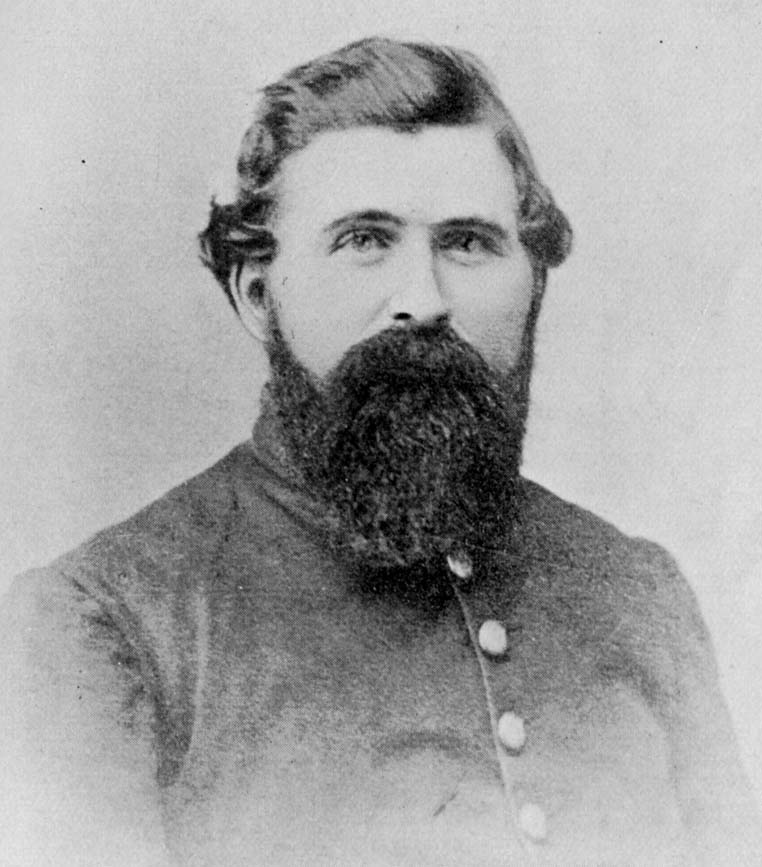
Samuel C. Means (WF Archives)

This internal division was most vividly illustrated by the military units that drew from the local population. The town became a primary recruiting ground for the Loudoun Rangers, which was the only organized Union unit from the state of Virginia. Led by local miller Samuel C. Means, the Rangers calvary unit was composed of men who felt their primary loyalty belonged to the federal government.

At the same time, other men from the Waterford area, who were often the neighbors or former associates of the Rangers, joined Confederate units like the 35th Battalion of Virginia Cavalry,
famously known as “White’s Comanches.” Led by Elijah V. White, who lived just a few miles away, these soldiers were equally determined to defend their vision of Virginia.

Battle at the Baptist Church

The skirmish at the Waterford Baptist Church on August 27, 1862, was a direct result of these clashing loyalties. There, a group of Loudoun Rangers suffered a surprise attack at its encampment by White’s Comanches.

The Rangers used the church’s brick walls for cover, firing from the windows while the Confederates charged through the streets. The engagement ended in a Confederate victory. The physical and psychic toll on the town was immense. The sight of soldiers bleeding in the shadows of the church and the mill served as a visceral reminder of the deep fracture within the county.

The tactical importance of Walker’s Hill

To the southwest of the town center lies Walker’s Hill, a high point of land that became a critical tactical position for both armies during the war. Because of its elevation, the hill provided a commanding view of the town and the surrounding roads, making it a natural location for pickets and scouts.

In August 1863, almost exactly a year after the fight at the Baptist Church, the hill became the site of another fierce encounter. A detachment of the Loudoun Rangers, operating under Captain Daniel M. Keyes, was positioned on the hill when they were attacked by their Confederate counterparts, White’s Comanches.

The fighting was desperate and underscored the “no-quarter” nature of this localized war. During the melee, the Confederates suffered significant local losses, including the deaths of Captain Richard B. Grubb and his cousin John C. Grubb, both of whom were well-known members of the surrounding community.

Life in a contested town

Because of its location and its divided heart, Waterford spent much of the war under “contested” status, where control shifted frequently. A Union patrol might be welcomed in the morning, only to have a Confederate detachment arrive by evening to arrest “disloyal” citizens or seize supplies.

For the residents, this meant a life of constant vigilance. Families with Confederate sympathies had to hide their support when Union troops occupied the town, and Unionists lived in fear of being sent to Castle Thunder, the notorious Confederate prison in Richmond, when Southern forces held the area.

The war’s end and the long recovery

The end of the war in 1865 brought a cessation of combat, but the internal divisions of Waterford took time to heal. The community had to find a way to function again with former Rangers and former Confederates living side by side.

Today, Waterford is preserved as a National Historic Landmark. Its architecture remains as a silent witness to a time when the village was a microcosm of a nation at war with itself, a place where competing definitions of loyalty lived door to door.


Debbie Robison writes about Northern Virginia history. You can read more of her articles on her website.

Want to learn more about Waterford history and the Civil War? Check out further articles below!
Filed Under: history, Waterford History Tagged With: history

How Area Quakers Approached the Revolutionary War

June 23, 2026 by Abigail Zurfluh

Written by Debbie Robison; Edited by Larisa Epatko

—

The Revolutionary War period was a time of immense pressure for the Northern Virginia area’s Quakers, who found their properties seized and their loyalties questioned by both their government and their church. It was only in the final year of the war, 1783, that Joseph Janney purchased the 12-acre parcel that would eventually serve as the site for the formal founding of the village of Waterford.

The agricultural shift and the slave economy

In the years leading up to the Revolutionary War, the region surrounding what would become Waterford underwent a major economic transformation. Farmers transitioned from tobacco to wheat cultivation, making the area a key supplier for the transatlantic flour trade.

Quakers played a significant role in this shift; for example, Mahlon Janney constructed a prominent stone and wood grist mill around 1762 as a commercial investment.

While Quakers typically did not own enslaved people, their involvement in the flour trade indirectly supported the institution of slavery. The flour produced in Loudoun County was frequently exported to the British West Indies to sustain the labor force on sugar plantations.

This economic connection caused a moral conflict within the Society of Friends, as leaders like John Woolman and John Wesley questioned the ethics of profiting from goods that supported the miseries of enslaved people.

Neutrality and the peace testimony

As tensions between the colonies and Great Britain escalated, the Quakers’ commitment to their “peace testimony” placed them in a precarious position. The newly formed Commonwealth of Virginia required male residents to affirm their allegiance and participate in the military.

Because Quakers refused to swear oaths or bear arms, they were often viewed with suspicion or labeled as “disaffected” by American leaders. General George Washington himself expressed frustration in his correspondence, noting that Quakers were doing everything in their power to counteract militia laws.

Military fines and property seizure

When voluntary enlistment proved insufficient, Virginia implemented a draft. Quakers who refused to serve or pay for a substitute faced heavy financial penalties. In April 1781, numerous Quakers, including Mahlon Janney, were fined 100 pounds each for failing to perform military service.

Because Quakers refused to pay these wartime taxes and fines voluntarily, the local sheriff was authorized to seize their property for sale. This process, known as “distraint,” resulted in the continuous loss of personal possessions.

Records from the Philadelphia Meeting of Suffering show that Loudoun Quakers had a wide range of goods confiscated, including cash, horses, cattle, clothing, household pewter, bedding and even a Bible.

Impressment of provisions

Loudoun County became a vital source of supplies for the Continental Army, particularly during the Yorktown campaign of 1781. Military officials “impressed” (forcibly requisitioned) resources from the local population.

While many items were taken, the most heavily impressed resource from Loudoun County was live beef. Local drovers would drive herds of cattle south for several days to reach military camps, such as the quartermaster’s camp at Fredericksburg.

Despite their pacifism, Quakers like Isaac Walker, Joseph Janney and Mahlon Janney saw their provisions seized to support the war effort.

Loyalty oaths and faith expulsion

The conflict also created internal religious crises. The Society of Friends strictly forbade any action that could be interpreted as support for the war, including the affirmation of allegiance required by Virginia law.

When individual Quakers chose to affirm their loyalty to the Commonwealth — placing patriotism over their faith’s principles — they were often admonished by their local Monthly Meetings. If they refused to renounce their affirmation, they faced expulsion from the Quaker community.

High-profile local figures, such as Israel Thompson and John Hough Jr., were among those who eventually wrote letters condemning their own affirmations of allegiance to maintain their standing within the Society.


Debbie Robison writes about Northern Virginia history. You can read more of her articles on her website.

Want to learn more about Waterford history? Check out some more articles below!

Filed Under: history, Waterford History Tagged With: history

Quakers Arrive, an Agricultural Community Thrives

June 23, 2026 by Abigail Zurfluh

Written by Debbie Robison; Edited by Larisa Epatko

—

The region between the Catoctin and Blue Ridge Mountains began to see European American settlement during the Great Awakening, a series of religious revivals in the 1730s and 1740s. While land generally was granted to wealthy speculators, it also attracted members of the Society of Friends, or Quakers, who sought a community where they could worship freely. Although Indigenous people had already moved out of the immediate area by this time, settlers found traces of their presence, including burial mounds, forts and established trail blazes on trees that marked crossings of the Potomac River.

The role of John Mead and Amos Janney

The specific land where Waterford now sits was originally part of a 703-acre tract identified by Patrick Lynch as a desirable land holding. Lynch assigned the land to John Mead, a Quaker carpenter from Maryland, and his father-in-law, Richard Abrill. Although title fees briefly transferred the land to Catesby Cocke in 1731, Mead purchased it back in 1733. As a skilled carpenter, Mead used a variety of specialized tools to carve a homestead out of the wilderness, possibly on this tract, farming small plots of wheat, rye and barley.

In roughly 1733, Amos Janney, a Quaker from Pennsylvania, relocated to a 253-acre portion of Mead’s tract. Janney’s arrival is verified by Quaker Monthly Meeting records from 1733 and 1734. Janney became a pivotal figure in the region’s development, serving as a surveyor for Lord Fairfax’s land agent. This position allowed him to identify other vacant land, and he eventually acquired more than 5,000 acres, which he sold or leased to other Quaker families, effectively establishing a cohesive religious community.

Founding of the Quaker Society

Religion was a cornerstone of early settlement life. While the Anglican Church of England was the official state-supported church, the colonial government was largely tolerant of Quakers because they provided necessary labor and were a buffer to the frontier.

In 1744, local Quakers received permission to establish the Fairfax Preparatory Meeting. Before a formal meetinghouse was constructed, Amos Janney hosted these religious gatherings in his own home. By 1749, Quaker households accounted for approximately 11% of the taxable men in the local Cameron Parish.

Land division and village origins

John Mead continued to divide his original 703-acre grant. In 1742, he sold 147 acres to David Griffith, and in 1743, he sold the remaining 303 acres to Francis Hague. Hague and Amos Janney were brothers-in-law, having married sisters back in Pennsylvania. It was on this specific tract purchased by Francis Hague that the village of Waterford would eventually be founded.

Although the year 1733 is often cited in relation to Waterford, it marks the arrival of the first settlers in the immediate area rather than the founding of the town itself. The village of Waterford was not formally established until 1784, more than five decades after the initial Quaker arrival.

Colonial economy and agriculture

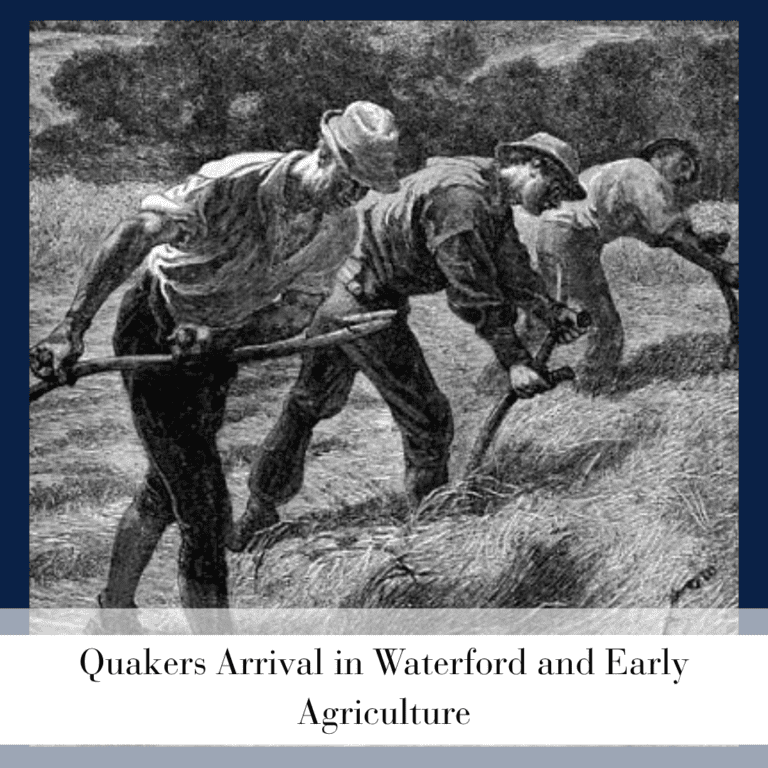
The early Quaker settlers were risk-takers who arrived with few possessions, often relying on wagons and small carts to transport their families and belongings from Pennsylvania. Early farming focused heavily on tobacco, which was a labor-intensive crop that required small, hand-worked fields. To manage this labor, some Quaker farmers utilized indentured servants.

Over time, the economy shifted due to British mercantilist policies and the demand for exports. By the 1750s, the focus began to move from tobacco to wheat cultivation. This transition led to the proliferation of grist mills in the area, marking a new economic era that would eventually support the growth of the post-Revolutionary War village.


Debbie Robison writes about Northern Virginia history. You can read more of her articles on her website.

Want to learn more about Waterford history? Check out some more articles below!

Filed Under: history, Waterford History Tagged With: history

The Founding of Waterford

June 23, 2026 by Abigail Zurfluh

Written by Debbie Robison; Edited by Larisa Epatko

—

The village of Waterford was founded in 1784 by Joseph Janney, a Quaker businessman who had already established himself with a retail store and tannery in nearby Leesburg, Virginia. Following the Revolutionary War, Janney looked to capitalize on the economic opportunities of the new nation. In 1781, he purchased a 12-acre parcel in Loudoun County, strategically located at a hub of existing roads and adjacent to Mahlon Janney’s operational grist mill and sawmill.

Janney’s plan was to create a commercial and industrial hub to serve the surrounding farming community. The location was ideal because the existing road network provided convenient access for customers, and the nearby sawmill offered the necessary materials for new residents to build their homes and workshops.

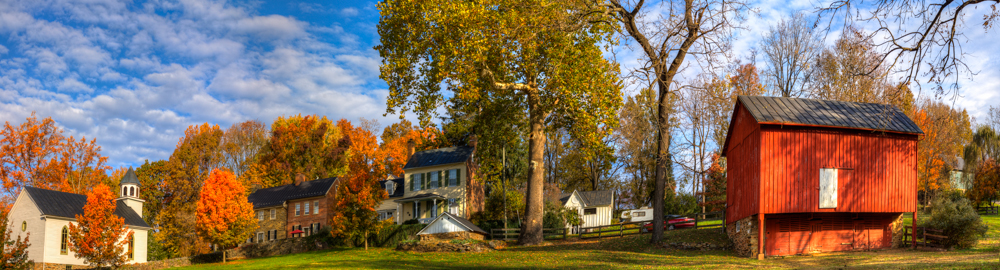
Panoramic Image of Bond Street from the Bond Street Tanyard. This area is across from the Waterford Mill and part of the oldest area of Waterford where Joseph Janney founded the Village.
The Moore Family and the naming of Waterford

The development of Waterford began in earnest in 1784 when Janney sold the first village lot, which included a stone house and stable, to Thomas Moore Jr. The Moore family became the cornerstone of the early community. Thomas Moore Jr. opened a general store to meet the pent-up demand for British goods, including coffee, rum, fine fabrics and tea.

Thomas was soon joined by his brothers, James and Asa. James Moore leased a tannery established by Janney to process raw hides into leather, while Asa Moore established a saddlery. Their sister, Ann, and her husband, Evan Taylor, a carpenter, also settled in the village, contributing their skills to its physical growth. This strong family presence eventually led to the village being named “Waterford” in honor of their ancestral home in Waterford, Ireland.

Industrial diversity and the apprenticeship system

Waterford quickly evolved into a self-sufficient cluster of related trades. To staff these
businesses, the Moores and other lot holders utilized an apprenticeship system managed by the county court. This system provided vocational training to “pauper apprentices,” who were young individuals from impoverished backgrounds, to learn essential skills such as tanning, blacksmithing and cabinet making.

As the village grew, other craftsmen established critical services:

  • Joseph Pierpoint: A blacksmith who purchased a lot in 1785 to repair tools and maintain the iron machinery required by the local grist mills.
  • William Paxson: A wheelwright and industrial screen-maker who, by 1789, produced specialized equipment like “rolling screens”, which were used for cleaning grain before it was milled into flour.
  • William Hough: Opened a second mercantile establishment around 1787 in a “red stone store house”, providing healthy competition and expanding the village’s role as a retail center.
Financial and religious challenges

The early years of the village coincided with significant political shifts in Virginia. To address Revolutionary War debts, the state implemented land taxes based on rental values. This created a moral dilemma for the pacifist Quaker community, who debated whether paying taxes for military debt aligned with their faith.

At the same time, the community was active in the movement for religious liberty. Waterford residents such as Asa Moore and Joseph Janney signed petitions against mandatory taxes for religious teachers.

The subsequent passage of the Statute for Religious Freedom in 1786 and the Marriage Act of 1785 provided the legal stability necessary for the Quaker community to flourish, ensuring their religious practices and marriages were fully recognized by the state.

A foundation for future expansion

By the end of the 1780s, the village had successfully established a diverse industrial and commercial base. The combination of essential trades, including blacksmithing, tanning and milling, alongside a growing retail sector, positioned Waterford as an increasingly important regional hub.

With a steady influx of skilled craftsmen and the successful integration of former apprentices into the local economy, the village sat on a solid foundation for continued physical and economic expansion into the coming decades.


Debbie Robison writes about Northern Virginia history. You can read more of her articles on her website.

Want to learn more about early Waterford? Check out some more articles below!

Check out these articles below!

How Area Quakers Approached the Revolutionary War

How Area Quakers Approached the Revolutionary War

ByAbigail Zurfluh history,Waterford History June 23, 2026
Written by Debbie Robison; Edited by Larisa Epatko — The Revolutionary War period was a time…
Read More
Quakers Arrive, an Agricultural Community Thrives

Quakers Arrive, an Agricultural Community Thrives

ByAbigail Zurfluh history,Waterford History June 23, 2026
Written by Debbie Robison; Edited by Larisa Epatko — The region between the Catoctin and Blue…
Read More
A General History of Waterford, VA: Waterford’s Past Reflects the History of the Nation

A General History of Waterford, VA: Waterford’s Past Reflects the History of the Nation

ByElizabeth McFadden Black History,history,Home-page,News,quaker,Waterford History April 7, 2023
Written by Debbie Robison; Edited by Larisa Epatko — The story of Waterford can be told…
Read More

Filed Under: history, Waterford History

Footer

Email: oldschool@waterfordfoundation.org
Phone: 540-882-3018

Privacy Policy

Join Our Email List and Stay Connected!

Copyright © 2026 · Waterford Foundation · Log in