• Skip to main content
  • Skip to footer
  • Donate
  • Become a Member
  • Volunteer With Us!
  • Cart

Waterford Foundation

  • Education
    • K-12 Education Programs
    • The Waterford Fair
    • Waterford Craft School
    • Waterford HIstory
    • Remote Learning
    • The Quakers
    • African Americans in Waterford
  • Preservation
    • Historic Buildings
    • Mill Stabilization Project (2009-2023)
    • John Wesley Community Church Restoration
    • Dashboard Map of Western Loudoun Development, 1950-2020
    • Phillips Farm
    • Notes from the Preservation Desk
  • Shop
    • Books
    • Donate
    • Membership
    • Lantern Light Fund
  • Events
  • Weddings & Rentals
  • About
    • Contact Us
    • Meet the Staff
    • Meet the Board
    • Visit Waterford
    • Support
    • Join Us
  • News
  • Privacy Policy

Abigail Zurfluh

The Founding of Waterford

June 23, 2026 by Abigail Zurfluh

Written by Debbie Robison; Edited by Larisa Epatko

—

The village of Waterford was founded in 1784 by Joseph Janney, a Quaker businessman who had already established himself with a retail store and tannery in nearby Leesburg, Virginia. Following the Revolutionary War, Janney looked to capitalize on the economic opportunities of the new nation. In 1781, he purchased a 12-acre parcel in Loudoun County, strategically located at a hub of existing roads and adjacent to Mahlon Janney’s operational grist mill and sawmill.

Janney’s plan was to create a commercial and industrial hub to serve the surrounding farming community. The location was ideal because the existing road network provided convenient access for customers, and the nearby sawmill offered the necessary materials for new residents to build their homes and workshops.
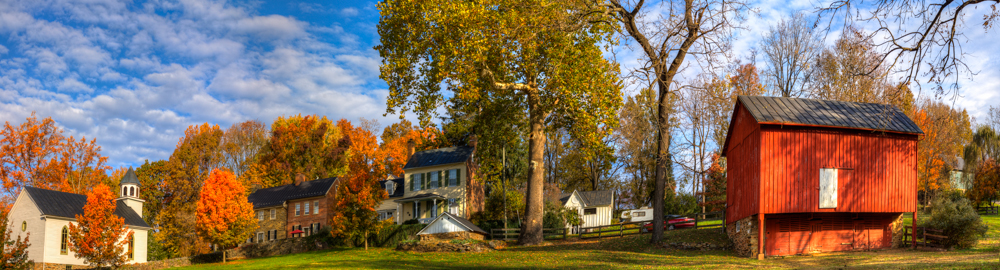
Panoramic Image of Bond Street from the Bond Street Tanyard. This area is across from the Waterford Mill and part of the oldest area of Waterford where Joseph Janney founded the Village.
The Moore Family and the naming of Waterford

The development of Waterford began in earnest in 1784 when Janney sold the first village lot, which included a stone house and stable, to Thomas Moore Jr. The Moore family became the cornerstone of the early community. Thomas Moore Jr. opened a general store to meet the pent-up demand for British goods, including coffee, rum, fine fabrics and tea.

Thomas was soon joined by his brothers, James and Asa. James Moore leased a tannery established by Janney to process raw hides into leather, while Asa Moore established a saddlery. Their sister, Ann, and her husband, Evan Taylor, a carpenter, also settled in the village, contributing their skills to its physical growth. This strong family presence eventually led to the village being named “Waterford” in honor of their ancestral home in Waterford, Ireland.

Industrial diversity and the apprenticeship system

Waterford quickly evolved into a self-sufficient cluster of related trades. To staff these
businesses, the Moores and other lot holders utilized an apprenticeship system managed by the county court. This system provided vocational training to “pauper apprentices,” who were young individuals from impoverished backgrounds, to learn essential skills such as tanning, blacksmithing and cabinet making.

As the village grew, other craftsmen established critical services:

  • Joseph Pierpoint: A blacksmith who purchased a lot in 1785 to repair tools and maintain the iron machinery required by the local grist mills.
  • William Paxson: A wheelwright and industrial screen-maker who, by 1789, produced specialized equipment like “rolling screens”, which were used for cleaning grain before it was milled into flour.
  • William Hough: Opened a second mercantile establishment around 1787 in a “red stone store house”, providing healthy competition and expanding the village’s role as a retail center.
Financial and religious challenges

The early years of the village coincided with significant political shifts in Virginia. To address Revolutionary War debts, the state implemented land taxes based on rental values. This created a moral dilemma for the pacifist Quaker community, who debated whether paying taxes for military debt aligned with their faith.

At the same time, the community was active in the movement for religious liberty. Waterford residents such as Asa Moore and Joseph Janney signed petitions against mandatory taxes for religious teachers.

The subsequent passage of the Statute for Religious Freedom in 1786 and the Marriage Act of 1785 provided the legal stability necessary for the Quaker community to flourish, ensuring their religious practices and marriages were fully recognized by the state.

A foundation for future expansion

By the end of the 1780s, the village had successfully established a diverse industrial and commercial base. The combination of essential trades, including blacksmithing, tanning and milling, alongside a growing retail sector, positioned Waterford as an increasingly important regional hub.

With a steady influx of skilled craftsmen and the successful integration of former apprentices into the local economy, the village sat on a solid foundation for continued physical and economic expansion into the coming decades.


Debbie Robison writes about Northern Virginia history. You can read more of her articles on her website.

Want to learn more about early Waterford? Check out some more articles below!
Check out these articles below!

How Area Quakers Approached the Revolutionary War

How Area Quakers Approached the Revolutionary War

ByAbigail Zurfluh history,Waterford History June 23, 2026
Written by Debbie Robison; Edited by Larisa Epatko — The Revolutionary War period was a time…
Read More
Quakers Arrive, an Agricultural Community Thrives

Quakers Arrive, an Agricultural Community Thrives

ByAbigail Zurfluh history,Waterford History June 23, 2026
Written by Debbie Robison; Edited by Larisa Epatko — The region between the Catoctin and Blue…
Read More
A General History of Waterford, VA: Waterford’s Past Reflects the History of the Nation

A General History of Waterford, VA: Waterford’s Past Reflects the History of the Nation

ByElizabeth McFadden Black History,history,Home-page,News,quaker,Waterford History April 7, 2023
Written by Debbie Robison; Edited by Larisa Epatko — The story of Waterford can be told…
Read More

Filed Under: history, Waterford History

Open House & Preservation Academy Recap

June 3, 2026 by Abigail Zurfluh

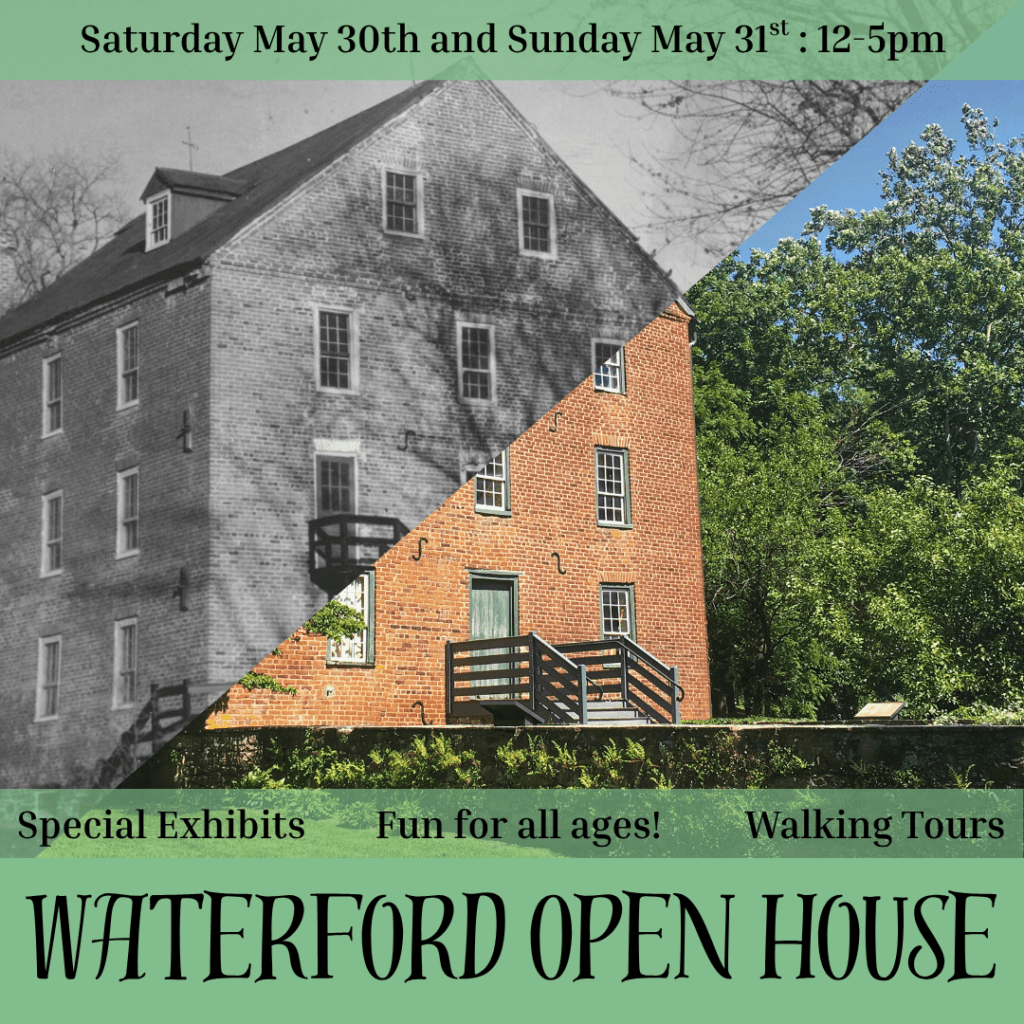
The sun was shining, the breeze was blowing, the birds were chirping, and it was a great weekend to explore Waterford! This past weekend on May 30th and 31st, we welcomed over 200 people to the Waterford National Historic Landmark for a weekend full of historic fun with special exhibits- including “Determined: The 300-Year Struggle for Black Equality”, children’s activities, walking tours, and talks. 

We hope that you were able to join us this past weekend, and thank you to all of our volunteers and partners who made this weekend possible!


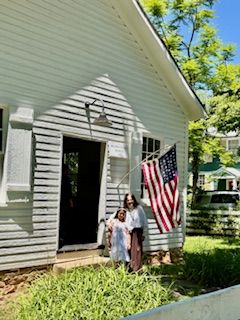
Docent with Visitor at the Second Street School

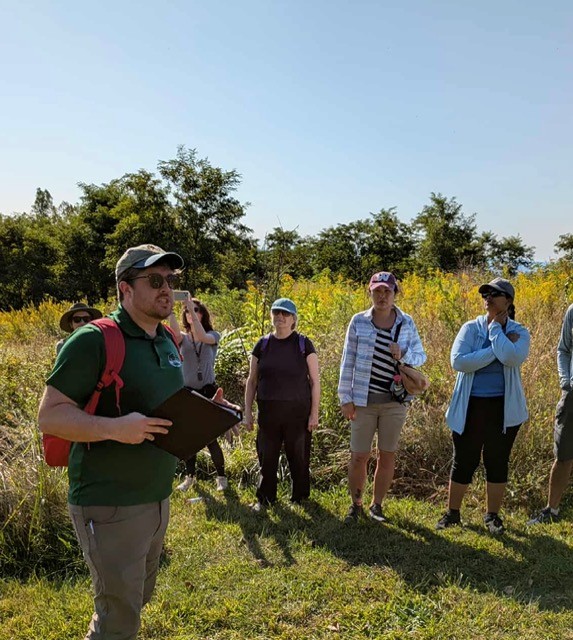
A weekend of historic fun started on Saturday May 30th! Doors opened to the Waterford Mill and Second Street School with exhibits and children’s activities for visitors young and old to learn more about the history of the Waterford National Historic Landmark. The day started with the opportunity for visitors to go on our popular guided walking tour of the Historic Village of Waterford with an experienced docent and hear stories of the people and events that helped build Waterford (and since the docent was an architectural historian- some information about different building styles and techniques throughout the Village). Visitors also had the opportunity to explore the flora and fauna, history, and conservation of the Phillips Farm on a special guided walk led by our Open Spaces Subcommittee and the Loudoun Wildlife Conservancy! Later, Civil War enthusiasts got to explore how the Civil War impacted the lives of those in Waterford on our Waterford in the Civil War walking tour.

Docent Introducing the Civil War in Waterford at the Old School

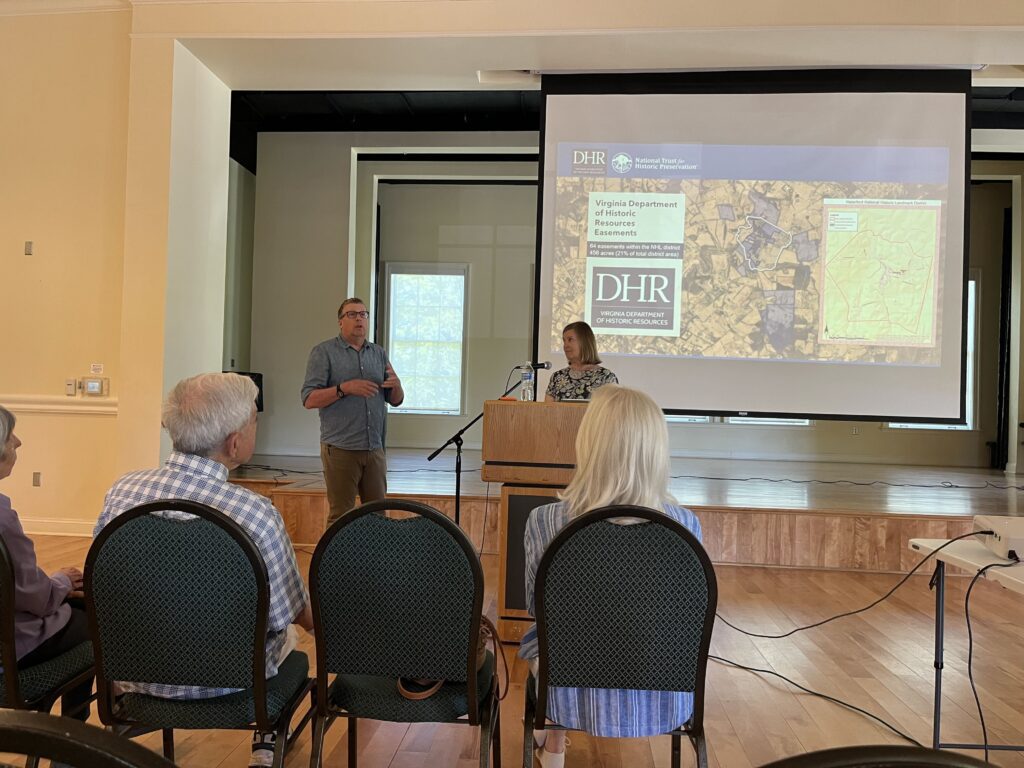
Saturday was also the first day of our Preservation Academy, a new series of talks diving into historic preservation and environmental conservation from experts in the County and beyond supported by a grant from the Van Huyck Chockley Family Foundation! Our first talk was from Claire Jones of the National Trust for Historic Preservation and Brad McDonald from the Virginia Department of Historic Resources on historic easements: what are they, how they work in each of their organizations, and how to put one in place. Attendees also got to participate in the easement process as they learned about how new easements are put in place through a case study based on actual eased properties! Will Milone, the Historic District Review Committee (HDRC) Liaison within the Community Planning Division of the Loudoun County Department of Planning and Zoning, gave insight into the differences of various historic designations, and protections and incentives that can result from those. The first day of speakers ended with Debbie Robison, historical consultant, diving into how she has researched the history of the Waterford National Historic Landmark and how you can research your own property.

Brad McDonald (VDHR) and Claire Jones (NTHP) during the Historic Easements Workshop
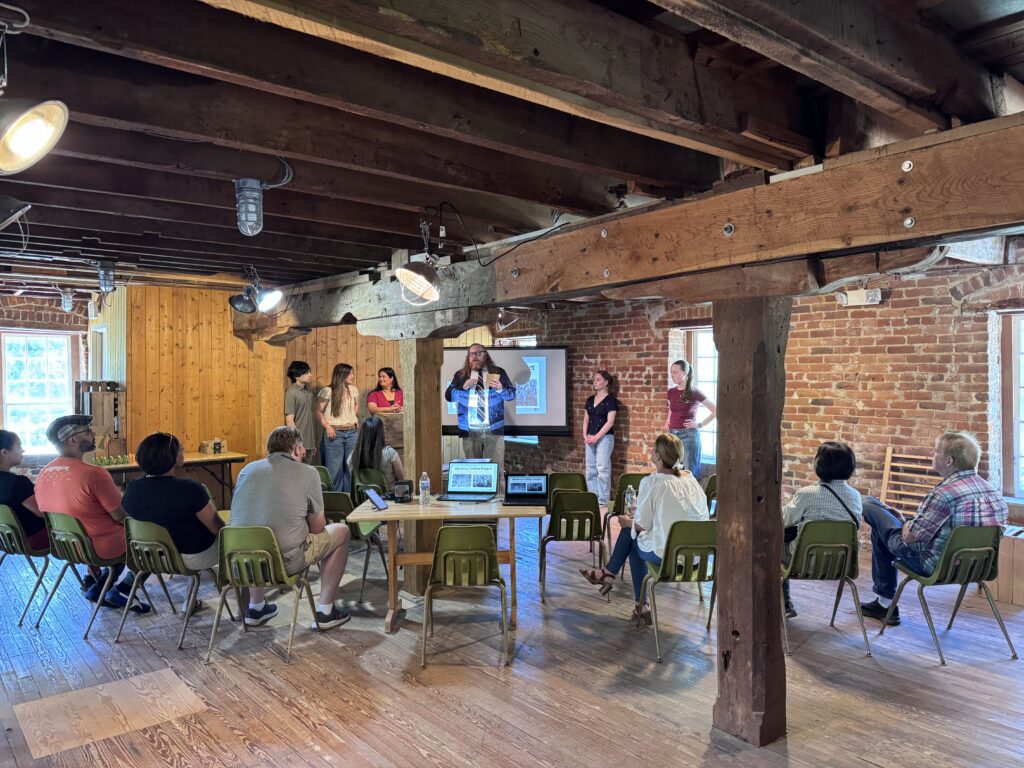
Members of the Lightridge High School Archaeology Program presenting in the Waterford Mill

Sunday kicked off another day of great weather, exhibits and children’s activities, walking tours, and fun for all ages! Participants were able to go on one of our popular walking tours, see inside the Mill and Second Street School, and get their Junior Waterford Historian buttons! Free trees were also available from our friends at the Planting for the Piedmont Program. At 2pm, we hosted a special presentation from the Lightridge High School Archaeology Program diving into the high-tech world of archaeology and their work in digitizing the Collins Cottage Archaeology Dig at the Waterford Mill. It was amazing to see these high school students part of the program leading us in a discussion about what could be under our feet!

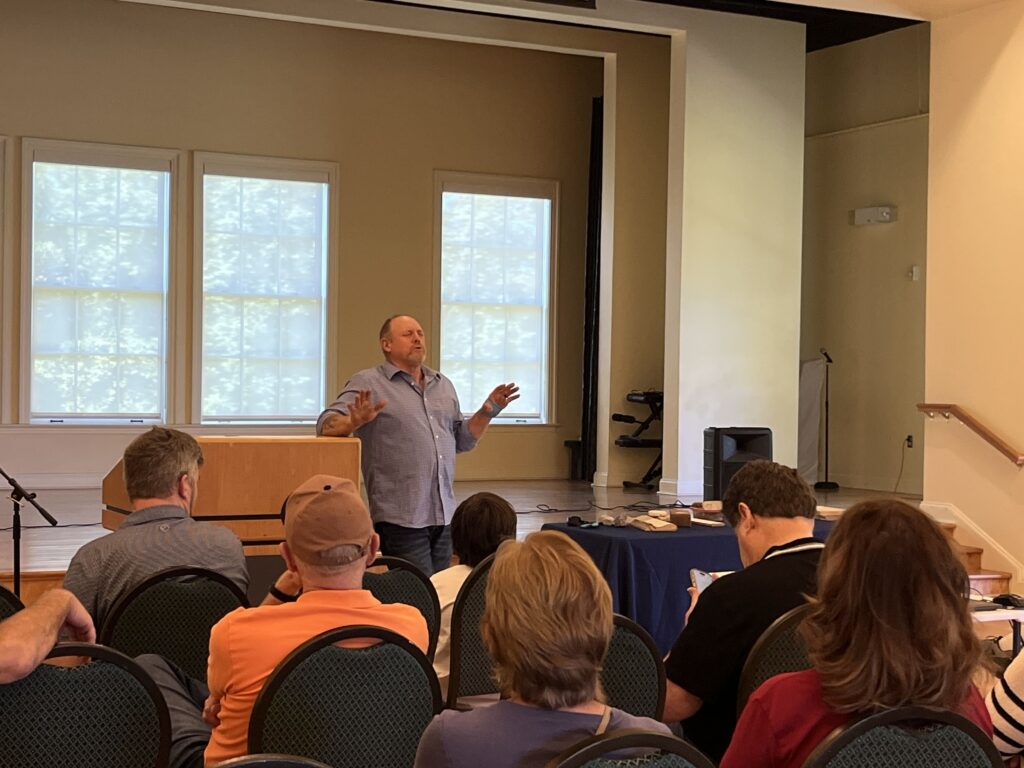
Allen Cochran presenting “Compatible Material Selection for Period Buildings” on Sunday afternoon

The second day of Preservation Academy talks kicked off with Leah Sattler, Invasive Plant Species Management Program Administrator for the Loudoun Soil & Water Conservation District, exploring the impacts of invasive plants, and what can be done to preserve the native habitat. Linnea Sherman and October Greenfield from the Piedmont Environmental Council continued the conversation about what can be done to restore the habitat around us, and programs available to support water and habitat restoration. The weekend ended with Allen Cochran of Cochran Stone Masonry, who led a fascinating discussion and dove deep into the mortar, stone, and wood you can find in and on your house and how to best maintain your historic materials so that they take care of you!

What a great way to wrap up National Historic Preservation Month here in Waterford!

Filed Under: Uncategorized

What is Historic Preservation Month?

April 30, 2026 by Abigail Zurfluh

Every May, preservation organizations and preservationists alike across the country celebrate National Historic Preservation Month- including us here in Waterford! This is a chance to get out in the community and celebrate the benefits and strengths of historic preservation, and learn more about how to keep it going. 

National Historic Preservation Month was started by the National Trust for Historic Preservation in 1973. This celebration of preservation first started out as National Preservation Week, the first being May 6-12, 1973 as approved by Congress and signed into action by President Richard Nixon. The second week of May was chosen as it would be at the same time as the National Trust’s annual award luncheon. In 2005, the National Trust expanded Preservation Week to Preservation Month to be the entirety of May. 

Whether it be a week or a month, May is marked by organizations across the country as a time to celebrate the vast and diverse history and heritage resources in the United States, and the work that goes into keeping that history alive for future generations!

How are We Celebrating Historic Preservation Month?

Come celebrate historic preservation month with us at this year’s Waterford Open House on Saturday May 30th and Sunday May 31st, both days from 12-5pm! Have you ever wandered by the Second Street School or the Waterford Mill and wanted to learn more? Now’s your chance! We invite you and your family to come explore the story of the Waterford National Historic Landmark on Saturday May 30th and Sunday May 31st for a weekend of historic fun including:

  • Explore the history of the Village in historic buildings and trails open throughout the Village!
  • Have fun with crafts, puzzles, and games throughout the Village to become a Junior Waterford Historian!
  • Come see a special exhibit on display for one weekend only from the Virginia Museum of History and Culture!
  • Dive further into the history of Waterford on a guided walking tour*!
  • Learn about the ins and outs of historic preservation from experts across the County and beyond at the Preservation Academy!
  • Traverse the natural side of Waterford on a special nature walk on Saturday and get your own baby tree while supplies last on Sunday!

We hope to see you out in Waterford this May! And happy historic preservation month!

(*Guided walking tours are the only fee based activity, tickets are $20 per person)

Filed Under: Preservation Tagged With: 250 Events, Notes from the Preservation Desk

Diving into the Phillips Farm

March 27, 2026 by Abigail Zurfluh

An integral part of the interpretation and preservation of the Waterford Historic District as an early American agricultural service village is the landscape around the village. In fact, the Waterford National Historic Landmark was one of the first nominations to the program to include the surrounding landscape as part of the significance. One of the most recognizable parts of the surrounding landscape is the Phillips Farm that runs behind Second and Main Streets of the Village extending on Old Wheatland Road. With April being Earth Month, it would surely be a remiss if this month’s Notes from the Preservation Desk didn’t dive into the Phillips Farm.

Brief History of the Phillips Farm:

The area we know as the Phillips Farm is a 144 acre portion of the culminated 220 acre parcel owned and collected by Thomas Phillips during the late 18th and early 19th centuries. Thomas Phillips was a Quaker and operated the Bond Street Tannery with fellow Quaker Asa Moore. After Moore passed away, Phillips acquired his business partner’s mill (on the same site as Waterford Mill) and associated acreage. Phillips would sell the mill in 1832, but kept the acreage for his farmland. After his death, Phillips’ descendants would continue to farm on the property for over a century. Products produced on the Phillips Farm include dairy and beef, pork, hay, corn, wheat, honey, and wool.

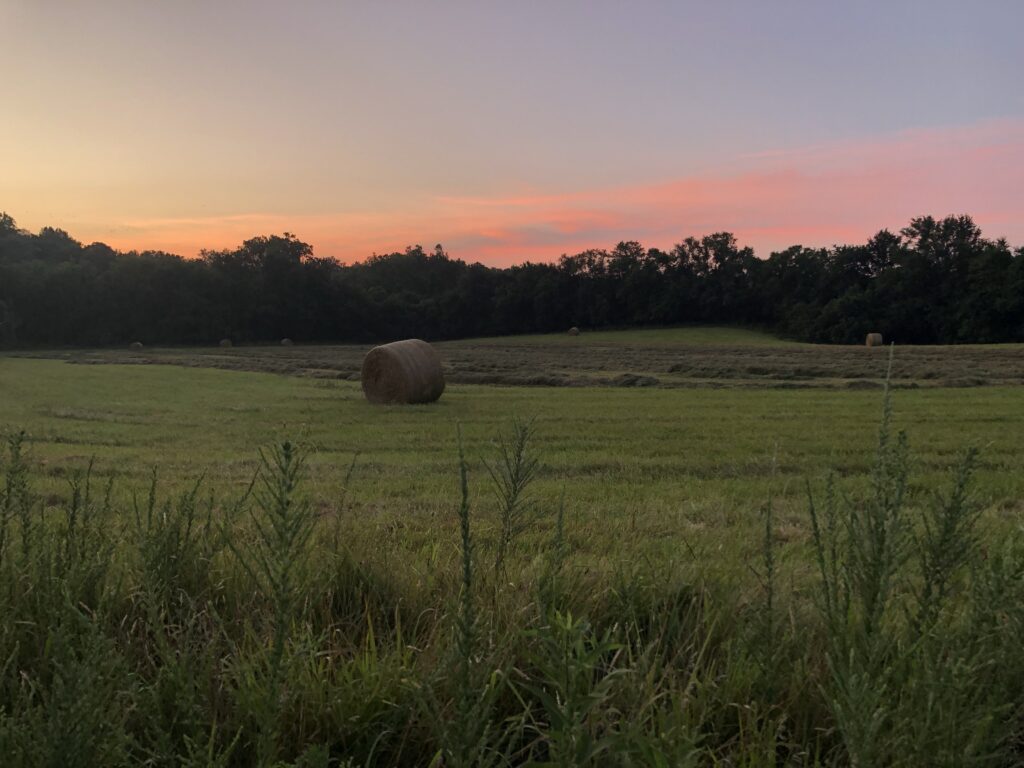
Phillips Farm Agricultural Area at Sunset

In 2003, the 144 acre parcel of land southwest of the village was slated to be subdivided into multiple lots. The Waterford Foundation and its many supporters locally and across the country secured nearly $4 million to purchase the Phillips Farm and conserve it as open space. Had that development occurred, destroying the pastoral viewshed beyond the South Fork of the Catoctin Creek, Waterford’s National Historic Landmark status would have been seriously jeopardized.

The Phillips Farm is now conserved open and agricultural space, under easement with the Virginia Outdoors Foundation. On the Phillips Farm, you can now find conserved meadow and streambank, an agricultural area that is tended to by a local farmer, hiking trails through the story of the Phillips Farm and the historic agricultural surrounds of the Village of Waterford.

Conservation Practices in Practice- Strategic Plan

In 2023, the Open Spaces Subcommittee reviewed and updated the Strategic Plan for the Management of the Phillips Farm (also known as the Phillips Farm Management Plan). A strategic plan is a living document that comprehensively looks at a project/area/organization’s long-term purpose and direction, goals, and what actions to take to meet those goals in a certain period of time.

For the case of the Phillips Farm, the strategic plan establishes the vision statement as: “The Waterford Foundation is committed to being an exemplary steward of the Phillips Farm by protecting it as an important contributing element of the Waterford National Historic Landmark and Loudoun County’s Waterford Historic & Cultural Conservation District. The Foundation will protect the agricultural, natural, historic, and cultural resources of the farm while providing opportunities for the public to engage with the farm through research, educational and passive recreation opportunities.”

The strategic plan lays out goals to best conserve the Phillips Farm and short and long-term actions to take to meet those in areas including but not limited to: natural resources (including stream health, forest, meadow, animal habitat areas, and agricultural areas), agriculture, historic resources, educational programming, and trails.

This plan has guided the work and project taken on by the Open Spaces Subcommittee, including some of the following that you might have seen:

  • Invasive Management and Meadow Replanting: A large focus of the Open Spaces Subcommittee for the past couple of years has been in the invasive species of poison hemlock, mile-a-minute vine, and autumn olive. This is identified in the strategic plan as an initiative to take part in. Post-COVID, treatments focusing on the poison hemlock have taken place over the growing months of the plant. After the past two summers, no new growth of poison hemlock has been detected. In its place, mile-a-minute vine and autumn olive have taken its place. The Foundation in partnership with the Waterford Citizens Association and local Scout Groups have led periodic pulling days for these invasive species. This season, a large focus of the work will be on planning of what to plant after invasives are removed.
  • Water Quality Monitoring of Ball’s Run and the South Fork of the Catoctin Creek: To best be able to understand the best practices for stream conservation, data needs to be collected to understand the current status. The Waterford Foundation, in partnership with the Loudoun Wildlife Conservancy, conducts twice yearly macroinvertebrate stream monitoring on each stream. This monitoring practice uses the macroinvertebrates living in the stream (that are caught and released back to the water for the monitoring) to help determine stream health. Along with that, the Foundation also conducts testing of the oxygen and e-coli counts of South Fork of the Catoctin Creek and Ball’s Run to also help get a better understanding of the streams and how they combine.
  • Wildlife Monitoring: New this past year, the Open Spaces subcommittee implemented trail cams in different habitat areas- forest, streambank, meadow- around the Phillips Farm to better be able to observe animal habits on the property. These cameras are located off the beaten path of the trails to best observe wildlife on the Phillips Farm. Some of the animals seen have been deer, raccoons, foxes, coyotes, opposums, river otters, and blue heron. We can’t wait to see what gets spotted this next year!

Come Explore the Phillips Farm!

This Earth Month and beyond, we want to invite you to come and experience the Phillips Farm. There are two different trails that you can explore the Phillips Farm on: The Phillips Farm Interpretive Trail and the Western Trail. Find out more about these trails at this link!

For our younger explorers, check out the Phillips Farm Bingo and other bingo games including plants and animals to become a keen observer of the natural world. You can find Waterford Bingo cards at the link here!

Finally, check out some of our staff’s favorite spots and tips for the trail:

  • The most mentioned place to see is the Dam that helped power the mills in Waterford, still standing at the end of an out and back trail off the interpretive trail. When back there, take a second and look across the stream because you might catch a glimpse of some deer and other wildlife running through! If you’re going to do this, make sure to wear shoes that can get wet
  • On the Western Trail, make sure to go up to the overlook and look down. During the fall months, you might be able to see the Village through the trees but at this time of year, the greenery and surroundings can help you forget that you’re in a Village in the first place.
  • This is a great trail to bring your furry friend on, with so much to see and explore! Just make sure to keep them on their leash, remove their waste, and be ready for some pets if you run into another hiker!
  • The Phillips Farm provides some great context to the agricultural nature of the Village! If you plan on walking through and exploring the Village after your walk on the Phillips Farm, we recommend using this online version of our free walking tour booklet to help you learn more about the buildings you are passing by!

We hope to see you out on the trails this month and beyond!

Filed Under: PF_Trail Tagged With: Notes from the Preservation Desk

Women’s History & Historic Preservation

March 3, 2026 by Abigail Zurfluh

This Women’s History Month, we are reminded that women’s history and the start of the early historic preservation movement in the United States are intrinsically linked. The story of the Mount Vernon Ladies’ Association and the start of the early historic preservation movement, while not happening in Waterford, has deeply impacted the Waterford that we see today.

Mount Vernon, which is only a little over fifty miles from Waterford, was the plantation home of first president George Washington and Martha Washington. After Martha Washington’s death, the house and four thousand acres were willed to the Washington’s nephew Bushrod Washington- who passed away in 1829. He left the property now consisting of 1,200 acres to John Augustine Washington II, whose widow in 1840 left the property to John Augustine Washington III. John Augustine Washington III tried to make money on the property in multiple different fashions- growing crops such as wheat, selling lumber, renting land, and being involved in selling and renting out enslaved people. He, however, was not successful in turning a profit for multiple different reasons. He attempted to sell the property to both the Virginia and federal governments, but was unsuccessful. Washington was also consistently inundated with visitors and tourists who wanted to come learn more about George Washington and see his house.

One of those passerby’s in 1853 was Louisa Bird Cunningham, who wrote in a letter to her daughter Ann Pamela Cunningham, “if the men of the United States would not save the home of its greatest citizen, perhaps it should be the responsibility of the women.” (Cunningham, Mount Vernon Ladies’ Association, Mount Vernon) Taking this sentiment and running with it, Ann Pamela Cunningham founded the Mount Vernon Ladies’ Association of the Union, and set out to raise $200,000 (or a little over $5.7 million in today’s money) for the purchase of Mount Vernon.

Cunningham wrote under the pen name “A Southern Matron” (Mount Vernon Ladies’ Association, Mount Vernon) to first convince fellow women in the Southern United States then in all states to save Mount Vernon. Along with her, the membership of the Mount Vernon Ladies’ Association set off in their circles as well to raise money all over the United States for the purchase of the property. The Mount Vernon Ladies’ Association was and still is comprised entirely of women. The chairman, or Regent, was selected from the membership as well were Vice Regents. Boards of Ladies’ Managers were appointed by the Vice Regents to help raise money in different states. These Ladies’ Managers and clubs would purposely target organizations that Washington had been a part of or associated with such as the Freemasons and Independent Order of Odd Fellows, and even military groups, fire companies, and surveyors. Ladies’ Manager groups would also host or attend dramatic readings and plays, concerts, fairs, and festivals to raise funds.

The Mount Vernon Ladies Association was able to purchase the mansion and approximately 500 acres to make up the Mount Vernon we know today, and took full possession of the property in 1860. The Mount Vernon Ladies’ Association continues on today and remains integral in the preservation of George Washington’s Mount Vernon. This group, and the advocacy and fundraising efforts to purchase Mount Vernon is often attributed to the beginning of the historic preservation movement in the United States.

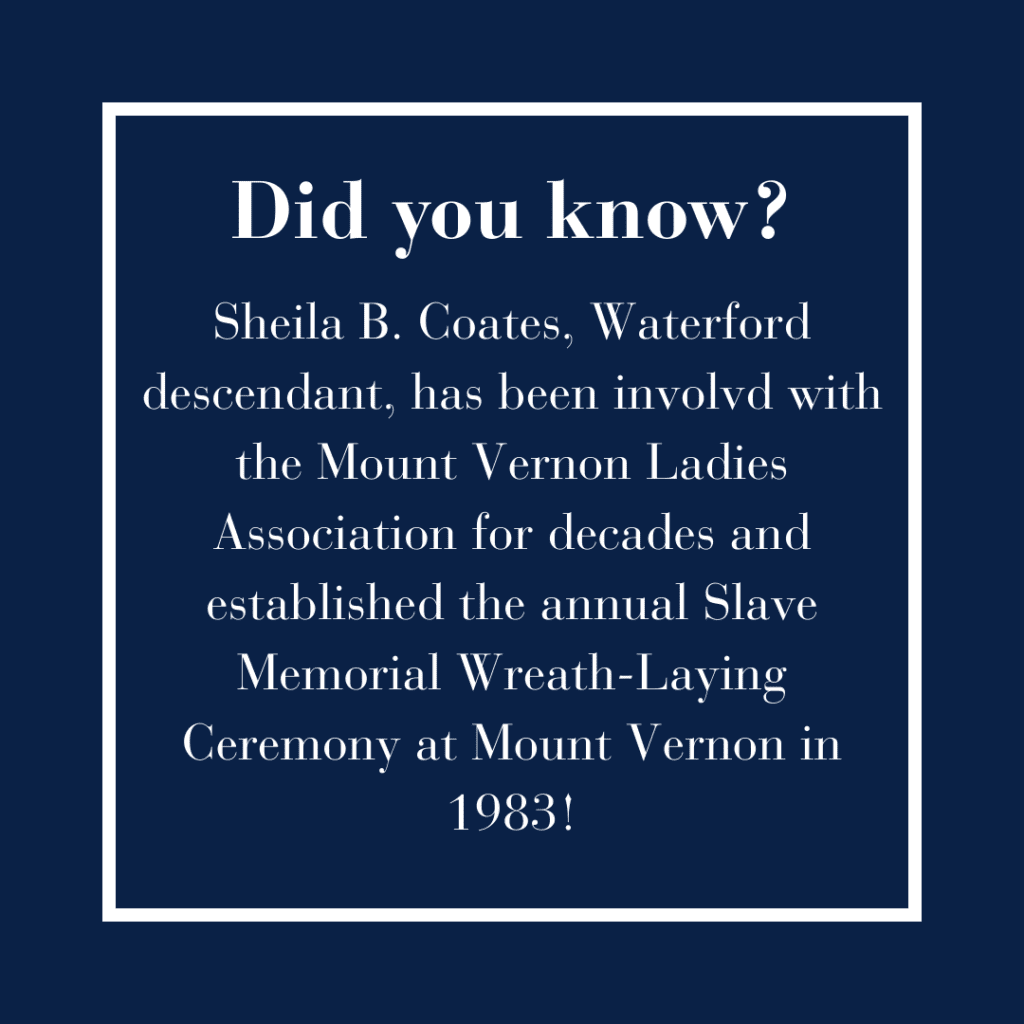
We could not talk about the Mount Vernon Ladies’ Association without paying homage to Sheila B. Coates- Waterford descendant and active contributor to the John Wesley Community Church and Waterford’s preservation and interpretation. In 1983, Sheila Coates established the annual Slave Memorial Wreath-Laying Ceremony at Mount Vernon that has since been internationally recognized and continues to this day. Two years later, she founded Black Women United for Action to advance education, economic opportunities, historic preservation, and public policy leadership nationwide. In 2023, she was integral in establishing the Black Women United for Action Fellowship at the George Washington Presidential Library to support research into African American history and leadership with the Mount Vernon Ladies’ Association. To recognize her achievements and accomplishments, Sheila Coates was awarded the Ann Pamela Cunningham Medal this year on George Washington’s birthday- the highest award given out by the Mount Vernon Ladies’ Association. She is only the fifth person to receive this award.

The work of the Mount Vernon Ladies’ Association is often contributed to the start of the early preservation movement in the United States. This movement would grow and shift throughout the years before coming here to Waterford. This women’s history month, we also want to highlight Sheila Coates and thank her for her contributions to the Waterford National Historic Landmark, Mount Vernon, and beyond!


Sources:

Early History of the Mount Vernon Ladies’ Association, Mount Vernon: https://edit.mountvernon.org/preservation/mount-vernon-ladies-association/early-history

The Ann Pamela Cunningham Medal. Mount Vernon. https://www.mountvernon.org/preservation/mount-vernon-ladies-association/ann-pamela-cunningham-medal

The Birth of the Mount Vernon Ladies’ Association, Mount Vernon: https://edit.mountvernon.org/preservation/mount-vernon-ladies-association/early-history/birth-of-the-mount-vernon-ladies-association

The Kindness of Strangers, Mount Vernon. https://edit.mountvernon.org/preservation/mount-vernon-ladies-association/early-history/the-kindness-of-strangers

Filed Under: Newsletters, Uncategorized Tagged With: Notes from the Preservation Desk

2026 Preserving Black Churches Grant Announcement

March 3, 2026 by Abigail Zurfluh

Exciting news! We are proud to share that we received additional grant funding for the John Wesley Community Church Restoration project from the Preserving Black Churches grant program of the African American Cultural Heritage Action Fund presented by the National Trust for Historic Preservation! These funds will be used to support interior restoration work in the sanctuary: including plaster work, restoration and protection of original woodwork, and work to secure the interior envelope.

You can learn more about this year’s grantees of the Preserving Black Churches fund linked here (including a story map of churches receiving funds across the country!), and learn more about the African American Cultural Heritage Action Fund below!


About the African American Cultural Heritage Action Fund

The African American Cultural Heritage Action Fund, a division of the National Trust for Historic Preservation, seeks to make an important and lasting contribution to our nation’s cultural landscape by elevating the stories and places of Black resilience, activism, and achievement. Supported by investments from the Ford Foundation, Mellon Foundation, Freedom Together Foundation, Lilly Endowment Inc. and other partners, it has raised over $200 million and supported over 400 preservation projects to date.

Preserving Black Churches Program Overview:

Preserving Black Churches (PBC) is a cornerstone initiative of the African American Cultural Heritage Action Fund, which is dedicated to the preservation of historic African American sites across the United States. The PBC program, backed by generous philanthropic support from Lilly Endowment Inc., is a $60 million initiative designed to uplift and preserve these historic places and the communities they serve. Since its launch in 2023, the program has supported historically Black churches in addressing preservation challenges, safeguarding their spiritual and cultural legacies, and providing vital social services.

PBC grants range from $50,000 to $500,000, and are awarded to support capital projects, programming and interpretation, endowments and financial sustainability, project planning, and organizational capacity building.

Filed Under: Preservation

What Does Historic Preservation Mean?

February 3, 2026 by Abigail Zurfluh

When you walk around places like Waterford, you can feel the history of the place. That is by design. The care and protection of historic areas like Waterford is called historic preservation. Historic preservation is largely agreed to be defined as the identification, interpretation, care of, and protection of historic artifacts and objects, sites, buildings and structures, landscapes, and districts. There are multiple different fields of preservation (that often intersect with other fields and interests) in which preservationists dive into that definition: including archaeology, architecture, museums, planning, building technology, advocacy, material culture, conservation, public history, and more. What the definition of historic preservation means and how they interpret it in their work can differ from preservationist to preservationist.

So, what does historic preservation mean to preservationists in Loudoun County? Below learn a little bit about the insights of what preservation means to them from Margaret “Margie” Salazar-Porzio, Ph.D. of Oatlands Historic House and Gardens, Ian MacDougall of the Virginia Piedmont Heritage Area, William Milone of Loudoun County Planning and Zoning, and Jana Shafagoj of Morven Park.


Margaret “Margie” Salazar-Porzio, Ph.D. is the Executive Director of Oatlands, a site of the National Trust for Historic Preservation in Loudoun County. With more than 15 years of experience in museums and public humanities, she previously served in leadership roles at the Smithsonian Institution, the Institute of Museum and Library Services, and the President’s Committee on the Arts and the Humanities. At Oatlands, she is leading a community-centered transformation focused on descendant engagement, education, land stewardship, and long-term sustainability.

What does historic preservation mean to you?

“To me, historic preservation is about stewarding places in ways that protect their historical and cultural significance while also inviting active engagement, inquiry, and connection to the present. Preservation to me is about honoring the people and their lives that are embedded in a landscape, including those that are difficult or complicated. At Oatlands, preservation means holding complexity, centering descendant voices, and ensuring that the site remains relevant and meaningful to the communities it serves today and in the future. As stewards, we must treat the site as a shared inheritance that extends beyond any one generation. Our choices today must therefore be guided by the long view, made with the understanding that others will inherit this place and continue its care.”

How did you get interested in historic preservation?

“My path into historic preservation came through public history and museum work. I’ve spent my career thinking about how history is interpreted, who gets to tell those stories, and how institutions can better reflect the full American story. Working at places like the Smithsonian and now at Oatlands has deepened my belief in the power of place: that historic sites are not simply lovely backdrops; they are places where civic learning, dialogue, and connection can unfold. With thoughtful interpretation, these places draw people into history as a lived experience, encouraging reflection and honest engagement with our shared past.”


Ian MacDougall joined the Virginia Piedmont Heritage Area in June 2021. He graduated with a Bachelor of Arts in Political Science from Virginia Commonwealth University in 2017. After completing his degree, Ian worked for the Colonial Williamsburg Foundation’s Military Programming department from 2017- 2021, focusing on organizing museum programming concerning Virginia’s role in the American War for Independence, as well as researching the experience of the British Army in the Commonwealth. Ian served as Public Programs Coordinator for VPHA from 2021-2025, managing the many public programs offered by the organization, including the popular Annual Conference on the Art of Command in the Civil War. He also served on the LoudounVA250 Committee in the role of Programs Chair from 2022-2025, having recently overseen the committee’s bicentennial commemorations of the Marquis de Lafayette’s visit in 1825. Ian became VPHA’s Executive Director in 2025, and oversees the Association’s daily business, development, fundraising, membership, and preserving the integrity of the historic landscape of the Virginia Piedmont Heritage Area. He and his wife Christine share a home in the bucolic village of Taylorstown in Loudoun County, and he spends his free time traveling to historic sites across Virginia and the east coast.

What does historic preservation mean to you?

“To me, historic preservation is the act of curating a living, outdoor museum where the landscape serves as the gallery floor and the structures act as its artifacts. Rather than just saving an old building simply because it’s been around a long time , it is about protecting the integrity of a site so that the relationship between the environment and its history remains visible and can be learned from. By treating a landscape as a museum, We ensure its exhibits are not obscured by modern encroachment but are instead maintained as immersive educational tools. To be able to take someone through a historic village, house, battlefield, or ancient road can and will inspire a sense of place and the moments in history it witnessed. There’s no better way to learn about ourselves and our history than to step into the places in which these events transpired and feel it around you.”

How did you get interested in historic preservation?

“I became engaged in history from a young age, from spending my time with my mother reenacting at Fort Loudoun State Historic Park in Tennessee. Sleeping in a wooden barracks building and watching muskets and cannons fired can do a lot to inspire curiosity in history. Growing up later in Williamsburg, I was surrounded by history and preservation. From my time in the Fife and Drum Corps, to some fantastic history teachers in school, and parents that fed that love of history, you could say there was little chance I wouldn’t pursue historic preservation as a career. I found a perfect home in the Virginia Piedmont Heritage Area in that way, matching my love of history with a passion to protect it for future generations.”


A local to this region, William Milone grew up in Alexandria’s Old and Historic District and fell in love with old places at an early age. William attended the University of Virginia (UVA) in Charlottesville, where he graduated with a Bachelors in Architectural History and a Masters of Architectural History. He lives with his wife Emily in Downtown Leesburg in a mid-19th century home.

What does historic preservation mean to you?

“To me, historic preservation- the effort to protect and interpret cultural resources in the face of visible and invisible change across society- is an imperative because it is the most socially responsible way to manage our constructed environment. Historic preservation offers people an immersive opportunity to understand their past, with physical evidence of past lives, cultures, social movements, wars, etc. to back up childhood history lessons. Preservation saves mountains of materials and energy by motivating us to reuse high-quality older buildings mostly produced with renewable, natural materials rather than replacing them with new buildings that may prove less physically durable or well-loved with time. Historic landscapes are an economic boon for local governments, and more importantly, create an irreplicable sense of place and quality of life for locals and visitors alike.”

How did you get interested in historic preservation?

“I grew up in an 1898 Queen Anne Victorian row house in the Old and Historic
District in Alexandria. For as long as I can remember, I’ve loved our old pine
floors with their rich wood grain pattern, the steep staircase with its decorative
newel posts and turned balusters, the door and window trim profiles that change
as you move up the house from floor to floor, and those wavy old window and
transom panes. My dad briefly worked in historic preservation locally and
remains involved at an advocacy level, so I was aware of the historic
preservation field from an early age. I’ve always cared deeply about historic
places and I knew I wanted to work in historic preservation just about as soon as
I realized I had the option.”


Jana Shafagoj holds a B.A. in Historic Preservation & History from Mary Washington College and a M.A. in Archaeology of Old Buildings from the University of York, UK. During her almost 30-year career, she has been lucky enough to explore, research, and preserve buildings throughout the Mid-Atlantic states and the UK. Jana accepted the Director of Preservation position at Morven Park in 2010 after being contracted by Morven Park in 2000 to determine the construction phasing of the Davis Mansion, a 6-month project, and again in 2009, to manage the Davis Mansion rehabilitation project. In her current role, Jana is responsible for the preservation of Morven Park’s historic structures and museum collections, and the interpretation of the site’s history to the public. She also manages Morven Park’s latest ground-breaking initiative, the 246 Years Project.

What does historic preservation mean to you?

“At its most basic, historic preservation is the study and protection of historic buildings. I don’t entirely agree with the word “preservation” which sounds like we are trying to stop all change and treat the building like an artifact in a museum, only to be carefully handled with white gloves. Instead, historic preservationists manage the evolution and adaptation of our built environment. As preservation professionals, we are called upon to identify the elements of each building that convey its history and must be maintained versus the ones that can be sacrificed to ensure the building’s continued relevancy to society. When properly done, historic preservation enables our historic built environment to continue to serve our community and remain a physical reminder of the community’s past for future generations. The old buildings and natural landscapes surviving within our communities allow us to subconsciously orientate ourselves in time and place, providing a sense of awe for the passage of time and a connection to our unique landscapes.”

How did you get interested in historic preservation?

“I love old houses. Ever since I was a kid, I have loved crawling around attics and cellars, looking for hidden rooms and old finishes. As I grew, this turned into a passion for understanding the evolution of our expectations for “home”. Although I appreciate buildings that have survived mostly untouched for a long time, I care more for the houses that have been shaped by each generation that called them home. Those buildings, like the Davis Mansion at Morven Park, are the ones where you find forgotten hidden spaces. That endless possibility of discovery is what I love most about this field.”


Filed Under: Preservation Tagged With: Notes from the Preservation Desk

Staff Spotlight: Leadership in Preservation and Public History

February 3, 2026 by Abigail Zurfluh

One of the most important parts about historic preservation is stewarding that love and care for history and the environment for future generations. Our Historic Preservation Director, Abigail Zurfluh, exemplifies this through her service on the inaugural Youth Advisory Council for another Loudoun County National Historic Landmark- Oatlands Historic House and Gardens!

The purpose of the Oatlands Youth Advisory Council is to advise Oatlands staff and the larger advisory council on interpretation, outreach, programming, and engagement with families, children, and young adults and professionals. The Youth Advisory Council has brought together people with multiple different backgrounds including historic preservation, art history, public history, archives and libraries, museums, and marketing. Together, they create, advise, and support the creation of new interpretive materials, programs, and more aimed at engaging families, children, and young adults and professionals with Oatlands. Finally, members of the Oatlands Youth Advisory Council will also serve as mentors to students interested in historic preservation, public history, and environmental conservation as they enter the field.

We are excited for Oatlands for this new chapter, and can’t wait to see what comes from the Youth Advisory Council!

Filed Under: Uncategorized

  • « Go to Previous Page
  • Page 1
  • Page 2
  • Page 3
  • Page 4
  • Go to Next Page »

Footer

Email: oldschool@waterfordfoundation.org
Phone: 540-882-3018

Privacy Policy

Join Our Email List and Stay Connected!

We Welcome Your Feedback!

Copyright © 2026 · Waterford Foundation · Log in