• Skip to main content
  • Skip to footer
  • Donate
  • Become a Member
  • Volunteer With Us!
  • Cart

Waterford Foundation

  • Education
    • K-12 Education Programs
    • The Waterford Fair
    • Waterford Craft School
    • Waterford HIstory
    • Remote Learning
    • The Quakers
    • African Americans in Waterford
  • Preservation
    • Historic Buildings
    • Mill Stabilization Project (2009-2023)
    • John Wesley Community Church Restoration
    • Dashboard Map of Western Loudoun Development, 1950-2020
    • Phillips Farm
  • Shop
    • Books
    • Donate
    • Membership
    • Lantern Light Fund
  • Events
  • Weddings & Rentals
  • About
    • Contact Us
    • Meet the Staff
    • Meet the Board
    • Visit Waterford
    • Support
    • Join Us
  • News
  • Privacy Policy

Waterford Foundation

Stories from the Attic: Just Like Home c1862

June 23, 2022 by Waterford Foundation

The following letter is in the Local History Collection of the Waterford Foundation. It was written by James Dickinson, a Union soldier of the 9th Division, bivouacked in Waterford, one of thousands of Yankee troops on their way south. James Dickinson’s home state was Michigan. His unit had only recently been mustered. For the most part, the original spelling and grammar of the letter have not been changed. Our thanks to John Souders for providing the history of the letter writer and identifying him..

Waterford Ver Mar the 1 1862

Dear Aunt,

I have a fine chance know[sic] to write you a few lines to let you know how we get along   We are all well know[sic] and in good spirits we are four miles in advance of our forces on picket Guard.   It is a splendid country and we have first rate times. The weather is very pleasant and warm. We are in a beautiful little grove where the walnuts are in abundance, aunt, perhaps that you would like it. Now what we had for Breakfast that perhaps that you know that while we are in the Enemys country that what we can get comes without money or without price. This morning there were twenty-eight very nice chickens came into our camp and only 20 of us to eat them so we fared first rate. We had chickens, pork, peas, sauce and coffee [illegible] hard bread for our breakfast and it relished first rate to [illegible] it is not very often that we are favored with such blessings as these here. We can crack nuts and apples, pears and chickens and thore [there] is a very nice spring of water not but a few feet from our tents. Aunt, this seems most like home of anything that I have had since we left home. You see we are left as a reserve so that if the rest of the pickets are driven(?) in we are to support them, so that we do not have to have but one man out of twenty to stand guard. Well Aunt you may think it strange that I do not write oftener but we are bothered most to. death to get postage stamps here and we have to divide them amongst our friends as equal as we can. Well, Aunt, I don’t know as I can think of anything more to write. At present I have just written home but have not received any letter from there in a long time. I must close. Give my love to all inquiring friends and don’t forget to accept a share for yourself. Good Buy [sic].

From  J D Dickinson

Image of unknown Union soldier courtesy of the Library of Congress.
 

Filed Under: From the Local History Collection, history, News, Waterford History

Preservation Committee Community Meeting Held June 22, 2022

June 23, 2022 by Waterford Foundation

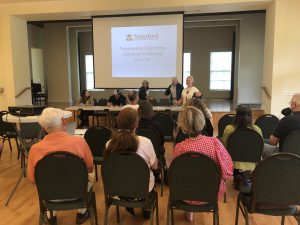
On Wednesday, June 22, 2022, the Waterford Foundation Preservation Committee welcomed the community for an informational meeting about the Phillips Farm and other ongoing preservation work on Foundation properties. Attendees gathered at 5:30 pm for a reception and opportunity to view exhibits, maps, and images of the Phillips Farm and properties under easement within the Waterford National Historic Landmark. At 6pm, WF President Susan Manch welcomed those assembled for a information packed presentation by a panel of speakers, including:
  • Erika Richardson from the Virginia Outdoors Foundation, who spoke about VOF’s work throughout the Commonwealth and detailed the particular protections of the easement they hold on the Phillips Farm,
  • James Remuzzi of Sustainable Solutions, LLC, who gave a report of herbicide treatments applied to date to manage the invasive poison hemlock that presents a threat to Phillips Farm visitors,
  • Susan Honig-Rogers of the Phillips Farm Subcommittee, who spoke about the subcommittees current and future efforts to document and manage other invasive plants present on the Phillips Farm,
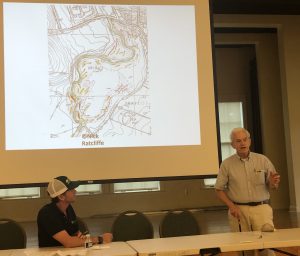
  • Nick Ratcliffe, who educated the audience on the geology and hydrology of the Phillips Farm and explained the present conditions of the South Fork Catoctin Creek as a result of damming the creek to generate power for Waterford’s mills,
  • Carl Sheider, who introduced the Phillips Farm Western Trail Pilot Project recently approved by the WF Board of Directors to establish a new walking trail on the western side of Catoctin Creek beginning summer 2022, and
  • Stephanie Thompson, Waterford Foundation Executive Director, who provided updates on the status of other preservation work this year including the Mill Stabilization Project, the Bond Street Tanyard easement project, and repair and restoration work throughout WF properties.
    Nick Ratcliffe speaks about the geology and hydrology of the Phillips Farm.
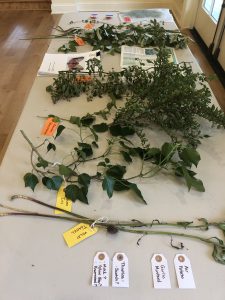
    Samples of invasive plants found on the Phillips Farm.
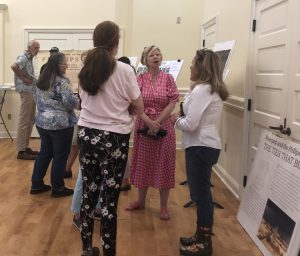
    Attendees in discussion during the opening reception.


We look forward to holding more such community meetings in the future, to keep our neighbors, members, and community members informed of our work. See the presentation slides from the evening for more information on the easement overview, poison hemlock treatment, pilot trail project, and preservation updates. Slides are available online here: Preservation Community Meeting Presentation Slides.


Filed Under: Committees, News, Preservation

Stories from the Attic: The Moore Family’s Influence on the Growth of Waterford

June 2, 2022 by Waterford Foundation

By Debbie Robison, May 27, 2022

When the village of Waterford was founded at the close of the American Revolutionary War, a mercantile store and a number of manufacturing ventures were established that had a significant impact on the success of the village. Almost immediately, a remarkable variety of goods began to be manufactured, including tanned leather, saddles, and cabinets.  Credit for developing these key businesses goes to one industrious Quaker family. Thomas Moore and his three adult sons, James Moore, Thomas Moore Jr, and Asa Moore, began several businesses on lots they bought and leased near Mahlon Janney’s mill. They likely named this new village after their homeland where the elder Thomas Moore was born.[1]

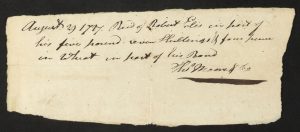
Receipt for payment of a five pound seven shilling four pence debt in wheat

Thomas Moore Jr. opened a store, operated as Thomas Moore & Co, with financial assistance from Alexandria merchant John Sutton.[2] The success of the business was hindered by a post-war depression that began the year the store opened. While it was typical at that time to sell merchandise on credit, the store had to discontinue the practice during the depression and limit providing credit to the purchase of small trifles. During this time, when a new nation was being formed, the United States did not yet have a federal banking system. Virginia had its own currency, a holdover from the colonial period, in denominations of pound, shilling, and pence. On at least one occasion, the company accepted wheat, the predominant cash crop of the time, to pay down debts owed to the store.[3] The store closed about 1790 when Thomas Moore Jr. moved to Maryland.

The tannery, where animal hides were tanned to make them pliable, was established ca. 1785 on a small branch that became known as Tan Yard Run. James Moore leased the 3/4-acre lot from Joseph Janney, who developed the village.[4] Pits were dug in the ground for soaking the animal hides; first to remove the hair and fat from the hide, then to soften the hide into leather. Tanners often sold the hair that was removed from the hides to a local plasterer. Original lime plaster walls in the village may contain animal hair from the tannery. Asa Moore and his son-in-law, Thomas Phillips, took over the business from James Moore. In 1832, following Asa Moore’s death, the tannery had 40 to 50 in-ground vats, a large bark house (to store bark used to tan hides), a currying house (where leather was treated), and a handling house.[5] The Waterford Foundation owns this historic tannery site.

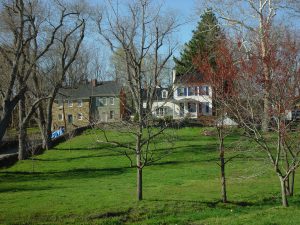
This open space bordered by Main, Liggett, and Bond streets was the site of the Moore family tanning operation from c1785 to 1832.

Asa Moore operated the saddlery where saddles were manufactured using tanned leather.[6] Saddle making required skilled craftsmanship to assemble saddles using glues while stitching together the various components.

Thomas Moore (Sr. or Jr.) was involved in a woodworking trade. It is unknown what type of products were made, though the skills of cabinet makers and joiners were used.[7] They could have been making furniture or had a role in building houses. A cabinet maker constructed furniture, such as cupboards, drawers, doors, and coffins. Joints, such as dovetail joints, were constructed by joiners to connect pieces of wood together.

The significance of the Moore family businesses is due, in part, to the many apprentices who were taught skills as boys while working for the Moores. At least 21 boys were apprenticed to the Moore family to work in these trades. Upon completing their apprenticeships, a number of these young men, along with other men who worked for the Moore family, established businesses in Waterford. For example, Henry Burkett, who lived with Thomas Moore, Jr. from 1789 through 1791, leased two lots on the south side of Main Street in 1792.[8] Evidently, Burkett knew the cabinet making/joiner trade because in 1793 Daniel Lovett (previously apprenticed to Thomas Moore) was bound to him to learn the trade of joiner.[9] In 1794, Jesse James (previously apprenticed to Thomas Moore, Jr to learn the trade of cabinet maker) was living with Burkett in the village.[10] Apparently they were operating a cabinet making shop. Another example is Joseph Talbott who, before becoming a tavern keeper, operated a saddle making business on Main Street.[11] He had previously lived with Asa Moore, who ran the Moore’s saddlery business, from 1792-1795.[12]

So not only was the Moore family vitally important at the formation of the village of Waterford, but they were also influential in its expansion and growth.


References

[1] Souders, Bronwyn C., Waterford, Virginia: Named for Waterford, Ireland, or not? (A Moore family history) [manuscript].

[2] Trust agreement between Thomas Moore Jr. and John Sutton, Loudoun County Deed Book O:423, 17 Jun 1785.

[3] George Emery etc. v. John Sutton, etc., Loudoun County Chancery Case 1791_009, pp. 12 and 15, as viewed at https://www.lva.virginia.gov/chancery/.

[4] Joseph Janney’s Will, Loudoun County Will Book D:341, probated October 11, 1793; Loudoun County Land Tax Ledgers: Alterations 1786, 1787-1799.

[5] “Public Sale,” Genius of Liberty, March 3, 1832, as viewed at www.geneologybank.com. Ad describes the tannery business of Moore & Phillips that was for sale.

[6] Loudoun County Order Book I:87, September 12, 1785.

[7] Loudoun County Order Book I:336

[8] Lease from Joseph Janney to Henry Burkett, Lots 7 and 8, Loudoun County Deed Book U:266, June 1, 1792.

[9] Loudoun County Order Book P:321.

[10] Loudoun County Personal Property Tax Ledgers, 1794-1796.

[11] Talbott, Joseph, Alexandria Daily Gazette, 11 Nov 1808.

[12] Loudoun County Personal Property Tax Ledgers, 1792-1795.


Filed Under: history, News, Waterford History

New Waterford Foundation Directors and Officers – 2022

May 6, 2022 by Waterford Foundation

We were pleased to welcome so many members and guests to our 2022 Annual Meeting on April 19, 2022. The evening included a presentation by Kathryn Smith of the National Park Service about the study to update Waterford’s National Historic Landmark designation. Find more information about the update and links to the documents on our website. President Chris Gleckner, Executive Director Stephanie Thompson, and Treasurer Dave Hunt provided reports on the state of the organization. Much of this information can be found in our Annual Report, available in pdf form here, or hardcopy at our offices in the Old School. Please see the letters below from our Executive Director Stephanie Thompson and new President of the Board, Susan Manch.

Valued Foundation Members,

Thanks to those of you able to attend our annual meeting on April 19.  We were especially pleased to honor our Scout volunteers Niko Kesari, John Case Hall, Evan Smith, Arabella Horton, and Emma Dolega-Jasinski, 2021 Community Partner Hunt Country Sotheby’s International Realty, and 2021 Volunteer of the Year, Liz Hohm.  We also presented the Lifetime Achievement Award to Margaret Good for her many years of service to the Foundation. It is because of dedicated community members such as these that the Foundation continues to be able to do its important work.

The Foundation Board added new members Jane Covington, Chris Doxey, and Susan Manch and elected new officers.  The Officers are as follows:

President – Susan Manch            Vice President – Annie Goode

Treasurer – Dave Hunt                 Secretary – Jane Covington

We are committed to continuing to fulfill our mission of preservation and education.

Best regards,

Stephanie Thompson

Executive Director, Waterford Foundation


A Personal Note From the Incoming Foundation Board President:

I want to thank Christine Gleckner, outgoing President, for her many years of service and for her continuing support of the Board and Foundation.  I am honored to be entrusted with this role.  While I am a more recent resident of Waterford, I have been a long-time Waterford Fair attendee and fan of this National Historic Landmark.  As the Foundation nears its eightieth year in 2023, I look forward to working with the Board to set ambitious goals for furthering our primary mission and preparing for our 300th anniversary in 2033.

As is true with all non-profits, the pandemic created hardships that we will have to work hard to overcome.  The return of the in-person Fair this year was a welcome return to normalcy and our Leaders and Committees will work collaboratively to chart a course that ensures that the Foundation and the National Historic Landmark are on solid footing for many years to come.

My goal is to be available to hear members’ priorities, ideas, and concerns.  To that end, I intend to hold office hours in the Old School every Thursday from 1:00 to 2:00 pm, beginning May 5.

I hope you will visit me there and actively partner with the Board and the Foundation as we embark on the next phase of the Waterford journey.

With gratitude,

Susan Manch

President, Waterford Foundation Board of Directors


Filed Under: News

Stories from the Attic – Edwin R. Gover

May 5, 2022 by Waterford Foundation

Written by Edith Crockett, with contributions from John and Bronwen Souders, Jonathan Daniel, and Debbie Robison.


More than a few Waterford residents are so fascinated by our village’s history that they always keep a sharp eye out for early artifacts, letters, paintings and more about Waterford. Last year, Edith Crockett learned of a painting of a “vintage” building said to be located in Waterford. Not recognizing the structure, she contacted Bronwen and John Souders about its possible identity. The Souders immediately recognized it as a painting of their own barnyard, done in the 1930s, by a member of the Carr family, prominent in Waterford history. It was quickly acquired by them and now has “come home.”

Not long ago, another Waterford resident, Jonathan Daniel, acquired a letter from Edwin R. Gover written to a Reverend C.H. Nourse concerning a transfer of property, dated July 7, 1854. In an effort to learn more about the circumstances of the letter and to share its contents more broadly, Jonathan was kind enough to share its contents with the Souders, Debbie Robison and Edith, and generously gave us permission to include it in our newsletter:

Waterford, July 7, 1854

Rev. C.H.  Nourse,

                        Dear Sir,

I received your letter on the Fourth, in which you wish to know whether I intend to stand to my proposition or not, in answer I would say that I always try to comply with all engagements that I make, it will not be convenient for me to be in Leesburg before August court Monday if that will suit you. You will let me hear from you or come up to Waterford I have my business to attend to and no one to assist me and I cannot leave it.

            The proposition from your letter coming to me is not altogether correct. Statement in that I could not [have]]? Possession before the first of January instead of the first December and that all the rent up to that time would be coming to me.

Yours with Respect,

Edwin R. Gover

Our own Northern Virginia history sleuth, Debbie Robison, replied:

“This letter suggests that Gover needed to go to the courthouse to record something… I found a deed and trust agreement between Gover and Nourse recorded at the January 1855 court. I suspect this is the [same] transaction since this is the only transaction between the two men at least from 1833-1857.”

Longtime Waterford historians Bronwen and John Souders also went to work immediately, and responded with a stream of remarkable history about Edwin Gover:

“Edwin R. Gover was born on 13 Oct 1818 in Waterford, the illegitimate child of 21-year-old Ann Gover and Andrew S. Anderson (29), a New York transplant. Ann gave birth in the house of Garrett and Elizabeth Gover Hough, her older sister, her mother having died. Edwin was apparently raised by Ann with the help of the extended Gover family (Andrew went on to marry the daughter of a prominent area farmer).

Edwin was living in Leesburg by 1841 as a “mechanic,” probably in the leather-working trade. By 1850 he was identified in the census as a saddler, married and the father of an infant daughter. As of 1859 he was back in Waterford, “gaining in reputation every day, as one of the finest Saddle and Harness Manufacturers in the county.”

In the meantime, he had become active in Democratic Party politics in Loudoun. At the time, the populist Democrats, heirs of the Jacksonian era, were a small minority in Waterford, but gaining strength elsewhere as Virginia slid toward war. By March 1860, Gover was among those endorsing “the candidate best calculated to ensure the triumph of the Democratic Party in the coming contest, and thereby crush out Black Republicanism, preserve the rights of the South, and perpetuate for ourselves and our posterity the blessings of a constitutional Union.”

Nonetheless, when Virginia put secession to the vote the following year, Gover bucked his party and voted with the majority in Waterford against the ordinance. And, in June 1862, he was among the first to enlist in the Loudoun Rangers, Sam Means’s Unionist cavalry company. The following February, “a majority having voted for Gover, he was declared elected [2nd Lt.]. The boys dubbed him ‘Four Eyes.’ He was a kind and pleasant officer, but perhaps a little old [at 43] and slow for the position.”  He was also called “the singing lieutenant” for his vocal talents. By the end of the war, Gover was 1st Lt. and senior officer of Co. A when he and his men were surprised and ignominiously captured on 6 April at Keyes’ Switch on the Shenandoah.

In the fall of 1865 he moved with his family to the farming village of Kansas, Illinois, a hundred miles west of Indianapolis. He died of typhoid in 1882 and was buried north of the village.

 As for the Reverend Charles H. Nourse, he was about the same age as Gover, but cut from different cloth. He was born in Washington, DC, and became a Presbyterian minister. He voted for secession and as of 1860 owned a 40-year-old mulatto slave and her three young children. Nourse was arrested by federal authorities on several occasions, but never wavered in his support for the Confederacy, refusing to sign the oath of allegiance. One Union officer referred to the “reverend gentleman acting as a kind of rebel postbag.” He was able to cross enemy lines with relative freedom as a minister and acted as a rebel courier. 

After the war he moved farther south in Virginia. In 1870 he was in Culpeper County, where he taught school in addition to his ministerial duties—and employed two Black domestics.”

 What an amazing amount of history has surfaced – vividly – all from a short letter written in July, 1854. And there is more: thanks to generous donations from the Gover family a few years ago, the Foundation has in its collections an early sampler by Ann T. Gover dated 1829, and a desk, made in Leesburg, once owned by the Gover family.


Thank you to all the contributors to this glimpse into Waterford history of more than 140 years ago!

Filed Under: archives, history, News, Waterford History

Waterford National Historic Landmark – Nomination Update

April 12, 2022 by Waterford Foundation

In 2018, the National Park Service began a study to update the National Historic Landmark nomination for the Waterford Historic District. Researchers from the University of Delaware Center for Historic Architecture and Design conducted an extensive inventory of the properties and structures within the 1420 acre Landmark District, identified historically significant features, and developed a more comprehensive description of the period of nationally historic significance of Waterford. The study was augmented in a second phase with oral histories of key participants in Waterford’s 20th century preservation story.

The completed study is appearing before the National Park System Advisory Board National Historic Landmarks Committee in May 2022 for review on its path to approval by the Secretary of the Interior. The final draft of the NHL nomination is now available for public review and comment at the following links:

Waterford Historic District, Loudoun County, Virginia
Executive Summary
Nomination
Figures
Photos 01
Photos 02

Please check the webpage link below for information on the May 11-12 NHL Committee meeting. The agenda is being finalized and will appear at the bottom of the page when it is ready, along with links for how to register to attend the virtual meeting.

2022 Spring Meeting – National Historic Landmarks (U.S. National Park Service) (nps.gov)

Comments on the update may be sent to Sherry A. Frear, Manager, National Register of Historic Places and National Historic Landmarks Program, National Park Service, 1849 C Street NW, Mail Stop 7228, Washington, DC 20240, email: nhl_info@nps.gov


Filed Under: News

Waterford’s 1860s Infrastructure Woes

April 1, 2022 by Waterford Foundation

Considering the remarkable story of the Waterford News, a Civil War era pro-Union newspaper published by three young Waterford ladies within secessionist Virginia, perhaps the most unexpected delight is the editors’ abilities to maintain their senses of humor during such a distressing time of war and uncertainty. A perfect example of their refreshing tone is an unlikely recurring character in their paper: the mud-hole.

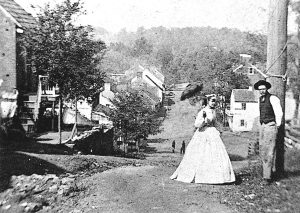
The Main Street Big Hill circa 1860, an illustration of the state of Waterford streets in the 1860s. Silas Hough and his sister Annie pictured at right.

The mud-hole first appears in May 1864 in Vol. I, No. 1 as a sardonic entreaty to the women of Waterford to remedy a situation that the men of the town have seemingly ignored:

“Pop-Gun.

[General Order, No. 6]

The young ladies of Waterford, Loudon Co., VA., are hereby notified to meet the first opportunity and lend their mutual aid in filling a large mud-hol with stone, said mud-hole being located in the middle of Second Street, and the men have driven around it so much that it is extending each side. Being fearful the gentlemen will get their feet muddy, the ladies will try and remedy it.”

The notice appears to have had some impact with the local citizenry, as noted by the follow up item in June 1864 in Vol. I, No. 2. However, we see that not all constituents favor the elimination of the mud-hole entirely:

“We record with pleasure one exception to the general apathy of the gentlemen. Are sorry ‘tis only one; but think the truth should not be withheld. Our thanks are due to the citizen for one load of sand deposited in the mud-hole. It will gladly be the recipient of a dozen more. We think it well to forewarn all young ladies of other neighborhoods not to let their heart’s devotion rest on young men who are so lost to the spirit of chivalry once the boast of Virginia’s sons. If that is not a sufficient reason, we would add they should not be so ungenerous as to interfere with the future prospects of the ladies here, which are slim enough anyhow.”

—

“Misses Editors of ‘Waterford News’” – Will you allow a much abused member of the Porcine species a word in your columns? Hitherto one of the greatest enjoyments of myself and fellow grunters, was an afternoon siesta in the mud hole on Second street, which enjoyment you have been the means of lessening by having one cartload of sand deposited in the deepest and most comfortable corner. If it should be filled, I don’t know where we shall go, for there is not another such a mud hole in the corporation.” 

The readers must have taken the plea from the local pig to heart, as little progress is mentioned in future issues; however, one should not assume that the problem was solved. The mud-hole reenters the narrative in November 1864 in Vol. 1, No. 6:

“All who wish to behold the great curiosity of muddy streets in Waterford, can be gratified by visiting our town at this time. We will be happy to show our friends around.”

…

Wants. 

…

“Wanted–A plaster for the mud-hole, it is breaking out again.”

The mud-hole persists throughout the winter, although it changes with the seasons. In January 1865 in Vol. I, No. 7, we learn:

“The mud hole at which we grumbled so much, has transmogrified itself into a skating pond, and is the daily resort of quite a number of boys, to say nothing of children of a larger growth, who we think appear interested.”

And in April 1865, the final issue Vol. I, No. 8, the editors include the latest updates on the situation, seemingly resigned to a fate of muddy streets for the foreseeable future:

“The ice and snow having disappeared, the mud hole has again made its appearance. It looks perfectly natural.”

The saga of the Second Street mud-hole is just one example of entertaining bits of humor sprinkled throughout the eight issues of the newspaper. It also serves as proof that some of the more mundane aspects of community and village life have changed little since the 1860s. Each spring brings mud along with flowers, roads need constant maintenance, and one man’s nuisance is another man’s (or pig’s) luxurious mud-hole. 


Find the complete collection of all eight issues of the Waterford News online here to read more from these remarkable young ladies.


Filed Under: history, News, Waterford History

Cheers for Women’s History Month: Anne E. Matthews’ Egg Nog Recipe

March 3, 2022 by Waterford Foundation

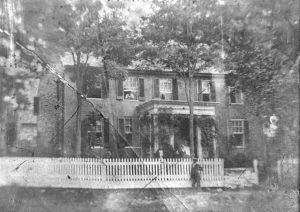
Clifton circa 1860s, photo courtesy of Bruce Clendenin

A formidable Egg Nog Recipe by Anne E. Matthews, a Waterford resident at the turn of the 19th century, was recently discovered among documents donated to the Foundation’s Local History Collection by the Chamberlin family. It reveals that, despite the Quaker tradition into which she was born of not imbibing alcohol, festive occasions requiring remarkable amounts of spirits sometimes took place.

Known familiarly from an early age as Annie, she was a daughter of Sarah Gover Matthews and Edward Y. Matthews, born outside Baltimore about 1842, just before the family bought property in Waterford and moved to their new home, “Clifton”, on Clarke’s Gap Road, just south of Waterford. The house is still occupied by descendants of the Chamberlin family. As a member of a Quaker family, Annie attended Samuel Janney School in the village of Goose Creek (now the village of Lincoln) and later, during the Civil War, the Quaker school at Sandy Spring, MD. Raised on the Quaker tenet that all people are equals, Annie became a strong activist for social and political reform on behalf of women, Blacks and other marginalized groups. She was among the earliest Quaker women to educate Blacks, including former slaves, after the Civil War.

At a young age Annie became an active participant in the Suffragette Movement, which ultimately resulted in the passage of the 19th Amendment to the Constitution in 1919, guaranteeing women the right to vote. She never married and lived much of her early life at Clifton. In the 1870s she moved to Washington and was employed at the Treasury Dept. She held a position there until shortly before her death in the 1920s.

Mix up a batch of Annie’s Egg Nog for your own toast to Women’s History Month!

Anne E. Matthews’ Egg Nog Recipe

1 quart best whiskey                    1 qt milk

1 pint best brandy                        2 doz eggs

1 pint Jamaica rum                     1 ¼ lbs granulated

3 qts cream                                   sugar


Have all ingredients & utensils cold & make in a cool place.

Separate eggs & beat very lightly. Beat whites to stiff froth adding about 3 teaspoonsful of powdered sugar as you beat. Put half the sugar in half the milk and cream to soften. Stirring from the bottom of the bowl and beating lightly with egg whip while working in yolks of egg. Beat yolks very light and after they get light and after they get quite light add sugar gradually, beating until perfectly smooth. Then begin to add in small quantities the brandy and whiskey as you beat. Beat the milk and cream some, but not too stiff, as you want to keep the mixture in liquid state. When you get most of the brandy and whiskey in, begin with the milk and rum and a little of the whites of the eggs, leaving most of this to stir in lightly at the last.

 I do not use a spoon at all, but mix entirely with an egg beater as it keeps it lighter – I use best California brandy and whiskey and Jamaica rum. In serving put ladel [sic] to bottom of bowl and bring straight up which keeps it the same consistency and gets an equal portion of from on top of glass.


Filed Under: From the Local History Collection, history, News

  • « Go to Previous Page
  • Page 1
  • Page 2
  • Page 3
  • Page 4
  • Interim pages omitted …
  • Page 8
  • Go to Next Page »

Footer

Office Manager oldschool@waterfordfoundation.org
Phone: 540-882-3018 x 2

Privacy Policy


Join Us

Copyright © 2025 · Waterford Foundation · Log in