• Skip to main content
  • Skip to footer
  • Donate
  • Become a Member
  • Volunteer With Us!
  • Cart

Waterford Foundation

  • Education
    • K-12 Education Programs
    • The Waterford Fair
    • Waterford Craft School
    • Waterford HIstory
    • Remote Learning
    • The Quakers
    • African Americans in Waterford
  • Preservation
    • Historic Buildings
    • Mill Stabilization Project (2009-2023)
    • John Wesley Community Church Restoration
    • Dashboard Map of Western Loudoun Development, 1950-2020
    • Phillips Farm
    • Notes from the Preservation Desk
  • Shop
    • Books
    • Donate
    • Membership
    • Lantern Light Fund
  • Events
  • Weddings & Rentals
  • About
    • Contact Us
    • Meet the Staff
    • Meet the Board
    • Visit Waterford
    • Support
    • Join Us
  • News
  • Privacy Policy

Waterford History

The History of Waterford’s John Wesley Church

July 6, 2023 by Stephanie Thompson

By Elise Bortey

It’s difficult to say when African Americans first came to Waterford, but we do know that in 1758, there was at least one enslaved person in the area. By the end of the eighteenth century, a few free African Americans had established residency. Because Waterford was largely a Quaker community and Quakers did not believe in slavery, it is believed that freed African Americans were drawn here. However, this didn’t mean non-Quakers in the area held the same sentiments towards slavery. While in 1810 there were 24 freed persons that resided in Waterford, there were also 11 Black enslaved people.

When Africans were brought to America, they continued to follow their beliefs and traditions as much as possible. White Christian slave owners tried to suppress their cultural beliefs and forced them to attend Christian church services. The teachings were a way for slave owners to gain more control over their enslaved, introduced under the guise of religion. They interpreted the Bible in ways that justified slavery. Throughout much of the late eighteenth century and early nineteenth century, Christianity began to take hold and replace much of the African religious belief system. African Americans embraced Evangelicalism and started forming their own churches. This enabled them to have more power over their own beliefs and interpretations of religious texts.

The primary Evangelical branches African Americans embraced were Methodist and Baptist churches. In 1867, the African American community of Waterford established the John Wesley Church, a Methodist church, in the building now known as the Second Street School. It was named after an Anglican clergyman, who was the founder of Methodism. When the congregation outgrew the small schoolhouse, they sought property to build a larger church. With the help of the white Methodist churches in the area, the John Wesley congregation was able to raise enough money to buy the Hough property on Bond Street, approximately a half a mile north of the Second Street School and near the Waterford Mill. There, they built their own church. They began building in 1889 and finished sometime towards the end of 1891.
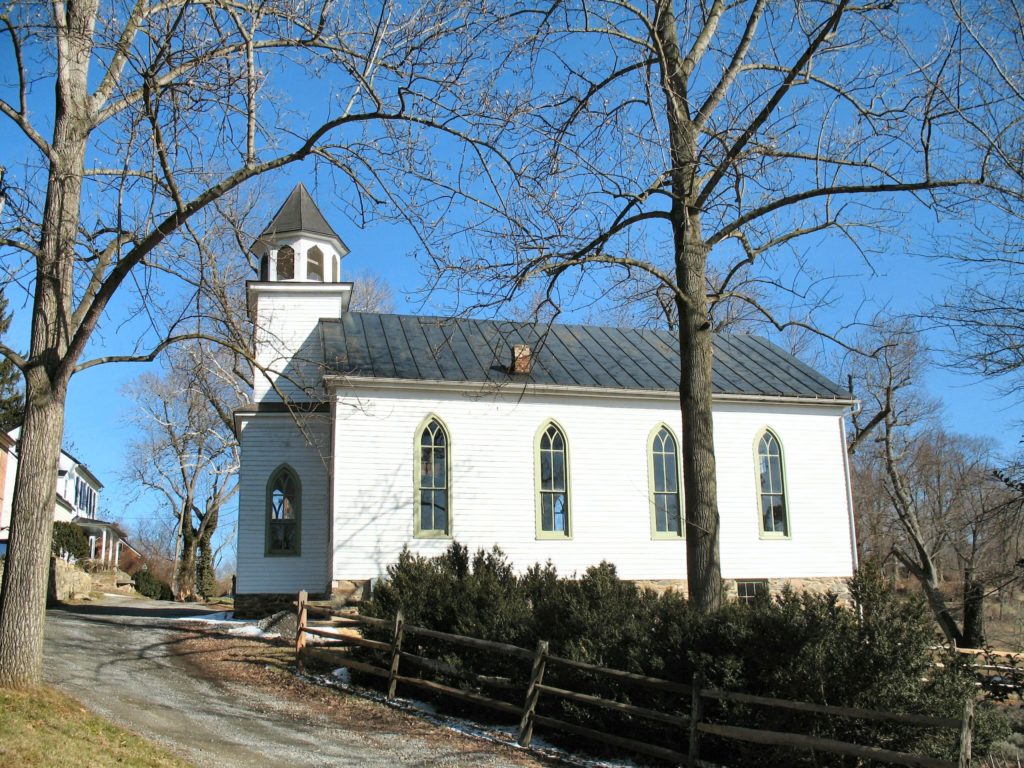
As of 1910, the church had a thriving, active membership consisting of 25 Black households residing in town. It was used both as a place of worship and as a central location for social gatherings. The church had an active charitable congregation that would regularly sponsor fundraisers, community picnics, and special events for children to enjoy.
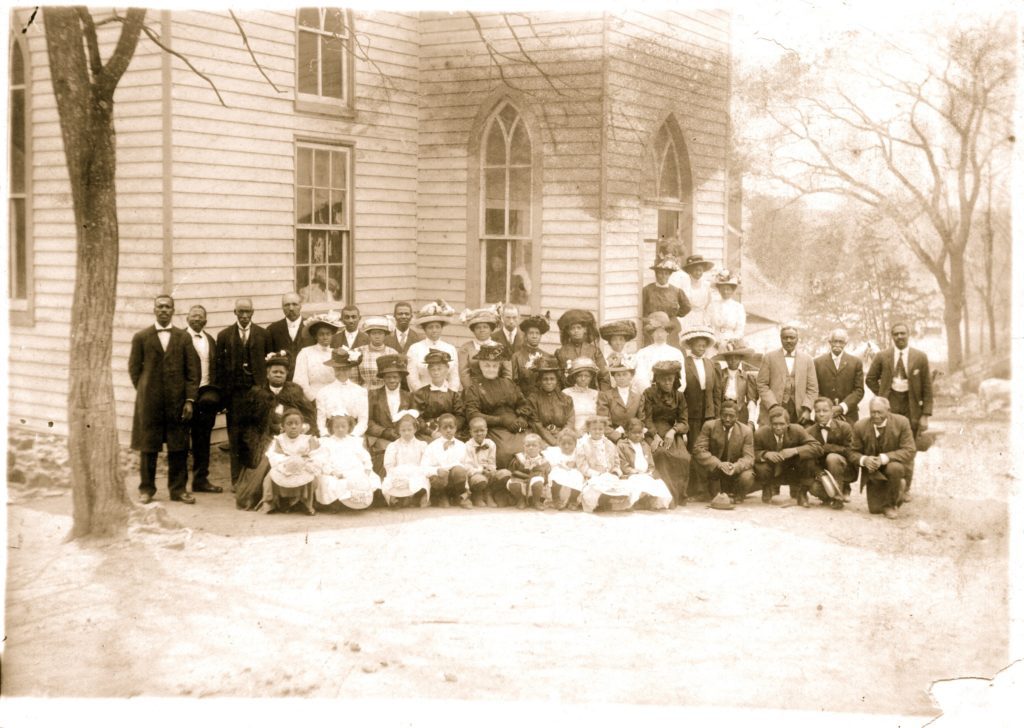
John Wesley Methodist-Episcopal Church congregation, circa 1910

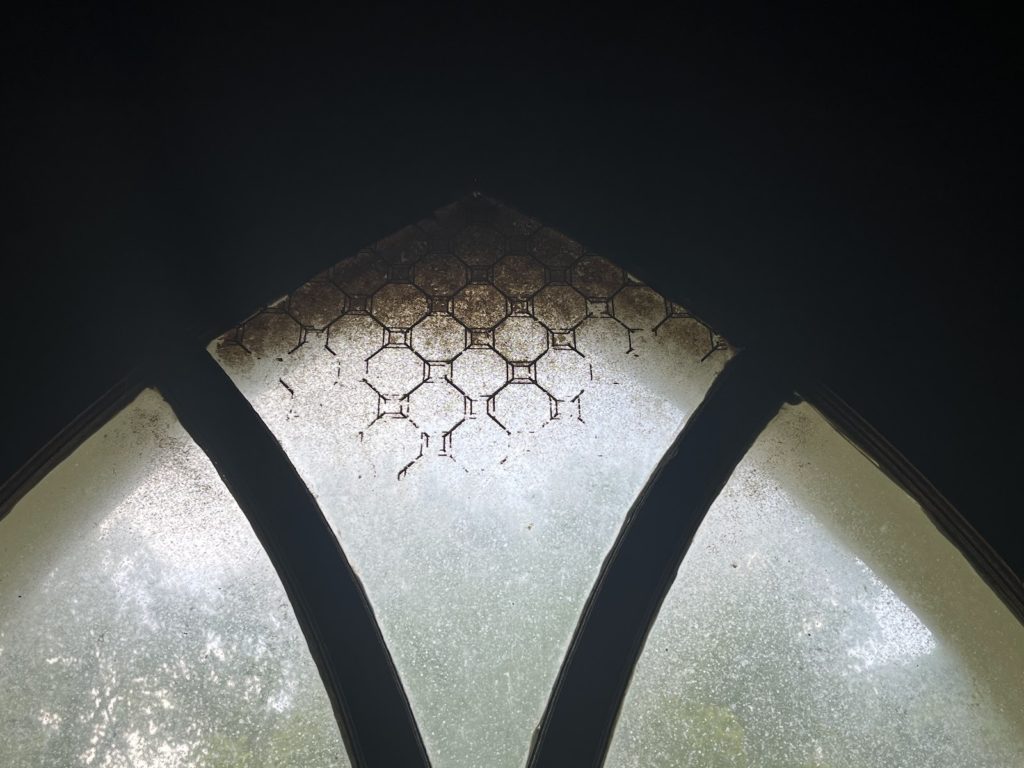
The Waterford Foundation commissioned a Historic Structure Report in 2018 to document the history of the church structure. By observing the existing structure and comparing historic photographs, it was determined that the congregation made a few changes to the church to ensure it was well maintained and with minor modifications to better suit their needs. They added shutters, moved the front door, and painted both the building and the glass to help give the effect of stained glass windows.
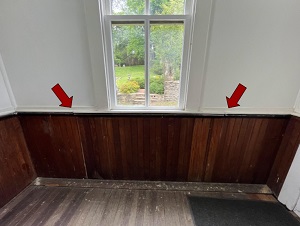
Original front door location, converted to window. Note the break in the molding.
Glass painted to look like stained glass in the belfy lancet windows.

Unfortunately, as the Great Depression hit, people began to struggle. With few jobs available and people needing to find work, many folks left Waterford. By 1940 there were only about 75 African Americans living in the area. During this period, the church’s population shrank and was primarily made up of the older generation. As the membership continued to decline, so did the funds. With the needed repairs continuing to grow, the church members had a difficult time maintaining the church. By 1967, the North Carolina-Virginia Conference of the Methodist Church declared the John Wesley Church of Waterford abandoned and sold the site to the Waterford Foundation that following year for $500.

After the church was sold, the descendants of the congregation and the few surviving church members that were left were able to become stewards of the property and continue to use the church to worship. Four months after the Waterford Foundation purchased the property, they transferred ownership to the stewardship committee for $10. The church became known as the John Wesley Community Church of Waterford and was overseen by a Board of Trustees. During this time, the church was used for religious meetings, homecoming celebrations to welcome back past church members that moved away, and an annual fundraising supper. In 1999, before the final member of the board of trustees passed away, he decided to sell the deed for the church to the Waterford Foundation so it could be preserved past his death. The terms of the purchase were that if the descendants were able to form an organization that could maintain the property and be up to the easement holder’s standards, they could buy back the property. In the meantime, the Waterford Foundation would maintain the property. In 2000, the Foundation donated an interior and exterior preservation easement to the Virginia Board of Historic Resources to prevent any inappropriate changes that would alter the historical integrity of the church. 

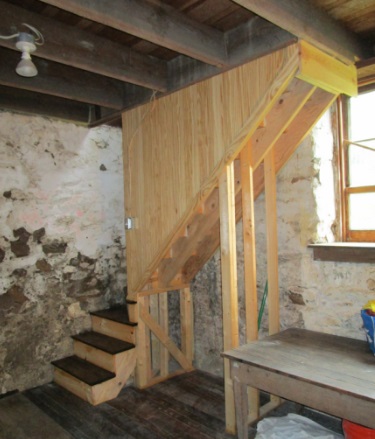
Since the Waterford Foundation acquired the property, they have renovated and restored the church. In 2001, they repaired the steeple and belfry’s framing and replaced and fixed the building’s roof. In 2002, the stone foundation was repointed, window panes and sills were repaired and replaced, steps and a landing were built, and French drains were installed to prevent further water damage. In 2018, the flight of stairs from the sanctuary to the basement was rebuilt, and a kitchenette, bathrooms, and mechanical room were installed. The newly built bathrooms introduced running water to the church for the first time. All repairs were made with the utmost care to ensure that they matched the original features of the church.
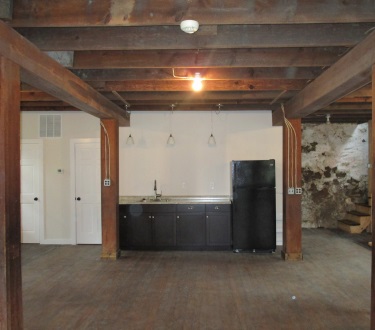
Kitchenette and bathrooms, installed in 2018.
Rebuilt interior staircase

The Foundation is currently applying for grant funding to continue the restoration of the sanctuary. They have also been in touch with some of the congregation’s descendants who may be interested in forming a new organization to reclaim the church. The Waterford Foundation looks forward to a day when they will be able to return ownership of the church to the descendants of the original congregation.


Sources:

  • Britannica, The Editors of Encyclopaedia. “John Wesley”. Encyclopedia Britannica, 6 May. 2023, https://www.britannica.com/biography/John-Wesley. Accessed 23 May 2023.
  • Coffield, Brian, et al. John Wesley Methodist-Episcopal Church Historic Structure Report, Smithgroup, prepared for the Waterford Foundation, 2019
Filed Under: Black History, history, News, Waterford History

A General History of Waterford, VA: Waterford’s Past Reflects the History of the Nation

April 7, 2023 by Elizabeth McFadden

Written by Debbie Robison; Edited by Larisa Epatko

—

The story of Waterford can be told hand-in-hand with the story of America. The impact of religious revivals, manufacturing innovations, slavery, economic depressions, and laws that governed free Black people all touched this village. The individual histories of each home, shop, barn, and outbuilding, as well as the people who lived here, are all part of a larger story. And that is, in part, what makes Waterford so special.

Establishing the village of Waterford
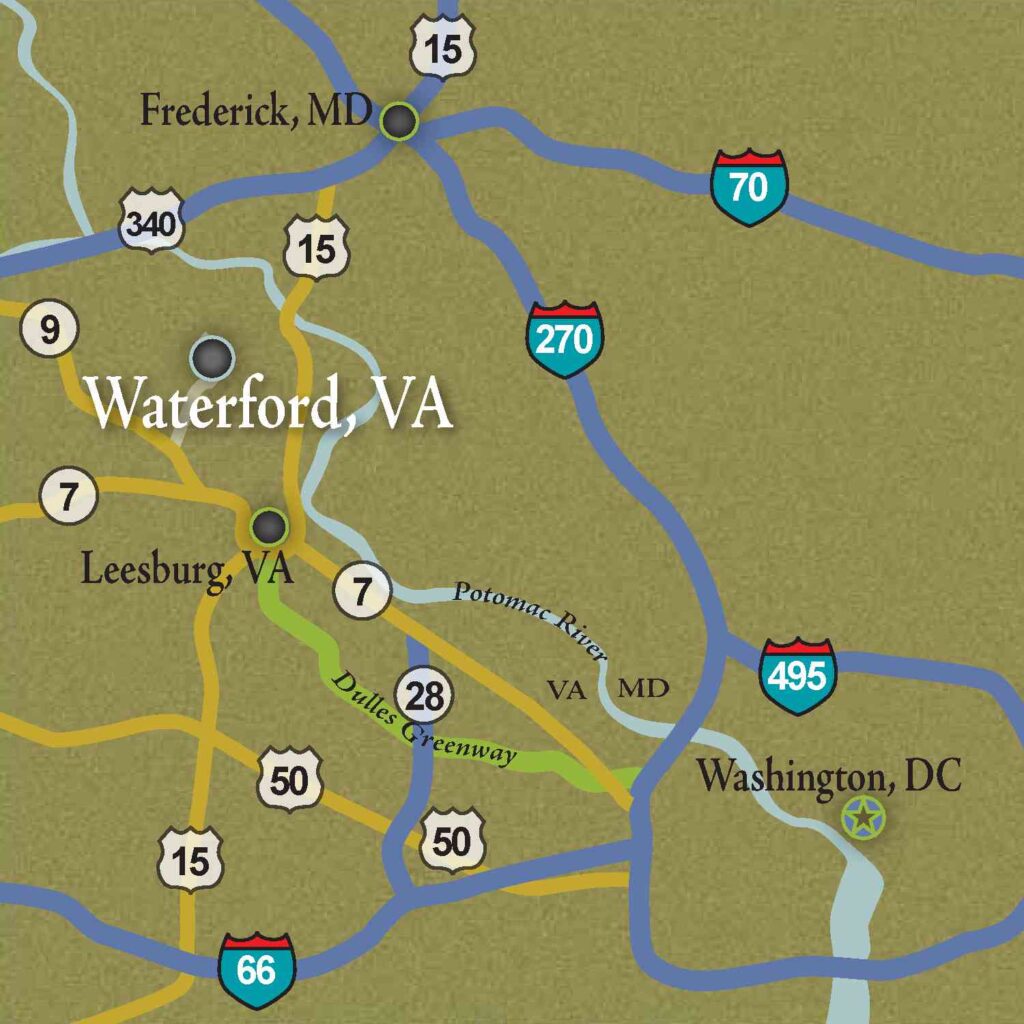
Map showing the modern ways to get to Waterford from Washington DC (WF Archives)

The village — located 47 miles northwest of Washington, D.C. — was founded ca. 1784 by Joseph Janney, a Quaker businessman formerly from Pennsylvania, who offered lots for sale and lease near a water-powered grist mill and sawmill. The land where the village was built was originally settled by Quakers, members of the Society of Friends, when John Mead purchased 703 acres in 1733. This was during the time of the Great Awakening, a religious revival in the 1730s and 1740s that led to an increase in religious conviction.

Other Quakers soon followed Mead and settled in the area where they found religious tolerance as well as fertile, well-watered soil. They farmed tobacco, raised families and established a Quaker meeting. During colonial rule, tobacco was shipped to Great Britain, which regulated and restricted trade. Once the flour trade opened to the British West Indies, grist mills were established along streams throughout the area, including the mill built by Mahlon Janney on Kittocton (now Catoctin) Creek ca. 1762.

Businesses start to take root

The village began with a dry goods store, saddlery, cabinet shop, tannery and blacksmith shop. The store did not prosper since farmers and millers, who were store patrons, struggled to find international buyers for their goods after the Revolutionary War. This was because, at the start of the new nation, America was only a confederation of states without a federal constitution to provide collective bargaining power for international trade agreements.

Despite this hurdle, the other businesses succeeded, with young apprentices providing much of the labor while learning valuable skills. In time, former apprentices and employees of these first manufacturing enterprises started their own businesses and purchased lots, along with others, in the expanding village.

Freeing the enslaved

The American Revolution heightened the ideals of religious liberty and freedom, which sparked the Virginia General Assembly to enact a law in 1782 allowing any person to emancipate his slaves. During this Second Great Awakening, a number of local Methodists, Presbyterians and Baptists freed their slaves, joining the Quakers who had disavowed slavery prior to the war.

Free Black people settled in the area, possibly attracted by job opportunities and a willingness of the Quaker population to assist them, establish store accounts and sell them lots. Some of the non-Quaker proprietors, particularly the tavern keepers, had enslaved Black people work in their establishments.

A Quaker commitment to education
Fairfax Meeting Schoolhouse (WF Archives)

Pre-Civil War education in Waterford varied depending on if you were a White person, free Black person, or an enslaved person. Early on, some free Black children learned to read and write as part of their apprentice agreement. In 1819, Virginia outlawed allowing enslaved people to meet at schools to learn to read and write, and then made educating free Black people illegal in 1831 in response to increased abolitionism in the north.

The Quakers in town were devoted to education and had built a schoolhouse in 1805 on the meeting house grounds. In 1818, Virginia created a literary fund to pay for the education of poor students. The fund helped pay for teachers in Waterford as early as 1818 when William Adams of Waterford was teaching. In 1822, three Waterford residents were paid for teaching: Jacob Mendenhall, who operated an academy in Waterford, Robert Braden, Jr., and Ann Ball.

The village ebbs and flows
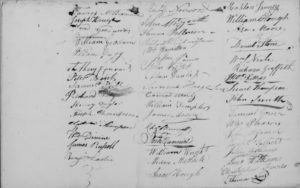
1800 Petition for Town Signatures

In 1801, the village officially became a town with the ability to lay off land into lots and streets. This enabled the town to expand beyond the existing Main Street, up what in the early days was called Federal Hill.

The town continued to grow and fill with tradesmen, tavern keepers and craftsmen who made furniture, hats, shoes, saddles and clothing. The building trade was so busy that a second water-powered sawmill was built off Balls Run to churn out even more lumber for the housing boom. Most of the new houses were constructed of brick, likely made at the brick manufactory that was established in a meadow by the mill race.

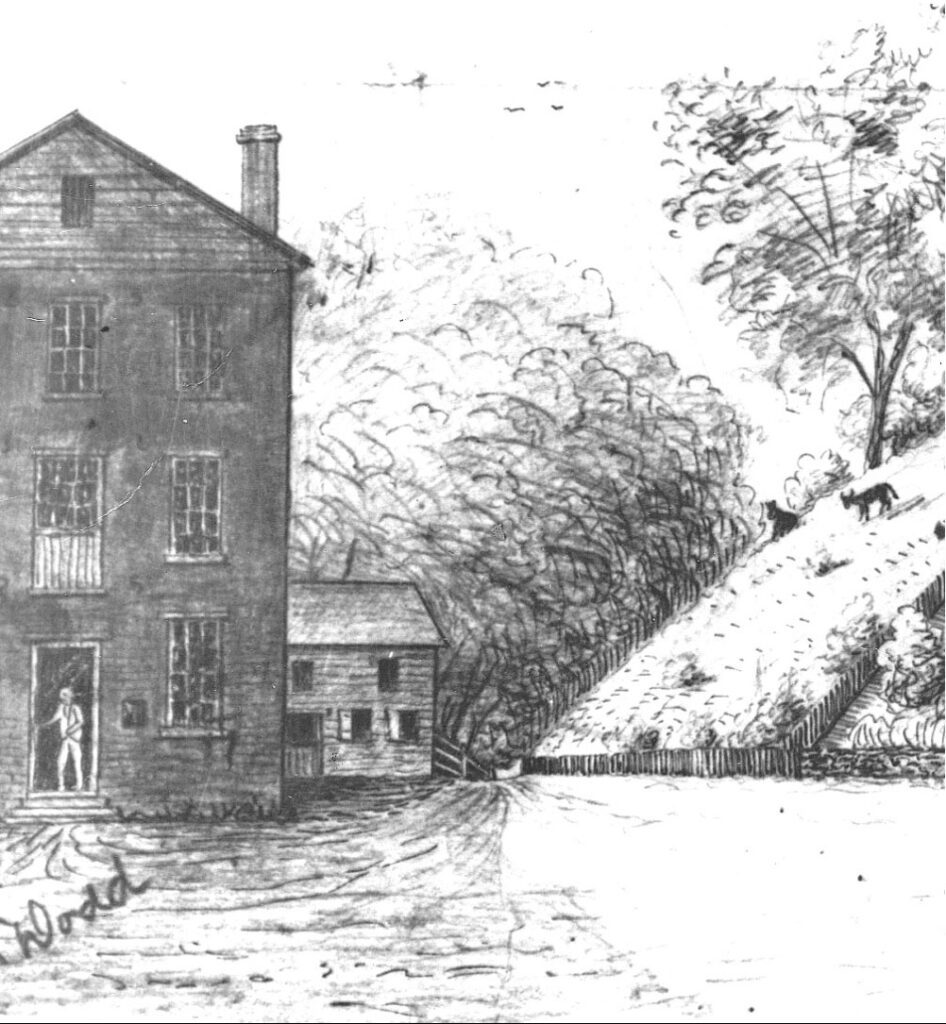
Sketch of the Waterford Mill by Dodd, c.1883 (WF Archives)

The pace of building slowed to a crawl after Thomas Jefferson enacted the Embargo of 1807 that prevented merchant ships from trading in foreign ports. This resulted in an economic depression and the financial ruin of the Waterford grist mill, which relied on foreign trade. Building in town resurged once the embargo was lifted in 1809.

Changes during the Industrial Revolution

Spurred by new innovations in America’s first Industrial Revolution, a woolen factory was established at the south end of town. This corner of Waterford would come to be a manufacturing hub where blacksmiths, carriage makers, wheelwrights and machinists worked at their anvils. Down the street, the nearby sawmill operation added machinery for a plaster mill and clover mill to foster increased local agricultural yields.

After the War of 1812, the town greatly expanded around new streets and alleys laid out in a grid pattern during America’s 1815-1819 economic speculative boom. To support the growth, a bank was established briefly in Waterford before the state required it to close.

Brick dwellings were constructed in the “New Addition,” the grist mill was replaced with a larger three-story brick mill, and a commodious three-story brick house with a lower-level store was built in the center of town – – right before everything came to a halt with the 1819 banking panic and years-long depression.

The proprietors of the Waterford Mill and the large stone tavern were forced to sell their businesses to meet their financial obligations. The long economic recovery, recession, and depression that followed stalled most growth in the town, though industrial manufacturing of agricultural implements continued to evolve.

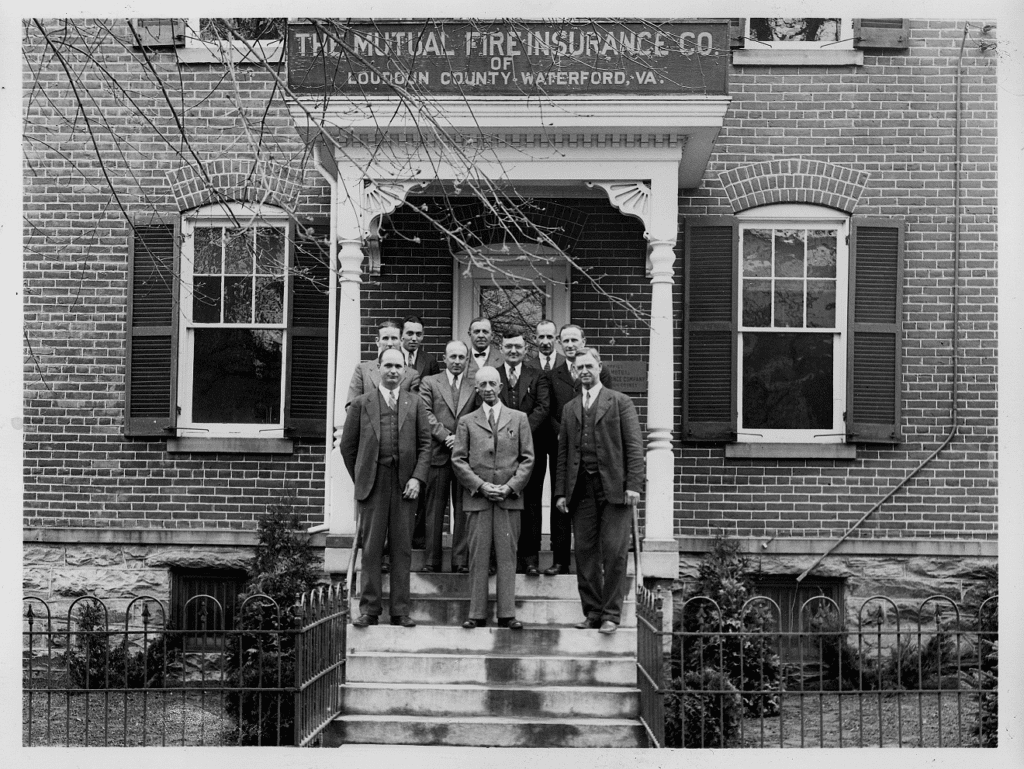
Mutual Fire Insurance Company Photo in the 20th Century (WF Archives)

A period of American business expansion from 1844-1856 included the establishment of a fire insurance company and construction of a few more houses and the Baptist Church edifice in Waterford. A fraternal benevolent association, Evergreen Lodge No. 51 of the Independent Order of Odd Fellows, was organized in 1847. They purchased a three-story brick house on Main Street where they held meetings and transacted business.

The Civil War and Reconstruction

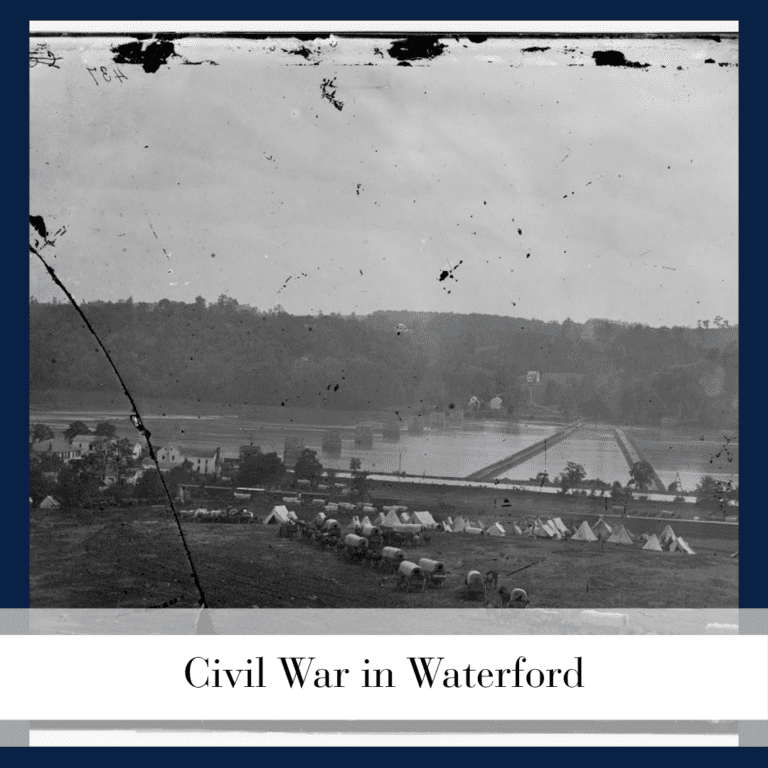
But soon, the Civil War commenced. Men from Waterford and other strongly Unionist areas of north Loudoun formed the Independent Loudoun Virginia Rangers, a federal cavalry company under the leadership of local miller Samuel C. Means. At least one free Black man from Waterford joined the 55th Massachusetts Volunteer Infantry Regiment, while a few more served in other Union units, sometimes informally. A handful of White residents voted for secession, though, and several fought for the Confederacy. The town was beset by raids, including a bloody skirmish at the Baptist Church, and intermittent occupation by Confederate troops.

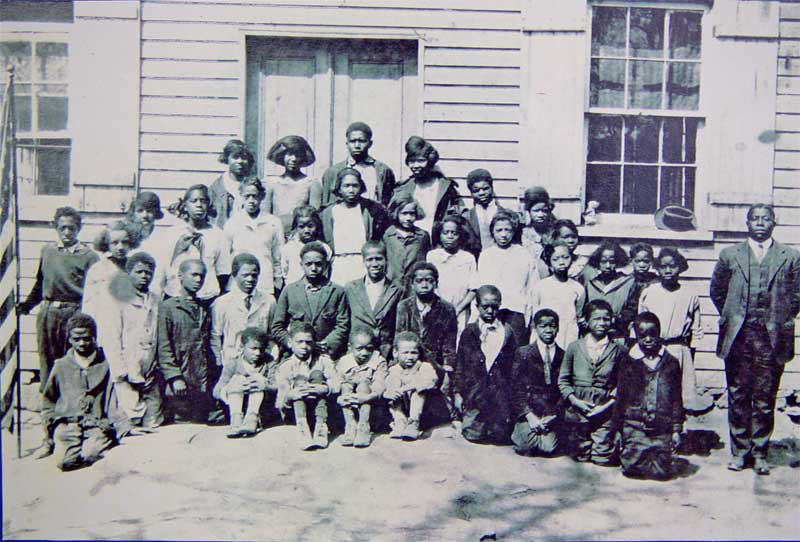
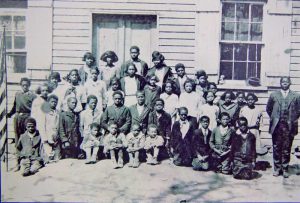
Class Photo at the Second Street School, or Colored School A (WF Archives)

Post-war reconstruction benefited the Black population when they constructed a school for their children, aided by the federal Freedman’s Bureau and a Philadelphia Quaker society.

Little growth followed until, bit-by-bit, Waterford started to shake off its stagnant economy. In 1867, passenger railroad service from Alexandria arrived at nearby Clarke’s Gap station, and two years later, a daily stage line ran between Waterford and the depot. This benefited Waterford homeowners who earned additional funds by boarding urban-area residents in the summer months.

Waterford gets on the map

In 1875, the town of Waterford was reincorporated and a map of the town was created that advertised businesses, including several women-owned establishments. The new charter allowed the town to collect a town tax, make public improvements and have use of the county jail.

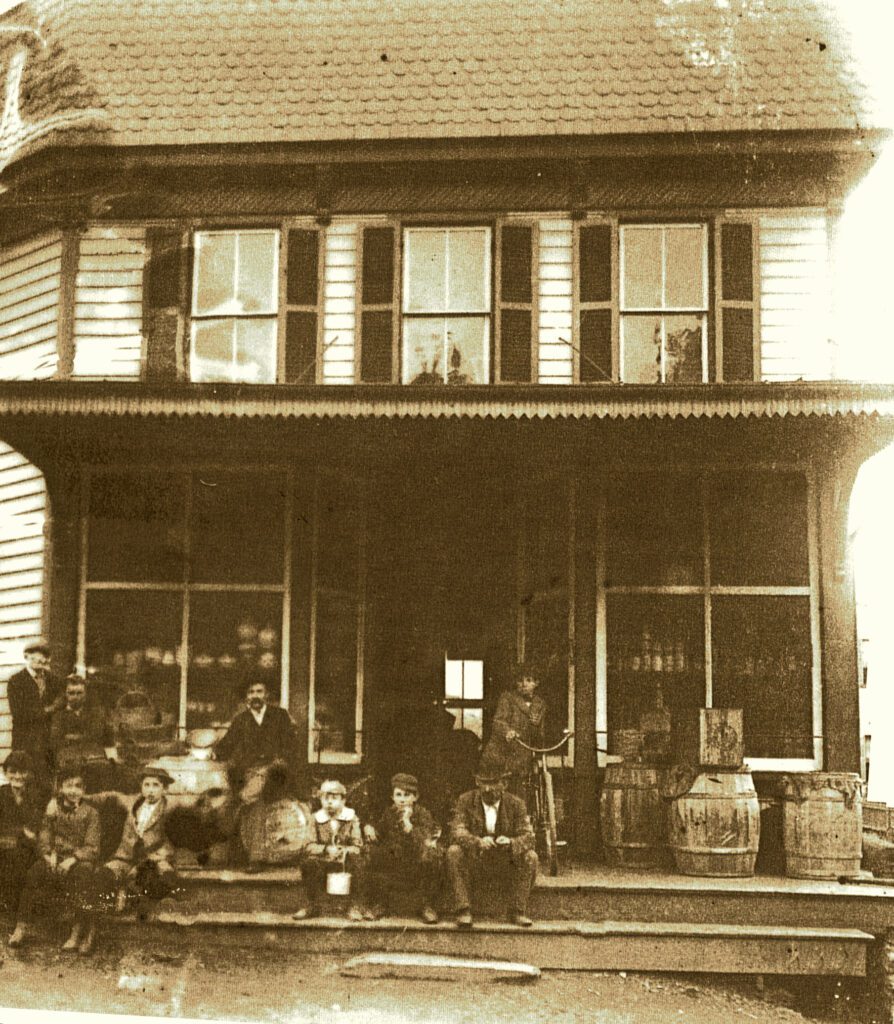
“Corner Store Hangout”, 1900 (WF Archives)

By the time industries fueled America’s business expansion from 1879-1893, Waterford carpenters were already quite busy. New types of specialty stores, such as grocery stores, drug stores, and tin shops opened; several in new buildings. And several Victorian-style homes were constructed on available town lots to house the shopkeepers and clerks.

This period of growth coincided with the Third Great Awakening. Increases in church attendance resulted in the return of a Presbyterian congregation to Waterford and construction of a Methodist church edifice for White congregants on the hill and for Black congregants near the mill.

The temperance movement, which sought to limit and then ban the consumption of alcoholic beverages, found new life in Waterford. Advocates met in the Temperance Hall above the Chair Factory. Other community activities at the time included attendance at literary society meetings held in local homes.

Electricity use and innovation
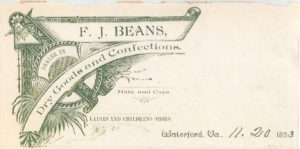
FJ Beans operated his store in the Waterford Market

Waterford saw remarkable changes during the Second Industrial Revolution. In 1884 you could place a telephone call at Dr. Connell’s store in Waterford to Clarke’s Gap after lines were run between the two places. Or you could receive electric therapy treatment from Dr. Connell with the use of his Electric Battery apparatus. Mr. J. F. Dodd improved the Waterford Mill by putting in machinery for making roller process flour. And in 1914, E. H. Beans, Waterford’s enterprising liveryman, acquired an automobile.

The type of employment available in Waterford also changed. By 1910, there were no longer any Waterford craftsmen making chairs, furniture, saddles, or shoes, which by then were made in urban factories. However, there was a stenographer, electrician, and a “phone girl” working in the Central office.

The impact of urbanization

The Industrial Revolution led to an increase in the pace of urbanization. The population of cities swelled as employment opportunities in factories and department stores rapidly grew. Farmers began converting fields into dairy farms to supply milk to local creameries that made butter for the burgeoning Washington, D. C. market.

Kingsley Creamery built a creamery on the Waterford town lot in 1885, but its duration was short-lived. Local creameries were made obsolete by new inventions that allowed city factories to obtain cream directly from farmers.

Local water-powered grist mills were also declining. Engineering advances in mill technology enabled large flour factories to be built on more substantial and reliable waterways.

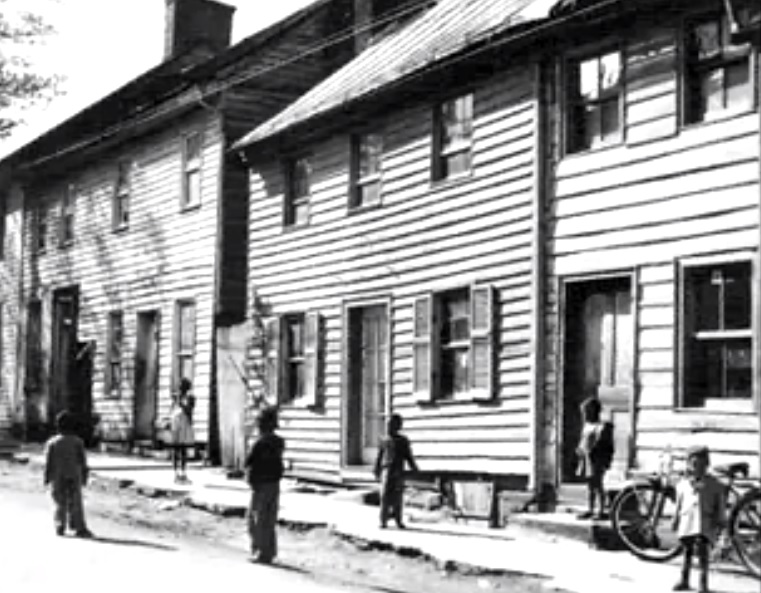
Kids Playing on Main Street, n.d. (WF Archives)

Because of urbanization and changes in manufacturing, both White and Black residents of Waterford moved to cities, notably Washington, D.C. When they left, many of the older structures on Main Street were purchased by Black families, greatly increasing home ownership for Waterford’s Black residents.

During the Great Depression, buildings were purchased by wealthy preservationists who wanted to revive Waterford into a “Little Williamsburg.” Colonial-revival fever struck Waterford. Buildings were stabilized, altered, and “restored” with hand-hewn beams and colonial-style door hardware.

Preserving the village of Waterford

The Waterford Foundation, an early preservation organization, was formed in 1943 to encourage interest in restoring the town to an earlier period. Fundraising fairs featured early crafts made by local artisans and home tours. The village and tour buildings were provided with histories, often with dates erring on the side of the colonial period, never mind that Waterford was founded after the American Revolutionary War.

In time, White families began moving to Waterford in search of post-World War II housing, while the Black population dwindled as the younger generation sought opportunities elsewhere.

The national historic preservation movement took hold after the enactment of the National Historic Preservation Act in 1966 that established funding and guidelines for preservation programs. Waterford was listed on the National Register of Historic Places in 1969 and designated a National Historic Landmark in 1970. Many of Waterford’s historic structures were placed under easements with the state in the 1970s to ensure appropriate preservation treatment.

The Waterford Foundation continues its work to preserve historic the historic properties, including those owned by the Foundation, and to further the understanding of the history of the village in support of its education mission.


Debbie Robison writes about Northern Virginia history. You can read more of her articles on her website.

Want to learn more about the history of Waterford? Check out these articles below!

Check out more of Waterford's history!

How the Civil War Divided Waterford

How the Civil War Divided Waterford

ByAbigail Zurfluh history,Waterford History June 23, 2026
Written by Debbie Robison; Edited by Larisa Epatko — Although Quakers were the original…
Read More
Quakers Arrive, an Agricultural Community Thrives

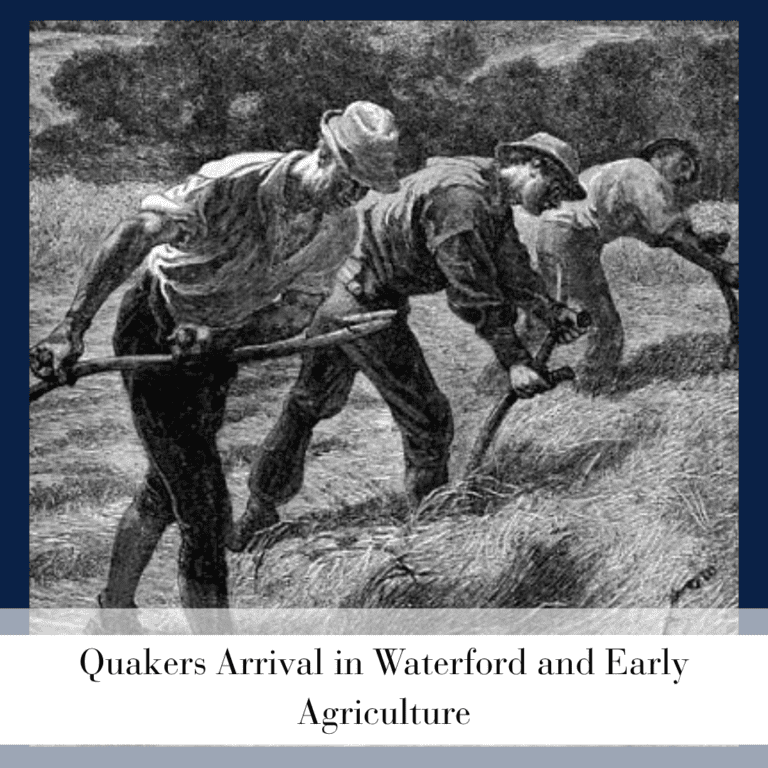
Quakers Arrive, an Agricultural Community Thrives

ByAbigail Zurfluh history,Waterford History June 23, 2026
Written by Debbie Robison; Edited by Larisa Epatko — The region between the Catoctin and Blue…
Read More
The Founding of Waterford

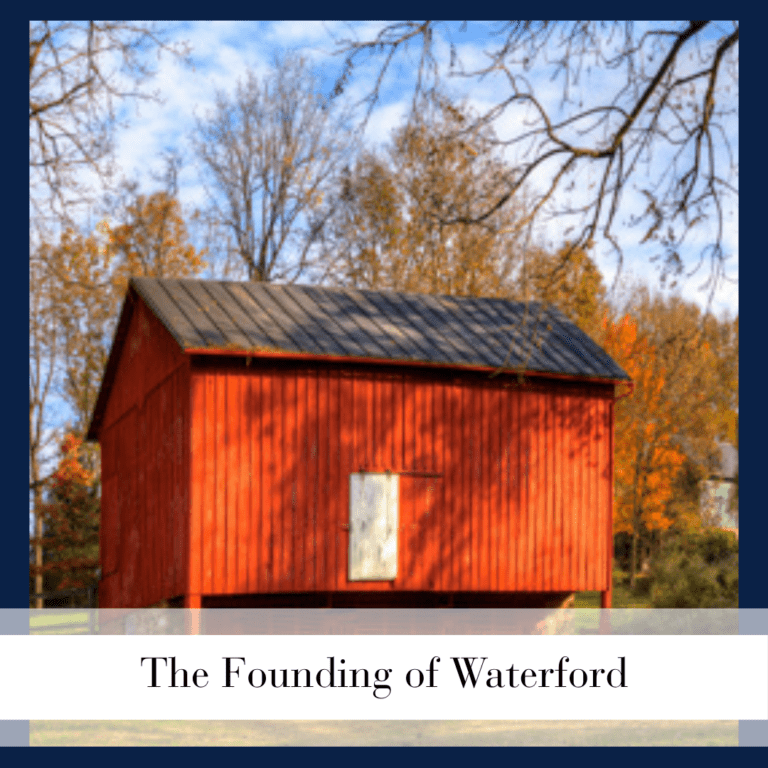
The Founding of Waterford

ByAbigail Zurfluh history,Waterford History June 23, 2026
Written by Debbie Robison; Edited by Larisa Epatko — The village of Waterford was founded in…
Read More

Filed Under: Black History, history, Home-page, News, quaker, Waterford History

The Telltale Nail: A Closer Look at the Second Street School

February 3, 2023 by Waterford Foundation

By Debbie Robison and John Souders

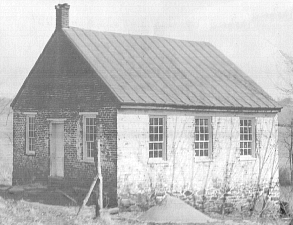
The simple one-room building on Second Street is the iconic symbol of Waterford’s rich African-American past. Black History Month is an opportunity to retell its story in light of intriguing recent discoveries.

Second Street School, 1920

For Waterford’s Black community, both free and enslaved, the prospect of education was one of the most prized results of the bloody Civil War; it was also a goal long supported by the local Quakers. Within months of Appomattox, 28-year-old Sarah Ann Steer had begun teaching under the auspices of her fellow Quakers in Philadelphia, where she had received training.[i] In September 1865 young Marie Matthews noted in her diary a trip in from her nearby farm to see “the Colored school held in Waterford.” She was favorably impressed.[ii]

Her reaction was far from typical in postwar Loudoun County, where former secessionists greatly outnumbered the Unionists who predominated in Waterford. The following January, a day after occupying Union forces had been shifted from Loudoun to Harpers Ferry, a minister from the Northern branch of the Methodist church was waylaid on his way from Leesburg to Waterford to preach. Three men in Confederate uniform put a pistol to his breast, saying “the damned Yankees have left now and you shall leave too.” The local agent of the federal Freedmen’s Bureau reported from Leesburg that in the absence of soldiers “it is the sheerest folly to keep an officer of the Bureau on duty here.”[iii]

Miss Steer was undeterred by such episodes. By July 1866 she was able to report to her school’s Quaker benefactors that “I have on my list 46 scholars all of them attend when they can, of the number 25 or 28 always present. They are mostly small children who can be spared from home. The larger Boys and Girls and Adults are obliged to work most of the time for their support and come to school when they have a leisure day or afternoon.” [iv]

Local historians have long supposed that Sarah Ann was teaching from her house—her family was then renting the Mahlon Schooley House (15555) on Second Street.[v] She regularly complained of the limited space available. A closer look at Freedmen’s Bureau records and Quaker correspondence, however, indicates that within a year she had begun to rent a small building from her cousin William B. Steer, a well-off elder of Fairfax Meeting.  He had purchased Dr. Charles Edwards’ old house (15545 Butchers Row) in June 1866 and on the property, according to insurance records, was a one-story brick structure—possibly the doctor’s office—measuring 16 feet square.[vi] The size closely matches the Freedmen’s agent’s description of Sarah Ann’s classroom as of May 1867: “. . . there are now attending Miss Steer’s school about 25 Scholars all that there are accommodations for as the school is taught in a room not more than 14 feet square.”[vii]

By then the Freedmen’s Bureau was paying William Steer the monthly rent—$2.10—while the Association of Friends of Philadelphia continued to pay Sarah Ann’s salary.[viii]

The local Black community, meanwhile, had taken an active role in their education. In July 1866 “the Colored People of Waterford” purchased for $75 a vacant lot on Second Street from Quaker wheelwright Reuben E. Schooley and his wife Louisa (Lucy).[ix] They aimed to put up their own building to serve as both a school and church. They had selected five men to serve as trustees: Jonathan Cannady (Kennedy), Matthew Harvey, Alfred Craven, Henson Young and Daniel Webster Minor. “Web” Minor could read and write, but most of the others were probably illiterate. Craven and Young had been born into slavery.[x]

Money for the new building was, of course, an issue, even as construction began in early 1867. The Quakers appear to have chipped in, and the local Freedmen’s agent appealed to his superiors in May for $250 to complete the work.[xi] “. . . when the new house is complete [it] will seat and accommodate about 65 or 70 scholars, it will be filled to its fullest capacity, many can not now be admitted [in the rented space] for the want of room.”[xii] By then the building was already “under roof,” according to the trustees’ application to Waterford’s insurance company for coverage. The structure was “Made of wood and new, 24 by 30 feet with one brick flue when completed. One or two stoves.”[xiii]

The new building was still not ready for occupancy when Sarah Ann reopened school in November 1867, in the crowded rented room. But, she reported, during the summer break “the colored people [had] set themselves to work in good earnest to finish the house which is to serve the double purpose of a school-room and church. They had it plastered, the entire expense of which was borne by one man. They then had a church festival, the proceeds of which they devoted to putting in seats and a desk for me.”[xiv]

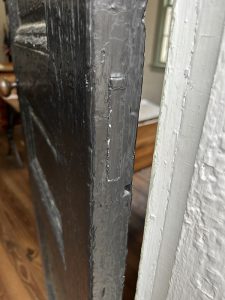
The style of the Second Street School doors, and the through tenons used in constructing the doors, suggests that the door was manufactured sometime around the late-19th century. Photo by Debbie Robison

Curiously, in June the Freedmen’s Bureau had paid local White carpenter Charles Fenton Myers $100 for “service rendered in repairing [the] School house at Waterford.” The job had taken two carpenters 20 days to complete. “Repairing” on that scale seems an unlikely activity on a building still under construction. Perhaps the term was a bureaucratic fudge deemed more likely to elicit reimbursement from headquarters.[xv]

By the end of 1868, despite setbacks and delays, the students and Sarah Ann had settled into their new building. A visitor forwarded a glowing report to the Freedmen’s Bureau:

“. . . I came to Waterford where I remained over night & half a day visiting the colored people and their school and have the [honor?] and pleasure of submitting the following with reference thereto. There are about Thirty-five (35) families of (col’d) people in and about this village almost all of whom are said to be industrious and worthy people. Their advantages in this community are very much greater than in any other visited by me so far in the counties of Fairfax & Loudoun. Almost the entire white population being wealthy Quakers who interest themselves in the welfare of all the people without regard to race. The Teacher of the (col’d) school now in operation at this place is Sarah Steer she has enrolled about (30) pupills but a smaller [number?] in attendance. The salary of the Teacher is $35.00 per month Paid entirely by the friends of Philadelphia . . . Best school house in the county I believe is this one, owned with the lot of half acre entirely by the (col’d) people worth about $800, frame house good style & painted in size 25 by 30 ft in addition to all this they have now in their associations Treasury about $200 for educational purposes whenever needed, but thus far as I understand they have not been required to contribute any thing to the salary of the Teacher. It is only necessary to say in conclusion that if all the colored people in Virginia were as these are, with such white neighbors, ‘Peace’ would reign and reconstruction might be short work . . . But . . . Waterford can take care of its colored people or rather . . . they can take care of themselves.” [xvi]

That report was probably a bit over the top, but the 1869-70 session continued to build on earlier success, as the Bureau’s monthly report for February 1869 made clear:

“Waterford School opened October 1st and was expected to close May or June. The school was funded in part by the Friends of Philadelphia and part by Freedmen who contributed $15 this month. One teacher, 50 students enrolled: 35 male, 15 female, avg attendance 36. 24 students are members of the Waterford Temperance Society. Number in Writing: Books 36, Slates 20. Sabbath school with 6 teachers and about 40 pupils.”[xvii]

The Freedmen’s Bureau had pressed for establishment of a temperance society as an important feature of its support for the local Black community.[xviii]

The October 1869 report introduced a couple of cautionary points, noting that the school had been closed for five days “to make necessary repairs to the building,” and that public sentiment toward colored schools was “not very favorable though I think improving.” It was a period in which the political tides in Loudoun and the South were running against the reformers.[xix]

1870 brought big changes to the school. Virginia had a new postwar constitution—a condition for readmission to the Union—and with it a statewide public school system. The transition marked Sarah Ann Steer’s last year at the school. “In accordance with instructions received from Philadelphia, I closed my school March 31st.”  She hoped “to be held in remembrance by those which whom I have been associated in this great work, a work in which my heart has been truly interested . . . .”[xx]

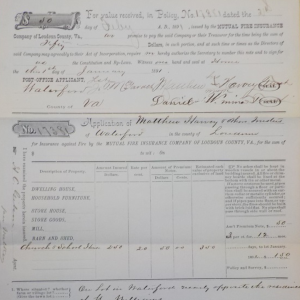
1891 Insurance Policy

Under the Loudoun County school system, subsequent teachers at “Colored School A” on Second Street were African American. The school continued to be a source of pride in the Black community, and the trustees evidently retained a role in the management of the building, possibly receiving rent from the Jefferson District School Board for use of the building. By 1884 there was concern that the building was no longer adequate. The press reported in January that “the school trustees are going to build a large school house for a graded colored school.”[xxi] From the beginning the building had also served as a place for church services but had probably never been large enough for the purpose. In March 1885 “the members of the Methodist Episcopal Church (Colored) of Waterford . . . have no place now that we can call a house of worship, and the building we usually occupy does not accommodate the congregation.”[xxii]

In the end the congregants decided to build their own church, and the John Wesley Methodist Episcopal Church on Bond Street was dedicated six years later.

The plan for an enlarged schoolhouse was never realized. The Jefferson District School Trustees purchased a lot on High Street but never built the school and ended up selling the lot.[xxiii] Instead, a recent close inspection of the current structure indicates that it was at some point largely rebuilt. The wire nails used to frame the building, attach siding and interior paneling, and construct shutters, etc.  did not come into use until well after the initial construction in 1867. And that siding is also not original; its cove-lap profile was not commonly used until the 1880s.

As yet, research has turned up no clear documentary evidence of reconstruction. Clues, though, appear on an insurance policy for the schoolhouse dated 1891, which shows that the schoolhouse, then in moderate repair, was still locally owned. At the top of the cover there is a second date, in red, of August 9, 1895. That may be the date when the insurance was discontinued, suggesting that a change occurred either in the names of local trustees or a possible transfer of ownership to the Jefferson District School Trustees. Ongoing research into insurance records, newspapers, and school reports is underway to narrow down the date of reconstruction, any ownership changes, and the reason for rebuilding the schoolhouse. Stay tuned.[xxiv]

In any event, the new building continued to serve the Black community of Waterford and its hinterland until 1957, when Loudoun consolidated its rural schools. The School Board sold the vacant structure to a private individual in 1966, and the Waterford Foundation acquired it in 1977.[xxv]


[i] O.S.B. Wall , Letter to Col S. P. Lee, U.S. Freedmen’s Bureau Records, Superintendent of Education, M1913, Roll 45, p. 908, 17 Dec 1868.

[ii] John E. Divine, When Waterford & I Were Young, Waterford Foundation, 1997, p. 40.

[iii] Ferree to Fullerton, Act As. Cmr DC, Leesburg, VA, U.S. Freedmen’s Bureau Records, Assistant Commissioner Files, National Archives and Records Administration (NARA) M1055, Roll 5, p. 248, 15 January 1866.

[iv] Sarah A Steer, Monthly School Report, U.S. Freedmen’s Bureau Records, Superintendent of Education, NARA M1056, Roll 14, p. 90, July 1866.

[v] Mutual Fire Insurance Company of Loudoun County, Policy 473, 31 August 1867, Library of Virginia.

[vi] Loudoun County Deed Book 5V:335, 02 Jun 1866; Mutual Fire Insurance Company of Loudoun County, Policy 231, 01 Apr 1869, Library of Virginia.

[vii] Smith to Manly Leesburg, U.S. Freedmen’s Bureau Records, Records of Field Offices, NARA M1913, Roll 100,  N495, 18 May 1867.

[viii] Smith to Lee, U.S. Freedmen’s Bureau Records, Records of Field Offices, NARA M1913, roll 100, N194, 22 Mar 1867.

[ix] Loudoun County Deed Book 5V:334, 29 Jul 1866.

[x] Mutual Fire Insurance Company of Loudoun County, Policy 17381, February 2, 1891; Loudoun County Will Book U, pp. 148 & 371

[xi] Smith to Capt S. P. Lee, U.S. Freedmen’s Bureau Records, Assistant Commissioner, NARA M1048, Roll 5, p.219, 08 May 1867.

[xii] Smith to Manly, U.S. Freedmen’s Bureau Records, Records of Field Offices, NARA, M1913, Roll 100, N495, 18 May 1867.

[xiii] Mutual Fire Insurance Company of Loudoun County, policy #425, 27 Apr 1867, Library of Virginia.

[xiv] Friends Intelligencer, Philadelphia, PA, November 3, 1867

[xv] Charles F Meyers, U.S. Freedmen’s Bureau Records, Records of Field Offices, NARA M1913, Roll 36, pp. 232, 234, 09 May 1867.

[xvi] O.S.B. Wall, letter to Col S. P. Lee, U.S. Freedmen’s Bureau Records, Records of Field Offices, NARA, M1913, roll 45, p 908, 17 Dec 1868.

[xvii] Sarah A Steer, Monthly School Report, U.S. Freedmen’s Bureau Records, Superintendent of Education, NARA M1913, roll 50, #821, Feb 1869.

[xviii] OO Howard, Circular letter to S P Lee, U.S. Freedmen’s Bureau Records, Records of Field Offices, NARA M1913, roll 048, p. 673, 23 May 1867.

[xix] Sarah A Steer, Monthly School Report, U.S. Freedmen’s Bureau Monthly School Report, Superintendent of Education, M1053, roll 17, p. 434, Oct 1869.

[xx] Friends Intelligencer, Philadelphia, PA, 1870.

[xxi] Alexandria Gazette, Volume 85, Number 26, 30 January 1884, p. 2.

[xxii] Loudoun Telephone, Hamilton, VA, 27 Mar 1885, p. 3.

[xxiii] Loudoun County Deed Book 6V:15, 28 Aug 1883; Loudoun County Deed Book 7I:437, 20 Sep 1894.

[xxiv] Mutual Fire Insurance Company of Loudoun County, Policy 17381, February 2, 1891, Library of Virginia.

[xxv] Loudoun County Deed Book 461:491, 31 May 1966 ; Loudoun County Deed Book 682:309, 19 Oct 1977.


Filed Under: Black History, history, Home-page, News, sss, Waterford History

Random Thoughts from the Elbow Chair of Tim Tickler Sr.

February 2, 2023 by Waterford Foundation

Tim Tickler Sr. was the nom de plume of S.B.T. Caldwell, a Wheatland resident and member of the “Young Friends Literary Society”, founded in the mid-19th century, although he was not a young man at the time, nor was he a member of the Religious Society of Friends (Quakers). A former publisher of the Genius of Liberty, Caldwell’s observations in the essay below demonstrate how quickly news could travel in an age of telegraph, railroads, and steam power, in some cases more quickly than folks were able to understand.

12th Mo 21st 1859

Random Thoughts from the Elbow Chair of Tim Tickler Sr.

Confined for many years to my chamber by the gout, cut off from the world without getting no information of passing events except what I can persuade my little flirt of a grand-daughter to read from the papers, and she soon tires, unless I can listen to love stories, or tales of murder- I am consequently badly posted in regard to matters and things in general, rather at home or abroad. My cogitations during the intervals between the twinges of the gout, have been principally upon things past, with a strong desire that I might be able to compare them with things present- but my knowledge of the present was too superficial- too unreliable- to come to any satisfactory conclusion. I have heard so many and such strange tales about the wonderful progress made and making in this age and generation from my nephew, Tim Twist, who by the way is a very fast young man, that my mind was not prepared to believe anything. There was too much of the Arabian Knights, too much of the Gulliver’s Travels, in the reports I heard to give credence to any of them. But my faith was staggered a few years ago [1852] by the sudden announcement of the death of my old favorite- Henry Clay.

My daughter Tilda came into my room with a paper in her hand, while I was suffering much with pain in my toes and feet. Say she Father- don’t disturb me child says I- but I thought you would like to hear the news- says she- well what is it? says I: Why Henry Clay is dead! Dead says I, when did he die? Yesterday morning says she! and she read an account of his death and then next on to read telegraphic dispatches showing how the news of his death was received in Philadelphia, New York, Boston, Richmond, Cincinnati, Louisville, and all the principal cities for 6 or 700 miles in every direction. What paper is that says I? The Baltimore American of this morning says she- well well says I, that will do Tilda, that will do. Then I began to reflect is it possible says I that H Clay died yesterday morning in Washington and that a Balt. paper of this morning not only gives me the sad intelligence but informed us how it affected the whole community for many hundred miles around us, east west north and south. It cannot be, there must be some mistake. The newspapers are working upon the credulity of the people, the news of his death cannot yet be known to the people of Boston, Louisville, etc. It is all guess work up on the part of the Editors. They would make us believe they are omnipotent, omnipresent; that they know all things by intuition. It’s all a humbug. I don’t believe a word of it & won’t believe that H Clay is dead until I hear further. Such were my cogitations at the time. But alas it all turned out to be too true. Still it was a mystery- one that I could not fathom. I looked back to the time when it took a whole day to get the mail from Washington to Baltimore- when it required a week to et the news from Richmond up into the country, when there was no unusual delay occasioned by bad roads and high waters- and could not believe that this progressive age had accomplished such wonders. 

My mind was much exercised for a week or two upon this mysterious development- It appear to me so much like a dream and it passed off and I have hardly given it a thought since- and have heard but little that is going on in the outside world since until very recently when the whole community was suddenly startled by the movements of a fanatic by the name of Brown, Old Ossawattamie Brown I think they call him– There was something so romantic in the whole affair that my witch of a granddaughter has read nothing else to me since it happened.

She has thrown away her love stories and while my daughter Tilda is bathing my feet with Radway, the little sprite sits on a stool beside me and reads all the news from Harpers Ferry and Charlestown from the Baltimore paper which gives all the news of the preceding day at either of those places- by which I learn that monomaniac Brown came to Harpers Ferry with a hand full of men 22 I think all told, black and white, took possession of the US arsenal laid the town under siege stopped the cars upon the Rail Road- blockaded the Bridges- guarded the various avenues to the place – made prisoners of some 50 or 60 of the citizens and government officers- broke the telegraph wires– went 5 or 6 miles in the country- captured some of the principal farmers- brought them with their servants prisoners of war to town in their own carriages and struck a panic thro’ the whole surrounding neighborhood- this was all done on Sunday night and Monday morning – Presto-

On Tuesday the whole state was in motion and by noon of that day Gov. Wise with the military from Richmond, Alexandria and Washington was there- Brown still holding his prisoners as hostages and resisting the authorities until the US Marines, by aid of battering ram broke open his fortress and compelled this modern Leonidus to capitulate. See this occurred almost within hearing of my chamber and I knew nothing of it until Tuesday evening when Tilda brought in my supper and told me the whole story and much more as she has heard it from Tim Twist just from the Ferry- Tis no such thing says I, Till- I don’t believe a word of it- It is not probable that Gov. Wise could get the news and come two or three hundred miles with a large military force and be on the spot before I, living within a stones throw of the place, should know anything about it- It is just one of Tim’s big stories- but before I had fully expressed by disbelief in the improbable tale my neighbour Crazon came in and confirmed the whole story with some additions and amendments, I was then compelled to believe against my own better judgment- for I knew him to be a truthful and reliable man- still ‘twas strange, ‘twas wonderful; Thinks to myself- O Steam & Electricity behold thy power–Had I ventured 25 years ago that I should live to witness such progress in the transmission of thought by Electricity- or such rapid locomotion by steam- I should have pronounced it all a humbug. 

The visionary schemes of some wild hare-brained romances- Now I am compelled to believe it a living reality- for I have listened to the daily reports of the last six or 8 weeks which has confirmed it all- It forms a part of the eventful history of the times and I am prepared to believe anything, everything no matter how unreasonable. If told that a Balloon from Australia and one from California were now sailing through the air showering gold dust upon our land I should believe it and call for Tilda to push my chair to the window that I might see the stranger sight with my own eyes- and should probably hold out my hand to catch some of the precious metal as it fell-there is nothing so wild, nothing so visionary, nothing so improbable as to create a doubt in my mind of its reality- yes Brown has been arrested, twice, convicted, condemned, and executed, by due course of law and without the aid of Judge Lynch. 

Since this Brown excitement has measurably subsided my mind has been particularly exercised upon the power and influence of Fashion Fickle Fashion whose tyrannical sway over her votaries is more powerful than Steam, more wonderful than Electricity- yes I am ok? ok! ok! The gout The gout, More Radway Tilda- more Radway…….


Find other stories like this in To Talk is Treason by Divine, Souders & Souders available here.


Filed Under: history, News, Waterford History

A Few Surprising Threads of Waterford’s History

October 28, 2022 by Waterford Foundation

by Jane Williams and Bronwen Souders

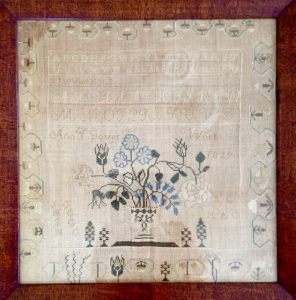
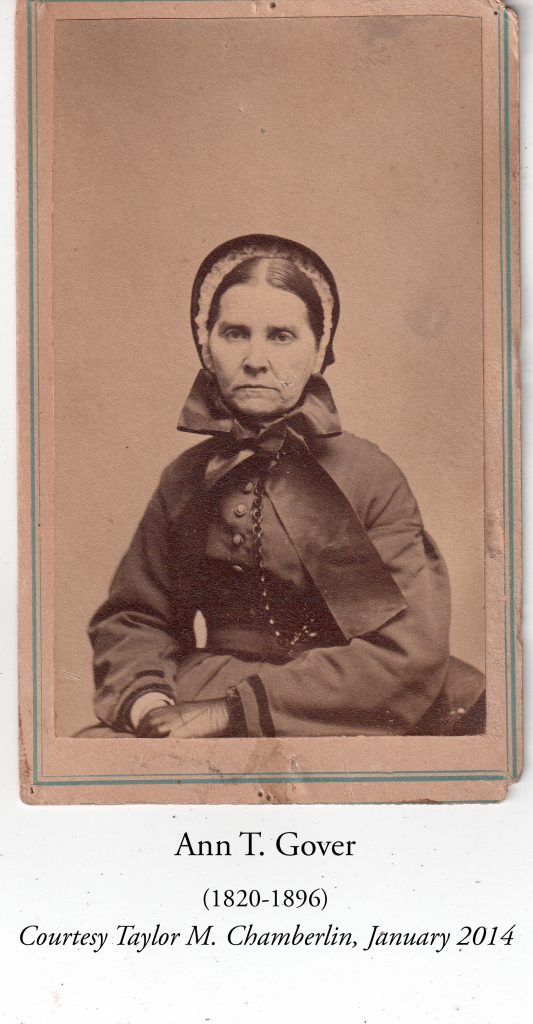
Waterford Quaker Ann Taylor Gover was probably not yet nine when, in 1829, she put down her needle and presented her latest handiwork for inspection. Her cross-stitch sampler evidently passed muster as it remained a treasured keepsake in the Gover family for nearly two centuries. It is now a valued part of Waterford’s Local History Collection, and to a trained eye it has stories to tell.

Cross-stitch samplers like Ann’s can tell us much about the cultural context and even artistic aspirations of ordinary women often marginalized in the telling of our history. Ann’s is exemplary of Quaker samplers of the early 19th century. Although the Society of Friends did not put a definite stamp on the artform of quilts, for example, as the Amish did, their samplers have a long prolific history in Quaker art.

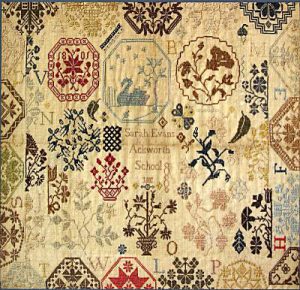
One of the most iconic series of samplers come out of the English Quaker school Ackworth in West Yorkshire, UK. The Ackworth School’s are marked by fine and intricate motifs that still influence sampler design today.

Sarah Evans’ Sampler 1801 Ackworth School, West Yorkshire, UK

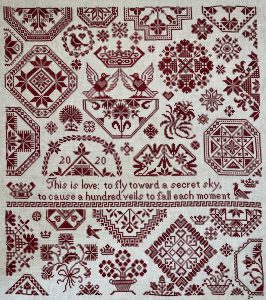
Modern Folk Embroidery 2017, stitched by Jane Williams


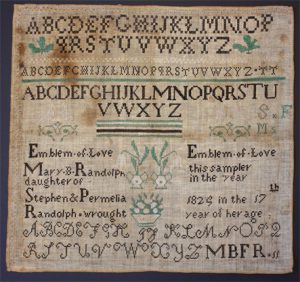
In 1829, Mary B. Randolph stitched the piece below under the guide of Quaker teachers in Redstone, PA. Although Randolph’s sampler is similar to Ann’s, both are unique in their details. Samplers are often described as a teaching tool, but we also now view them as distinct artistic endeavors by the embroiderer. Ann’s piece is lovely and balanced and gives us some insight into everyday life in Waterford’s Quaker community. It includes a central urn, scripted alphabet and intricate border. It was worked in linen with silk thread.

Mary B. Randolph Sampler, Courtesy of Benton County Museum, Benton, OR

Ann T. Gover sampler, Courtesy of Waterford Foundation Archives


Ann was born into an important Quaker family in Waterford. Her father Jesse had earned prosperity as a harness and saddle maker, dry goods merchant, butcher and hat manufacturer. Both he and his wife Miriam “had received a gift in the ministry” of their Quaker meeting. And Jesse was active in the Loudoun Manumission and Emigration Society, an early effort to ameliorate the condition of Loudoun’s enslaved Blacks.

Ann as a teenager attended Samuel M. Janney’s highly regarded Springdale boarding school in nearby Goose Creek (Lincoln). Janney was Loudoun’s most prominent Quaker. But family fortunes darkened in 1845 when Jesse Gover died, still in his 40s. Ann, as the youngest daughter and still single, evidently set aside any plans of a family of her own to help look after her mother.

In 1871, some years after Miriam’s death, President Grant appointed Samuel M. Janney superintendent of Indian affairs in Nebraska, and, at about 50 years of age, Ann jumped in to help with her old Quaker headmaster’s mission. She set to work at the Manuel Labor School on the Pawnee Reservation, and with a fellow instructor was put in charge of the sewing program. Her childhood skill with needle and thread was thus passed on to another generation in a far-off place.

The circumstances were often trying. “. . . Of the 80 scholars connected with us at the time of our last report, one was a day-scholar, and attendance has been discontinued; five have been married and are now living in their own homes, two were killed by the Sioux, two died of chronic diseases, and one of an epidemic . . . [but] the girls are becoming skillful cooks, laundresses, housekeepers, and seamstresses under the kindly and watchful direction of those who instruct them . . . .”[1]

Ann eventually returned to Waterford and lived with her brother Samuel in the Griffith-Gover House on Main Street; she never married. She died in 1896 and rests in the Fairfax Meeting Burying Ground, leaving a childhood sampler that offers a glimpse into the artistic endeavors of everyday life in Waterford and presaged an adventure in the West that was not ordinary at all.


[1] Report of the Commissioner of Indian Affairs, Nebraska Superintendency http://images.library.wisc.edu/History/EFacs/CommRep/AnnRep71/reference/history.annrep71.i0011.pdf


Filed Under: history, News, Waterford History

The Man on the White Horse

October 27, 2022 by Waterford Foundation

An excerpt from “When Waterford and I Were Young” by John Divine

Aunt Dolly devoted much of her later life to taking care of her mother after the death of Grandfather in 1903. She never lost her love for her Baptist Church nor her belief in ghosts. Woe be unto anyone who did not share her belief in the supernatural.

I enjoyed hearing Aunt Dolly’s stories but, never having seen a ghost, remained privately skeptical. Several years after her death, though, I had an experience that is still as fresh in my mind as the day it shook me.

On January 24, 1885, Landon Merchant, a man who lived north of Waterford, was found dead on the road that leads to Clark’s Gap; his white horse was standing near the body. Mr. Merchant’s head had suffered a severe blow, whether from a fall from his horse or foul play was not known, but a legend was born of the “Man on the White Horse.”

Aunt Dolly, herself, had seen the white horse, and in an unpleasant way, resulting in skinned shins. She and several others of the younger set were going to a party in a light wagon with boards across the wagon bed for additional seats. As they passed the site of Merchant’s death, their horses shied to the side, and a white horse reared up, striking the board in front of Aunt Dolly and driving it back into her shins. I recall that she did have a badly scarred leg.

There is a sequel. In 1964, while doing an article for the Waterford Foundation, I interviewed Miss Eleanor “Bide” Chamberlin. This was a great experience as Miss Eleanor, then 90 years old, was a charming lady with an excellent memory of her life at Clifton on Clark’s Gap Road and the stories her mother had related of Civil War times there. Each trip to visit her was such a pleasure that I’ll admit that I made more than were necessary for the article. Talking to her and her niece, Mrs. Edith Stahl, was unforgettable.

One day, when I was leaving, Miss Bide said, “John, why don’t you write about the Man on the White Horse?”

I was bug-eyed. Shades of Aunt Dolly! Seventeen years after her death I hear of the Man on the White Horse from another source. My question to Miss Bide: “Did you ever see it?”

“No, but my brother and others saw it many years ago.”

With testimonials from persons of the character of these two ladies, maybe we should take a second look at ghosts.


For more stories of Waterford by John Divine, see When Waterford and I Were Young, in our online shop.

Filed Under: News, Waterford History

Taverns in Waterford

August 4, 2022 by Waterford Foundation

by John Souders

Waterford’s history with alcohol is long, complicated and often dreadful. In 1888 a village correspondent commented, “I hear the charge that there is a good deal of drinking in Waterford and I am afraid the town is not in position to bring suit for slander on this score.”

By the mid-1830s, according to Martin’s Gazetteer of Virginia towns and villages, Waterford boasted four taverns, outnumbering churches and schools. The tavern with the longest run operated at 40170 Main Street. It was known variously as Talbott’s Tavern, after lapsed Quaker Joseph Talbott, who bought the property in 1810; Manning’s Tavern; Matthews’ Tavern; and for long stretches the Waterford Hotel. Waterford Quaker Mary Dutton Steer probably had this establishment in mind in the early 20th century when she added the following stanza to her poem “Old Memories”:

A tavern stood upon the street

That some did much deplore,

For many a noble-minded man Went down to rise no more.

An early competitor was Klein’s Tavern, which owner Lewis B. Klein opened in 1825 as a “house of entertainment.” Its run as a tavern was relatively brief. The building today is known as the Pink House (40174 Main Street).

Around the middle of the 19th century, Oscar Fitzallen Reed operated a tavern in the center of town.

Thirsty Waterfordians also bought brandy and whiskey at any of several stores in town. And there were numerous instances of villagers, both Black and White, selling liquor without a license (see below). The results of all the drinking were predictable; they pepper the historical record. The press account below, from December 1865, is a vivid example.

On Tuesday and Wednesday of last week the County Court of Loudoun, sitting as an examining Court, was engaged in the trial of William H. Hardy and Charles Curry, for an assault on John P. Gregg, and robbery committed by them of one Gold Watch valued at one hundred and seventy-five dollars, one Gold Chain valued at twenty dollars, and thirty-five dollars in currency (commonly called Greenbacks,) consisting of three ten dollar and one five dollar notes . . .

Lieut. W.F. Keys,[1]  late of the United States army, lives in Waterford, Loudoun county, was there on the night of the 8th of December, 1865, [where he] saw Curry and Hardy and Gregg, all warm friends of his, on that night. [Keys] was in his store when Hardy came in with Charles Virts and Gregg treated [them?] to cigars. Hardy was pretty drunk and commenced bragging about his shotgun, said it was the best gun in Waterford, in fact, the best gun in the County, and could out shoot any other gun. Gregg objected to the statement, and a bet was proposed. [Keys] Asked Hardy to drop it, as it was impossible for him to know whether this was the best gun in Loudoun, it was too broad an assertion. They asked him [Keys] to draw up a bond and he commenced to do so, and they urged him to do so; he consenting as he would do anything to get rid of them. Gregg immediately said he could get rid of him very soon if he did not want him. Hardy wanted Gregg to take back what he had said, but G. insisted that he had said nothing wrong.

Hardy wanted to fight badly, and took off his coat, and flung his arms about a good deal. Gregg also took off his coat, but after a good deal of wrangling, at Keys’ suggestion, put it on again. [Keys] tried to pacify them.

Gregg said he could whip the best man in Waterford, when Keys said hold on, you must not say so, when Gregg said he would take that back. Hardy continued quarreling and flinging his arms about, and Gregg, when he had his coat on his shoulder, said I can whip you with my coat on.

Hardy went out saying to Gregg, I can find someone who will dispose of you pretty soon. Shortly after he came back with Curry and [a] soldier of the United States army. Was about 12 o’clock that the whole row took place. Door [to Keys’s store] was open, Gregg staid there. Hardy came up to the door; Curry came in near the side of Gregg. Hardy said, “now John Gregg you damned rebel son of a bitch, I will settle your hash for you.”  Gregg struck him and knocked him out of the door. Curry seized Gregg and they went down together. When I got out, Hardy was a little distance down the hill, with a stone in his hand, Gregg was on top of Curry, and the soldier on top of Gregg and struck at him twice. [Keys] Jerked the soldier violently off of Gregg, and then Gregg off of Curry. Young Howard Hardy came up and Wm. Hardy who had sidled round threw his stone, [supposedly] at Gregg, and it struck Howard, who threw his and struck William. This was done at his [Keys’s] door; he pushed Gregg in and locked the door. Hardy and Curry wanted [the] soldier to break the door, and [the] soldier wanted them to do it. [They] Called Gregg a damned rebel son of a bitch, and said he Keys, was harboring him. Looked into the store, saw back window open and concluded Gregg had gone, and let them into the store; they all searched for Gregg, but not finding him, commenced abusing Keys, and wanted to whip him. This witness [Keys] used a great deal of profane language and was ordered by the Court to cease using it.

W.T. McNully[1] testified that hearing a noise near Keys store, went up and found Hardy with a stone in his hand, in his shirt sleeves; soon after [he, McNulty] returned to Mr. Graham’s bar-room; which he keeps. Some fifteen minutes afterwards, Curry came with a soldier to borrow a pistol, which he refused to lend him; [he, Curry] was in the bar-room several times during the evening, and was pretty well intoxicated. This was about twelve o’clock at night.

John P. Gregg [was] examined [and] gave substantially the same statement that Keys did until he got outside of the door after knocking Hardy down, was in close contest with Curry and the soldier, one of them laid his hand on the hook of his watch chain, and he [Gregg] said that’s what you’re at is it? and knocked Curry down [and] from that time [he] became so excited, that he remembers nothing until he was again in the store, the door locked and violent attempts made to force it open. He escaped by the back door and retreated to the house of ——- two hundred yards distant; some time after returned to Dr. Fox’s office to have his wound dressed, and while there Curry and soldier came in threatening violently, demanding a [fight]. He being in fear of bodily harm and acting in defense of his life, knocked Curry down with a chair and thinks he bounded over him, and got out of Waterford; as he went out someone called halt, halt, several times, but he did not halt. Lost his watch, chain and money; watch and chain [were] recovered from the hands of a negro named Robinson by warrant from a Justice.

For [the] defense Henry Virts and Henry Hough testified that Hardy was pretty drunk, and Curry very effectually whipped. Submitted without argument. Both prisoners sent on to Circuit Court. Hardy bailed in $500, H.[enry] M. Hardy his father, [acted as] security. Bail was refused to Curry.

Whiskey seems to have been a very potent agent in producing this scene, as it is in almost all others.


[1] Pvt. [not Lieut.] William “S.” Keyes of the Loudoun Rangers lived after the war with wife Virginia at what became known as the Collins Cottage (no longer standing). William applied for a county liquor license in 1866, but in 1869 was fined a stiff $50 for selling without a license.

[2] William T. McNulty was about 17 at the time. He was living with his widowed mother at 40145 Main Street (Camelot School).


Loudoun County Liquor & Ordinary Licenses (Waterford)

Ordinary License 1852 Anderson, James S
Liquor License 1868 Berry, Newton
Liquor License 1847 Conrad, David
Liquor License 1867,1868 Hain[e]s, Joel
Liquor License 1866 Keys, William S.
Ordinary License 1824, 1827, 1828, 1831-1836 Klein, Lewis
Ordinary License 1837, 1838, 1851 Lee, Dodridge
Ordinary License 1848, 1849, 1854 Mathews, John
Liquor License 1852 Matthews, John
Liquor License 1901 Patton, M.H.
Ordinary License 1829-1833, 1835 Paxson, John
Liquor License 1849, 1850, 1854 Reed, Oscar F.
Ordinary License 1843-1849 Reed, Oscar
Liquor License 1867 Russell, James
Ordinary License 1840 Smith, George
Ordinary License 1856, 1858, 1859, 1860 Williams, Robert W.
Ordinary License 1851 Williams, J
Ordinary License 1861 Wine, George H.

Loudoun County Restaurant and Hotel Licenses 1856-1876 (Waterford)

Berry, Newton 1867 Taxed to Keep an Eating House
Haines, Joel 1867, 1868 To Keep an Eating House
Hough, Henry C. 1868 Eating House
Russell, James W. 1856 to keep an eating house
Russell, James W. 1866 to keep a hotel

Loudoun County Criminal Papers 1800-1899 (Waterford)

1790  McGavack, Patrick Selling liquor without a license. 2 counts
1800  Lacey, David Selling liquor without a license
1809  Patterson, Flemon Selling liquor without a license
1812  Lacey, David Selling liquor without a license Inn Keeper
1812  Sappington, John Keeping a Disorderly House Nov-1812 Listed as Inn Keeper
1815  Patterson, Fleming Selling liquor without a license

  • Conrad, David Selling liquor without a license
  • Bogges[s], Peter (Free Black) Selling liquor without a license
  • Talbot[t], Joseph Selling liquor without a license Guilty

1828  Lacey, Sarah White Female Selling liquor without a license
1828  Minor, Nathan (Free Black) Selling liquor without a license Guilty
1832  Hough, Joseph Selling liquor without a license
1859  Densmore, William Selling liquor without a license
1859  Roberts, Lorenzo D. Selling liquor without a license
1869  Keys, William, Selling Liquor without a license Guilty $50.00 Fine


Filed Under: Fair, From the Local History Collection, News, Waterford History

Stories from the Attic: A. W. Phillips Meadow pastel, Interview Bronwen Souders

August 3, 2022 by Waterford Foundation

“Stories in the Attic” is a series compiled and edited by Edith Crockett, Waterford Foundation Archives & Local History Collections Subcommittee. Individual stories are written by different authors.  This month’s “story” is the result of a collaboration between Bronwen C. Souders and Jane Williams.


Bronwen C. Souders grew up in the American West and in a recent interview said her younger self found history “boring”.  The past 50 years living near Waterford have changed her perspective. Now, as she used to say of her friend and mentor, historian John Divine, she is more familiar with the village of the 1820s than of the 2020s.  This month’s interview with Bronwen focuses on the A.W. Phillips Meadow pastel, created by
Mary “Molly” Dutton Steer, a Quaker, in 1900.  Think you have never seen this artwork? Think again.  It graces Waterford’s new signs on the entrances to our village.   Nearly lost to history, the pastel has recently been reframed for preservation by the Archives & Local History Collections Subcommittee.

Jane:  Bronwen, how did the Dutton Steer pastel come to the Waterford Historical Collections?

Bronwen:  More than 20 years ago, I was visiting with John Middleton (1925-2021) to discuss his early memories of Waterford.  John grew up in the village and was a member of the African American Collins family, long-time residents of the Waterford area.  He told me he had an old picture of Waterford that I might be interested in.  (His daughter only wanted the frame.) It was a charming view of the Phillips Farm from Second Street.

Jane:  Who was Molly Dutton Steer?

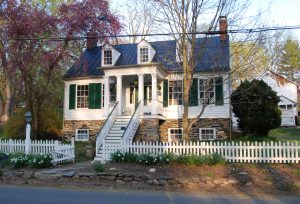
Sunnyside, circa 2007

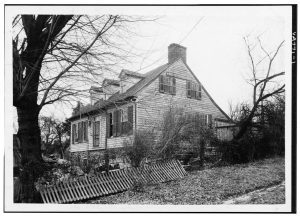
Sunnyside, circa 1930

Molly Steer grew up at Sunnyside, a house that still stands on Second Street.  She was the artist of the four Dutton sisters.  Sisters Lida and Lizzie, along with Sarah Steer, created the Waterford News.  This pro-Union newspaper was one of the few women-run newspapers in the country during the Civil War.  Their father, John B. Dutton, was a strong Unionist who, with Sarah’s father Samuel Steer, sat out the war at Point of Rocks, Maryland, sneaking home periodically to see their families.

In the early 2000s, the owner of the Phillips Farm died, and 144 acres of the farm came on the market. The Waterford Foundation raised $2M to purchase the property, but a developer won the sales contract and announced plans to develop the property as a residential subdivision. The Foundation worked with the community, the Trust for Public Land, and other public and private supporters to buy the farm from the developer for just under $3.9M. Read more about this effort from the Washington Post. The Waterford Foundation embarked on an all-out fund-raising effort. To help raise money, the Foundation created T-shirts featuring the historic pastel.

Mary Frances “Molly” Dutton Steer with husband Frank Steer

Martha Parmes, pictured on Janney Street

During the war Molly married Franklin M. Steer, son of Second Street neighbor James M. Steer, a blacksmith. She lived into her 90s and eventually moved to a Quaker home in Baltimore, returning to Waterford for summertime visits.  During one such visit she gave the pastel to her friend Martha Parmes, a highly respected and much beloved member of the African American community.  Miss Parmes most likely passed it along to John Middleton.

Jane: Molly’s friendship with Martha Parmes suggests that the white community and the African American community were intertwined?

Bronwen: Waterford had always been integrated–even house-by-house.  There were enslaved African Americans living in White-owned homes, of course, but there were free African Americans who owned homes in Waterford alongside Whites well before the Civil War.  The African American community oversaw the Second Street School and built the John Wesley Church in the village.  Black and White children played together but never attended the same schools.  Black and White women would sometimes share a cup of tea, particularly in Quaker homes.

Jane:  Bronwen, thank you so much for your time and invaluable knowledge of Waterford!  This lovely pastel gives us an important portrait of how rural Waterford looked in the past.  And, as an artifact, provides insight into the close relationships among individuals despite racial segregation.  Thank you!


Filed Under: From the Local History Collection, history, News, Waterford History

  • « Go to Previous Page
  • Page 1
  • Page 2
  • Page 3
  • Page 4
  • Page 5
  • Go to Next Page »

Footer

Email: oldschool@waterfordfoundation.org
Phone: 540-882-3018

Privacy Policy

Join Our Email List and Stay Connected!

Copyright © 2026 · Waterford Foundation · Log in